Saturday, 8 July 2023

Keep on digging

The main task preoccupying the team continues to be the up side diversion of the outlet of culvert 11B at Stanton to run inside the railway boundary to culvert 11A under bridge 11.

With over 120m of trench to dig; five new access chambers to construct and 25 new sections of pipe to lay, this is quite a large project for the team. However, we are now on the home straight, literally as the trench digging is now between the last two chambers.

However, the team did have a ‘day out’, which made a good break from digging and cement/mortar mixing.

Thursday 15th June

Six of the team in attendance.

Jonathan continued excavating the trench - now about two thirds of the way between the second and third intermediate chambers. Polly laid the brick and block courses for the second intermediate chamber. Nigel & Roger kept Polly supplied with mortar - also they laid the first pipe in the third pipe run. Stuart and Andrew collected another tonne of pea gravel from Elliots (the 4th so far). Using the laser level Stuart checked the depth of the trench digging; however the unit is playing up in strong sunshine. Andrew trimmed the hedge alongside the third pipe run.

Early-ish finish due to the hot weather. The excavated material from the trench, mainly clay, has dried out. This will need breaking up into smaller chunks before filling in the trench.

Polly checks the size of the second intermediate chamber.

Additionally an inspection of the deep manhole on the up side of Winchcombe Yard near the oak tree by the Usk building was undertaken. This requires the brick walls raised by 5 or 6 courses, so that it is above the ground level - to prevent any vehicle running over it. Potentially a relatively simple brick laying job; however it will need temporary cover of the chamber to prevent anything or anyone falling in during the job.

The chamber near the Usk hut is already one of the deepest we have; the height extension will make it more so.

Wildlife report:
Winchcombe Yard - house martins (a puddle was topped up to provide mud for nest building)
Stanton - identified one of the wild rose species as Rosa canina (Dog Rose). The hedgerow also contained another white rose but, further investigation required to identify it correctly. There is also Heracleum sphondylium, hogweed in the hedge road alongside the trench. The sap in contact with skin reacts to sunlight and causes phytophotodermatitus.  This is similar to burns with orange blisters and the effects last over a month.

Dog rose [Photo by Roger]

Thursday 22nd June

All team members attending - but not on the Railway! We all went to Rail Live at Long Marston.

Lots of big yellow machines that we, PWay and C&M would like to have!

Rail Live is the largest railway industry hands-on event of the year - a sort of Farnborough Air Show for the Rail industry. Literally hundreds of stands from suppliers across all aspects of the industry. Even a steam loco (1501 from SVR on an Alleys low loader).

.

The only visible heritage item of rolling stock at Rail Live.

There were lots of interesting stands, quite a few relevant stands (to us) and some that were both interesting and relevant.

Some highlights ....

Aqua Fabrications www.aquafab.co.uk
Hi-Pact HDPE Ditchliner - could be useful for lining leaking crest ditches (like at Two Hedges Road) and waterproofing the ditch behind Churchward House;
GRP catch pit frames - a lot lighter to handle than the concrete ones; two standard sizes; various sump units and covers;
Carlisle Cascade system - vacuum formed from ABS sheet to make modular 'waterfall'; would be useful to prevent down and back erosion in several places (such as culvert 14B low mileage down side toe entry).

Concrete Canvas https://www.concretecanvas.com/
Core product is 3-dimensional fibre matrix containing a specially formulated dry cementitious mix on PVC backing. Also could be useful for lining leaking crest ditches - comes in big rolls but they say there are hand-portable batched rolls.

Civil Water Management https://www.civilwatermanagement.com/
TDS-400 a mat of recycled plastic panels which water is drawn and then rapidly discharged through hydraulic pressure. The demo made it look like water was flowing up hill! Possibly something to investigate where the water table is close to the track level and prone to silting - for example low mileage side of Southam Lane bridge.

Cubis Systems https://www.cubis-systems.com/uk/
STAKKAbov access chamber system - various types and grades of stackable catch pit frames. Some GRP; some other composite material with metal reinforcing. We think the raising of the manhole at Winchcombe up side near the Usk could deploy these - would avoid need to get scaffolding put in. There are various types of lid available - including those that can be fixed down.

Husqvarna https://www.husqvarnaconstruction.com/uk/
We tried the battery powered pole saw, brush cutter and hedge trimmer. With the battery on the harness they are very much easier to handle than the petrol ones we have now. Suggest when any of these tools need replacing we go for battery ones. We also had a look at the similar tools on the Bosch stand.

Skyes pumps https://www.andrews-sykes.com/
They showed us a variable rate pump (VP80 and VP100) which would be great for a fast pump out of a flooded ditch then a slow keeping the water out. However they are 415v 3 phase!

A good day out - thankfully no rain as it is mainly outdoor (noticeable that the big plush carpeted marquees were for the consulting companies).

Thursday 29th June

A day full of obstacles! (And no team leader to sort them out!) But, some achievements were made.

Firstly the LWB Transit van which has the toolbox containing our tools was away for it’s MOT. We had to scrounge around to find some replacement tools. However, we found enough for the day; enabling completion of the concrete backfilled around the second intermediate chamber on the 11B to 11A diversion. Nine concrete rings were installed on top; this is the deepest new chamber on this diversion.
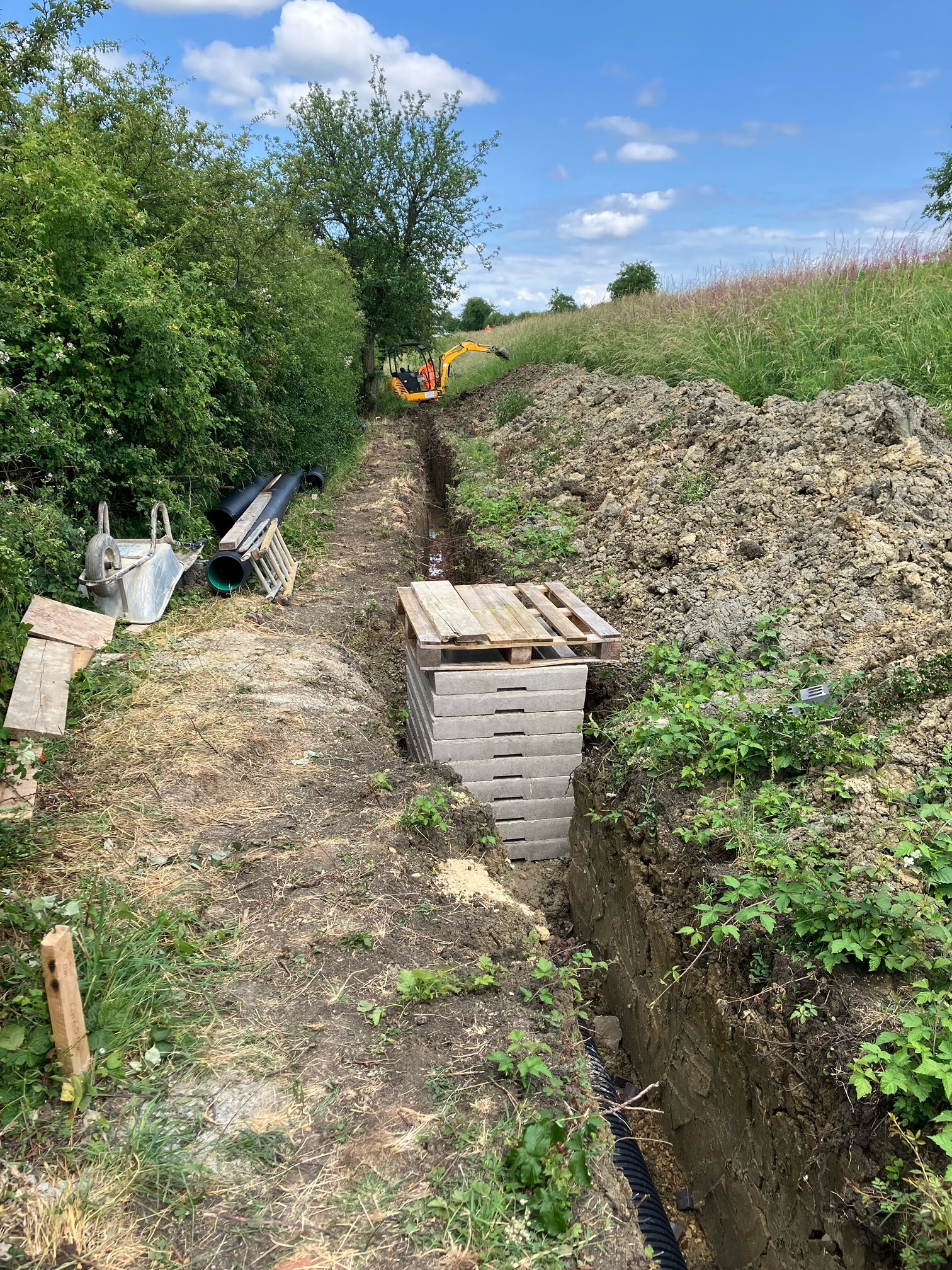
A nine ring stack. [Photo by Dave]

 The laser level decided it would not work even without bright sunshine. Hence we resorted to the old fashioned method using spirit levels.

Accurate measure of the depth of the trench is vital. Too shallow or too deep leads to a switchback and thus standing water in the pipe. In a couple of places our digger operative had been too eager; so the trench needs filling with some type 1 stone / rubble which had been donated to us. Much cheaper than extra pea gravel.

The trench digging continued; but only a few metres excavated as the wet clay and tree roots causes the mini digger to struggle. It is really operating at it’s limit here.


Digging approaching one of the famous Stanton pear trees - so finding lots of roots. [Photo by Dave]


Always a colourful sight. [Photo by Dave]

For the wild flower report two of items interest; the Common Poppy, Papaver rhoeas and the Common Spotted Orchid, Dactylorhiza fuchsii.

Thursday 6th July

Back to full strength of eight team members today.

We took advantage of the dry weather - there was no water flowing out of 11B’s under track bore and in the existing exit ditch to the adjoining field. So the first courses of bricks and blocks were laid for the entrance chamber at the current bore exit. We left a gap for water to flow out by the existing ditch; this length of pipe will be the final to be laid. However, we did make a start on removing the section between the new trench and the entrance chamber. This is a manual dig as the minidigger can not reach the location until the trench is in-filled.

The new bore exit chamber - blue mesh cover is just temporary at this stage - three concrete rings to add first.

The trench with almost complete pipe work stretching into the distance. All that vegetation was less than an inch high two months ago.

Two new lengths of pipe laid and connected. Another tonne of Pea Gravel collected from Elliots (the 5th) - most of which was spread around the recently laid pipes in the ditch. The hedge trimmer used to trim boundary hedge at digger site and to clear the recent growth around the trench. Amazing what some sunshine and a few showers does for growth.

Digging with the minidigger was completed to the site of the third intermediate chamber, and most of this dug out. This just leaves 30m of plain trench to dig. (The end is nigh!)

Final intermediate chamber pit dug out - so now it is just 30m of plain trench.

Wildlife report
Winchcombe station - female pheasants on the down platform at 8am
Stanton - lots of moths and butterflies, only species positively identified was cabbage white. Several poppies in full bloom.

Monday, 12 June 2023

Roadside Recovery

It is not just drainage that our team become involved in. With one member who works in the motor trade, we frequently attend to the regular maintenance and minor repairs of the Railway’s road vehciles and plant. However, we are not intending to set-up a service to rival the AA or the RAC. The roadside recovery in this post’s title refers to extracting drain rods from the pipe alongside the road on the outlet of culvert 31B at Prescott Road.

Thursday 11th May

Another day of changed plans, mainly due to the continuing wet weather. After getting the trailer with the minidigger stuck in mud the previous week, we decided not to take it to Stanton, as the entrance to the neighbours field is under a big puddle.

Jonathan and Martin extracted the water bowser trailer from behind various other items at Winchcombe Yard, ready for use in watering the new trees at Chicken Curve and opposite the Royal Oak at Gretton. They then fitted a new towing ball to the Isuzu truck.

New towing ball on the Isuzu truck.


Dave and Nigel headed to Prescott Road bridge, culvert 31B, to measure up for the replacement section of pipe to run from our boundary fence line to the intact roadside pipe. They also tried again to extract the rods that are stuck in the pipe - still not successful. However close examination of a photograph looking into the pipe shows that they are in there. A scout round the yard at Winchcombe found some useable sections of SGP pipe that can be deployed at 31B.

Looking inside the roadside pipe of the outlet of 31B at Prescott Road. End of the stuck red rods just visible. [Photo by Dave]

 
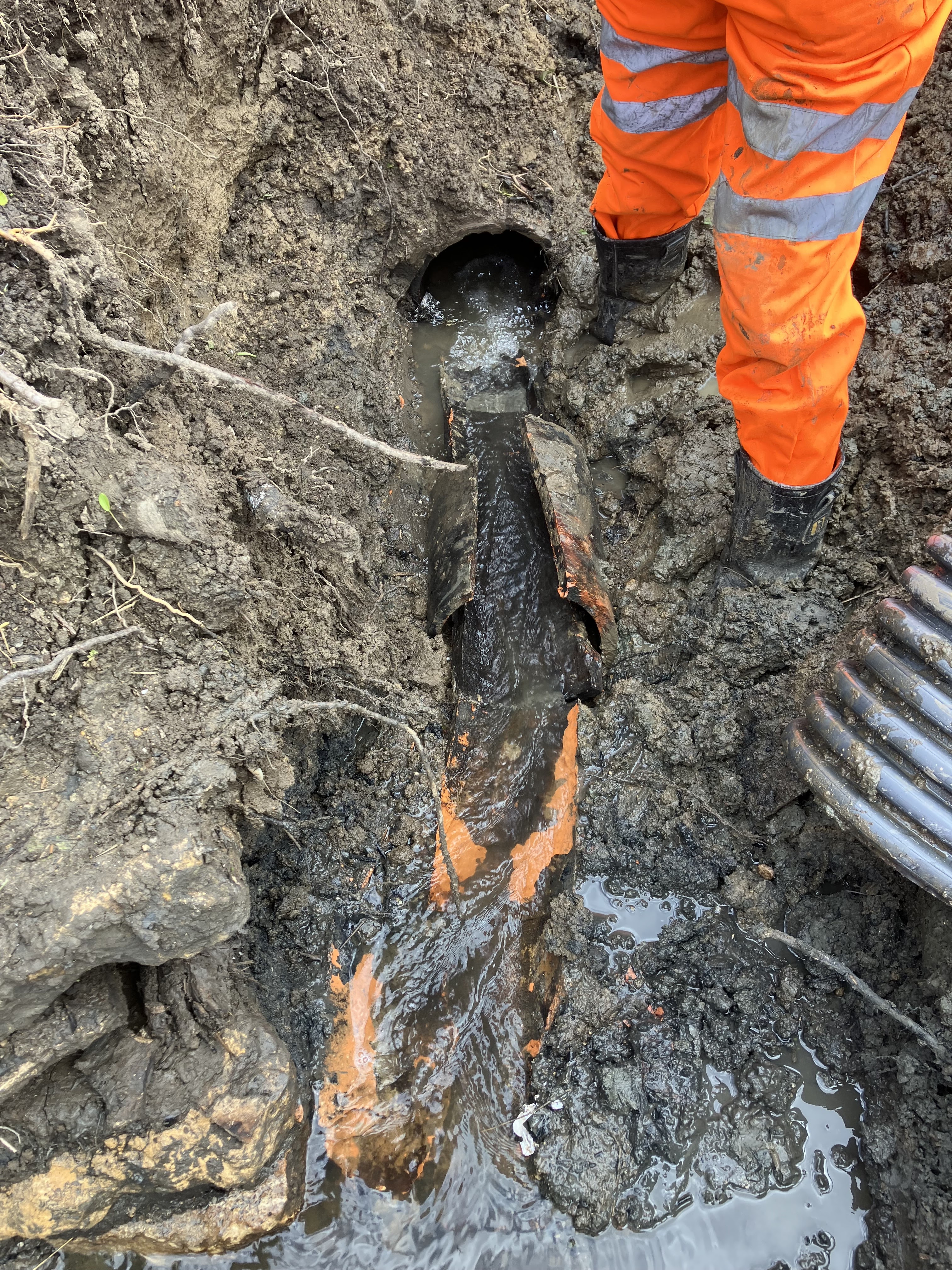
The lengths of broken roadside pipe at Prescott Road that require replacing. Note the depth of the silt! [Photo by Dave]

Andrew and Stuart went to Toddington North cutting to measure for the replacement of milepost 9¼. Roger also went to Toddington to check and reseal a First Aid kit and to collect First Aid items for the gala. Then they headed for culvert 11B at Stanton. The new 110v submersible pump was put to use to pump out the first intermediate chamber. The pump works a treat, especially if in a sump. They then laid the first course of bricks for this chamber.

The new 110v pump working in the second intermediate chamber at 11B up side. [Photo by Roger]

 
First course of bricks for intermediate chamber one.

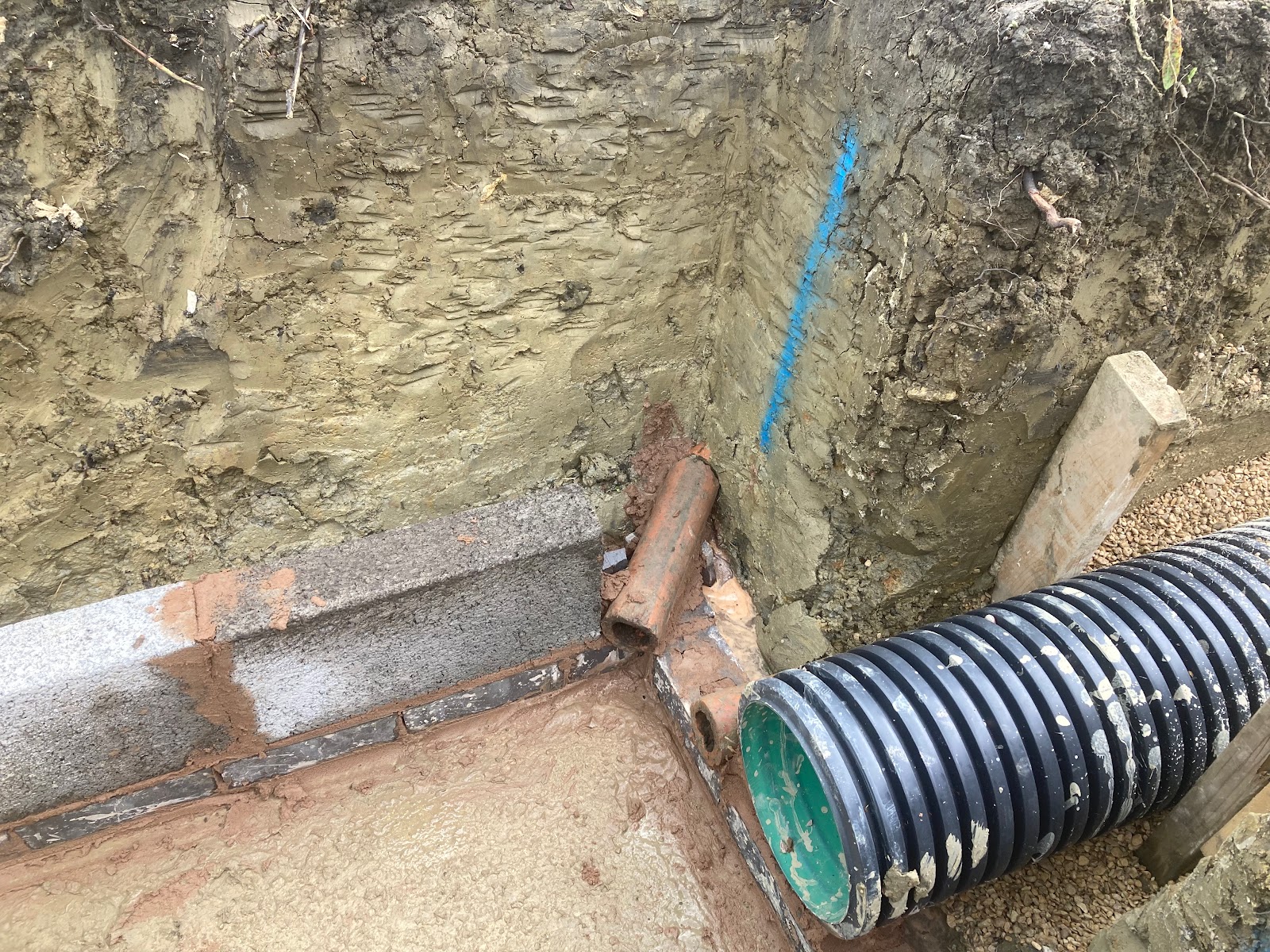
Close up of where an old land drain (the clay pipe) is now incorporated into the intermediate chamber.


After lunch, Dave and Nigel went to Stanton aqueduct with some mortar to fill the void in the grouting on the ups side abutment caused by the excess foam for sealing the shuttering. This is really now the end of the aqueduct repair.

Final item of Stanton aqueduct repair - filling the void creased by excess foam. [Photo by Dave]
 

After their work in the yard, Jonathan and Martin headed to Elliots at Bishops Cleeve to collect the first tonne of pea gravel for the 11B trench at Stanton. Elliots have kindly donated a new rake and a long handled shovel, both very useful tools for spreading the pea gravel. In the afternoon, all seven of the team unloaded the pea gravel at 11B; and some was used around the first length of pipe placed in the trench. A start was made on the course of blocks in the chamber. 

Jonathan demonstrates the new long handled spade - it does make unloading from the bed of the truck much easier.

End of day progress - pea gravel around the laid pipes and concrete block layer in the chamber.


Thursday 18th May

All of the team present this week, but one notable absence was the 'drainage' LWB Transit. This had broken down at Cheltenham Racecourse on Wednesday with electrical problems. Most of our hand tools are in the tool box on the back. Fortunately we were able borrow sufficient tools and use the 'C&M' transit, along with the Isuzu and the Ford Ranger to achieve most of our planned activities.

Jonathan and Martin headed to Stanton with the minidigger on the trailer behind the Isuzu. The 11B to 11A up side diversion trench was progressed towards the second intermediate chamber. This is where the trench is deep due to the lie of the land; so progress was not quite as fast as other weeks. At least after no digging because of wet conditions it was good to get going again.

Roger, Polly and Stuart also went to Stanton 11B. They completed the brick and block courses of the first intermediate chamber; a prerequisite was the laying of the first length of pipe in the trench between the first and second intermediate chambers. The first intermediate chamber is now ready for some concrete backfill; then the concrete rings can go in.

The 11B to 11A up side trench at Stanton - first length of pipe visible just beyond the plank. [Photo by Roger]
 

Dave, Nigel and Andrew first headed to Culvert 31 at Prescott Road Bridge (32). After temporarily damming the outlet at our boundary to enable visual inspection of the roadside pipe; the sharp end of the stuck lengths of red drainage rods was located. Then some delft work with a corkscrew attachment on the black drain rods; the red set was extracted - all 29 rods. Next was a trial fitting of the SGP pipe found last week. Unfortunately this was just a tad too small. We need to reinstate around 12 feet of the roadside pipe; make a suitable headwall and backfill. On return another search of Winchcombe yard identified some more possible pipe lengths.

Success - the red drain rods emerging from the roadside pipe at Prescott Road. [Photo by Dave]
 

Then on to the cutting south of Two Hedges Road, at milepost 17 & half. During the previous weeks of heavy rain, water was coming out of the down side cutting in three places. This comes from a stream which rises on Cleeve Hill; when it enters the railway boundary some takes a 90 bend into the crest ditch. This was the site of some work by contractors back in 2019, the work was interrupted by Covid. Two lengths of large diameter pipe were installed in the ditch; another two were further down and were creating a bit of a restriction. These were recovered back to the stream entry point; the ditch was removed of vegetation debris. The areas of the cutting side by the leak points was brush cut. This reduced two of the leaks to minor trickles. The root problem is that this crest ditch is not water tight - before it gets to the end of the cutting and becomes an embankment toe ditch it is dry. That toe ditch eventually enters culvert 40B. We will need to give some thought as to the best way to make that ditch watertight.

One of the points where in very wet weather water from the crest ditch escapes to the down side cess south of Two Hedges Road.


Thursday 25th May

All of the team in attendance this week.

Nigel, Dave and Polly headed to Prescott Road, culvert 31B, taking materials to make a sandbag headwall on the roadside pipe inlet just outside the railway boundary. Roger and Andrew delivered cement, pipes, and gravel, again we had only one working Transit truck. Using a mix of SGP and twinwall pipe; the roadside pipe was extended back almost to the boundary; all the available sandbags were then used to construct a headwall. Finally some back filling using the material excavated a few weeks ago. As you can see in the photo, the team did a very neat job on this sandbag wall.

Replacement pipe in the roadside outlet of 31B extending to the railway boundary. [Photo by Nigel]

 
The neat sandbag headwall. Just infill and fence replacement required to finish the work outside of our boundary. [Photo by Nigel]

Jonathan, Martin and Stuart headed to 11B at Stanton. Jonathan spent the day extending the trench; have now got as far as the second intermediate chamber - so half way. Martin and Stuart setup the laster level to check that the trench is at the correct level - it is. The strong sunshine initially meant the level was giving some strange readings - but repositioning and with the sun higher in the sky all was working fine.

Stuart setting up the laser level. Hawthorn in full bloom.

 
Visiting BR Standard 78019 with the first down train passes the work site at Stanton 11B.

After delivering material to Prescott Road 31B, Roger and Andrew set up the mixer for concrete - backfilling of the brick and block course of the first intermediate chamber was completed.

First intermediate chamber - completed brick and block courses.

 
Blue jelly pipe joining lubricant - very slippery stuff.

Finally at 11B the second section of pipe in the first run was joined to the first. The recently acquired blue lubricant working a treat - pushing the two sections together did not require a great deal of force.

One item of note on the wildlife side was the rescue of a young mole from the 11B to 11A trench. We set him (or her) free by the hedge but it burrowed into the ground before being photographed. On the plant front we noted some stalks of asparagus officinalis growing on the pile of earth excavated from the trench. Some of these were tall and gone to see but a few stalks were still at the harvesting stage.

Thursday 1st June

Full strength team today, at least for the morning. All working on the culvert 11B to 11A up side diversion.

This was the last day the visiting GWR Castle 4079 Pendennis Castle was in service. Here it heading the early morning Toddington to Broadway ECS past Stanton crossing - note the correct lamp codes.

The second intermediate chamber was fully excavated (so we are now half way with the trench). The first intermediate chamber was built with concrete rings and blue mesh top. So this is now complete - apart from the backfilling with soil. That will have to wait until the digger comes back from the end of the trench - the clay has become too hard to dig by hand.

The first concrete ring fitted! Over three & half years since delivery.

 
Dave checks the fitting of the blue mesh cover of the first intermediate chamber. Apart from the backfill that is job done. Just another four chambers to build.

Three more pipe sections were laid and connected. Another 1 tonne of pea gravel collected from Elliots and most of it placed in the trench.

End of day progress.

Using our CCTV equipment we inspected the existing 11B bore under the railway. This showed V - no sign of any secondary pipe entering it. However it did show that the bore is very uneven. At the up side exit the water depth was a few inches after pumping the outlet trench - but by 12m in the water level is almost at the top of the bore. Most probably the exit end has been disturbed by the roots of the tree that used to grow by the exit. This tree was removed a few years ago.

Two of the team visited Broadway to inspect the up side french drains that are approximately half way between the end of the platform and the boundary fence. The middle larger drain has had a significant amount of its stone (slag ) removed and this is piled up on the high mileage side of it. This must have been dug out for a reason in the past - it is not a washout. Until the clearance work there back in the winter this crater was obscured by thick scrub. There was evidence that all three of these french drains do carry water at times. Both the cess drains were checked, but after 10+ days of almost no rain there was not likely to be any flow.


The mystery crater in the up side french drain north of Broadway station.


Thursday 8th June

The primary task involving the six team members on this warm June day was to further progress the 11B to 11A up side diversion at Stanton.

Jonathan spent the day extending the trench from the second intermediate chamber to the site of the third intermediate chamber. This length of trench is now about two thirds complete, and it is past the high point of the land so will now progressively get shallower.

Jonathan progress the trench excavation - marker post behind him to show the direction.

Roger, Polly and Andrew mixed and laid the concrete base for the second intermediate chamber. They also installed the remaining pipe lengths in the section between first and second intermediate chambers. Filled around all the laid pipes with pea gravel.

Concrete base of second intermediate chamber.
 

Dave and Nigel did a lot of fetching and carrying using the only working transit truck. First they delivered aggregate to Stanton; then collected another tonne of pea gravel from Elliots at Bishops Cleeve and delivered to Stanton. Finally they collected about half a tonne of No1 stone from Stoke Orchard. This had been donated to us, a left over from a building job. It turned out to be very mixed - but will be useful as infill.

Pipe run between the fist and second intermediate chambers completed.

 
By mid afternoon the sun is just on the up side of the line at 11B - Dinmore Manor passes. The transit truck safely parked out of the way back at bridge 11. Once the train has passed it will be backed down to collect all the gear to head back to Winchcombe. And for us it is then a welcome cup of tea in The Coffee Shop on the station platform.


Wednesday, 10 May 2023

Archaeological digging

Our team’s work is primarily to maintain and improve the railway’s drainage system. The earliest structures date from the construction of the line starting in 1902. Not often do we come across items that pre-date this time. However, our work at Stanton on the up side diversion of the outlet of culvert 11B has found two such items – one considerably older.

Thursday 13th April

Two groups working at two sites. At Stanton aqueduct one group installed the rebar and shuttering ready for the concrete pour on the up side abutment. The rebar sits on top of the first layer of grout which was poured the previous week. The concrete layer then surrounds the rebar.


Rebar high mileage side of trough. (Photo by Roger)

Rebar low mileage side of trough. (Photo by Roger)

Shuttering around the new collar. (Photo by Roger)

The other team attempted clearance of the up side outlet of culvert 31B at Prescott Road. Using the minidigger in the JJ Farms leased field beside the road, some silt and debris was removed from the ditch upstream of the roadside pipe. However, as the Evolution petrol powered pump would only work intermittently, the water level never became low enough to expose the entrance of the pipe. A rather frustrating day, so another visit is needed with a working pump.

Thursday 20th April

Two groups again, but both working at Stanton, almost within sight of each other.

At the aqueduct, the ‘aqueduct repair’ group mixed and poured the concrete. The mix of this used the special high strength 40N cement. There were no leaks from the shuttering.


The concrete pour on the high mileage side of the trough.

The shuttering on the high mileage side of the trough - expanding foam to seal the joints.

Just down the line at culvert 11B, we were able to get the minidigger on site. Excavating of the trench for the new pipe resumed, it was dug to the correct level almost as far as the first intermediate chamber site. That is approximately one quarter of the trench dug. The reason for the slower than anticipated progress is two fold. First the very wet weather earlier in the year making it impossible to get the digger on site. Secondly, the heavy clay soil which even the minidigger complains about. Frequently one of us has to remove solid clay from the digger’s bucket with a spade. How the old canal and railway navvies managed with hand digging in such conditions is amazing.

Jonathan concentrates on keeping the ditch in a straight line and at the correct depth.

Thursday 27th April

A slightly reduced team size of five today. However, we still progressed work at both of the Stanton sites.

At culvert 11B, a group of two with the minidigger continued extending the ditch northwards and excavating the first intermediate chamber.


Looking back (towards Toddington) from the first intermediate chamber site.

The other three attended Stanton aqueduct. The grout was poured (two separate pours, one each from each side of the abutment) around the through; thus completing the additional anchorage for the new retaining collar. The shuttering will be left in position until next week - although the grout goes off quickly; a weeks curing time will mean it is very solid. The three then joined the diggers at 11B.

Shuttering on the outlet end of the aqueduct trough. Stuart makes final checks on the high mileage side after the grout pour.

 
The grout is self levelling. This is the low mileage side complete.

High mileage side, just before final top up. The length of plastic guttering on the right is the pouring funnel.

The ditch digging is slow going as below 6 inches the soil is the infamous Stanton clay. We came across remains of clay field drains; the depth and alignment of these suggest they were in the field when the embankment was built. Also close examination of a whole section of pipe indicates that is hand-made; it has a one slightly flat face. This suggests these land drains date from the early 19th century, our first pre-railway find. The second find is even older – a small ammonite fossil. This will be at least 66 million years old.

The very old land drain at the first intermediate chamber site. Even though it is clogged with silt, water still dribbles out of it.

 
The Stanton ammonite.

The ditch now extends to approximately 12m north of the first intermediate chamber. Some hand digging ensured that chamber is ready for the concrete to go in, a wood post marking the correct level. One advantage (perhaps the only advantage) of thick clay is that there is no need to construct wooden shuttering for these bases.

Back at Winchcombe we fitted some replacement parts to the Evoultion petrol powered pump - adding some underwater grease to the inlet pipe threads. This will be tested next week at Prescot Road (culvert 31B).

Thursday 4th May

Just like on the 13th April, two groups of three headed to two sites in opposite directions.

The first group took the minidigger and the repaired Evolution petrol powered pump to Culvert 31B at Prescott Road. The pump now runs well. After pumping the outlet out; they rodded the pipe in the roadside ditch outside of the railway land. This indicated a blockage just a couple of feet in. They then excavated this length; revealing a couple of lengths of broken and misaligned SGP pipe. After removing this, the roadside exit is flowing well. This should prevent the build up of water in the bore which runs under bridge 32. There is a large amount of silt which has built up in the catch pit and back up the bore under the bridge – this will require removing at some point. Finally the group installed some red plastic barriers to fence off the excavation from the road and the field.


Exposed - where the roadside pipe of the 31B outlet was broken.

The second group headed to Stanton, first to culvert 11B. They cast the concrete base of the first intermediate chamber of the up side diversion of culvert 11B to 11. Added interest was that the young grass snake (Natrix natrix) visited the ditch. It quickly slithered away before we had time to take a photograph.

Snakes eye view of Foremarke Hall from the new 11B ditch at Stanton.

 
Concrete base of the first intermediate chamber.

After lunch the group moved on to Stanton aqueduct to remove all the shuttering from the up side abutment now the grouting and concrete around the new retaining collar is complete. The new retaining collar is now firmly held in place. The repair is complete, apart from filling a small void in the lower grout level caused by some of the sealing foam.

Nice clean edge to the grout and concrete around the trough and new collar. Low mileage (Broadway) side.

With all the shuttering removed, the new collar looks like it has always been part of the structure.
 

Signs of spring at Stanton included observations of increased insect activity, we noted a hornet and a red tailed bumble bee (Bombus lapidarius). Also the magnificent pear tree on the down side just on the low mileage end of bridge 11 was in full blossom.

Stanton pear in full blossom. (Photo by Roger)