Friday, 25 March 2022

Rock hard!

The changeable late Winter and early Spring weather is still affecting our plans; and not just because of too much rain. Certainly there is a lot of truth in the saying ‘Other countries have climate, the UK has weather!’

Thursday 17th March

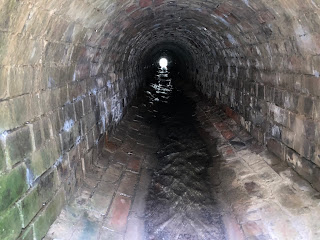
The day before (Wednesday of the Cheltenham Race meeting) had seen heavy rain almost all day; but St. Patrick’s day was dry and warm. However, there was a lot of water coming down off the Cotswolds and most of our culverts were flowing well. This included 25A at Working Lane, Gretton which we wished to survey the upstream bore with our CCTV equipment. This is an open channel in a brick invert underneath the bridge, but is culverted upstream. Old maps of the 1920s show it as an open ditch all the way back to Winchcombe Road. We wished to see the state of the bore whilst under railway land, and whether there are any connections from road or house drains. One of the home owners has reported occasional flooding of a land drain which probably connects into the main culvert. Unfortunately the depth of water was over the top of the camera trolley, so we could not see anything. Hence a task postponed for later.

Looking upstream in the bore of culvert 25A at Gretton. CCTV trolley was underwater. There must be a manhole up there somewhere!

The construction team of three completed the concreting for the apron of the new culvert 24C exit headwall by the haul road on the up side at Working Lane. This involved almost a tonne of aggregate and a lot of bags of cement. So both the long wheel based Transits trucks were used - one for plant and one for materials. There also had to be a return trip to Winchcombe to swap cement mixers as the drive belt on one broke. (Unlike C&M, we do not have names for our mixers, they are just the older one and the newer one).

Concrete apron for culvert 24C haul road exit headwall poured. Note the temporary barrow run on the planks to the right. (The smaller diameter extension pipe is only temporary; to get the water away from the setting concrete and in the coming weeks to keep the bricklayer's feet dry.)

Meanwhile an odd job team of two first attended to a request to install slip marker posts. This is just north of Stanway viaduct on the down side by the Toddington distant signal. PWay have had to regularly top up the ballast for a short length here, hence the request to monitor for slips. A visual check of the embankment side revealed no tell tale signs; but plenty of animal holes. This is an area where badgers were active until a few years ago; the up side embankment was meshed to stop any more digging. Additionally the area of concern is right on top of culvert 11C; which many years ago was extended with a pipe on the down side, that involved digging into the embankment.

Slip monitoring posts in place on down side north of Stanway Viaduct. Marker post for culvert 11C visible lineside and beyond the area with plenty of ballast topped up.

The odd job team then moved up to the B4632 bridge (No 8) at Stanton. Now the bridge works are complete we had access to install the new head for milepost 7¾. This is the first of the ‘house number’ style posts to be replaced with the more authentic new head with numerals in the correct GW typeface. Then it was on to Broadway for a similar exercise for milepost 5. Another ‘house number’ head but this time on a non authentic wooden post. The bolts fixing the head to the post refused to move thus preventing a simple swap of heads. The complete post and head were removed back to the workshop, but still the bolts would not budge! Partial dismantling of the head revealed extensive damp and a lot of woodlice inside; a consequence of not fitting rainproof flashing on the head. Renovating this head with correct numerals for reuse elsewhere will be a bigger task than anticipated. The new milepost 5 head will now be mounted on a length of bridge rail in the coming weeks. This will be much more in keeping with the heritage look at Broadway; milepost 4¾ just north of the up platform will be replaced in a similar way.

Out with the house numbers, in with the authentic looking GW style numerals. Mp 7¾ is just on the Toddington side of the B4632 bridge at Stanton if you want to look out for it.

A train picture for a change. This was our first working day of the year with real trains to watch out for - here 47105 brings the ECS for the Friday Broadway race train past the site of milepost 5.

Thursday 24th March

A complex plan involving three sub teams with four vehicles working at four sites was the order of the day.

Another request to install a set of slip monitoring posts was attended to. This time it was on the up side in Toddington north cutting, so just south of the viaduct. When the vegetation was cut on the cutting side it revealed the tell tail signs of a slip; cracks in the ground near the top and a snout of material near the bottom. From our investigations it looks like this is not a very recent slip; with the marker posts in place we can monitor it to determine if it is still moving. The down side cutting behind the retaining wall by the north siding has a similar ‘dormant’ slip discovered a few years ago.

More slip monitoring posts; up side Toddington North.

The construction team today was only two in number; but they made excellent progress on the new headwall for culvert 24C haul road exit at Working Lane. No problems with out mixers today (I think it was the older one in use). Seven courses of concrete blocks (new small ones, not the heavy recovered BR era big hollow ones) and one course of bricks went in. The wall here will be 14 courses of block high; so we are halfway there already.

Halfway there - well on the block courses. 24C haul road exit headwall takes shape. When complete it will be one of our higher headwalls.

Earlier in the day, chief brickie Polly does not pause for the photographer. Note how the temporary extension pipe is keeping the work area dry.

We are extending the hard standing area at the bottom of the haul road. The Saturday clearance team have removed the vegetation in the foreground and some of the willow tree. The rest is due to be felled on Saturday 27th. The area will be levelled using infill from the old garden centre at Toddington.  

The main job of the day was at Stanley Pontlarge, repairing the driveway through the small holding adjacent to the railway on the up side. Unfortunately the warm, dry, sunny weather over the previous week had made the ground rock hard, too hard for the telehandler to level out. So, unusually, we have had to postpone a task until we get some wet weather to soften the ground. We did however place some of the one tonne of No1 stone we collected from Bishops Cleeve in the worst of the ruts in the driveway. The rest of the stone is on site for when we can resume the job.

The only soft ground at Stanley Pontlarge was this puddle under the railway gate. One month ago all the drive way was mud - deep in places.

Awaiting a damp day - the rest of the stone for the driveway repair at Stanley Pontlarge.

Whilst we had the telehandler and the Citroen tipper truck in the area we proceeded to Gotherington yard to load one of the dumpy bags of pea gravel we recovered from Dixton Bridge last year. This was used to make good the damage to the U shaped concrete drain channels in Dixton Cutting, between the Tirle Brook flume culvert (32A) and Prestcott Road Bridge. Hopefully with the PWay work now complete in Dixton cutting there will be no more damage to these concrete channel; they are impossible to repair and exact replacements of these BR era relics do not exist.

Pea gravel used to level out tops of the BR style U shape concrete drainage channel. When new this would have had concrete lids on it for the entire length (nearly ¾ mile here at Dixton Cutting).

Whilst all the weather related disruptions to our plans are annoying; working out side in warm, spring sunshine was a joy. It was almost like summer!


Friday, 11 March 2022

First too dry, then too wet!

Not that we wish to sound like some farmers for whom the weather is never perfect, we certainly noticed the change to wet conditions at the end of Winter. After writing in many culvert inspection reports that the flow was minimal and the cess drains were just damp we had the opposite for the final few. After a few wet days, a lot of our culverts were flowing well. Whilst checking in wet conditions is a benefit, it does preclude taking photographs looking into the culvert bore. The water is just too deep to stand in and the banks too slippery as well. However, we now have finally caught up with the COVID-19 induced backlog of internal visual inspections of culverts and cross drains. This season’s round will commence towards the end of summer.

Thursday 3rd March

First job for whole team of five today was replacing two damaged manhole lids near Southam Lane bridge, including that shown in the previous blog post. This required all five as we had to use barrows to transport the lids from the nearest level road access point, the RDA crossing at Cheltenham. Whilst there we also inspected the metal covers on the driveway which runs between the RDA crossing and Cheltenham signal box - this drive is used for race vehicle traffic during race week. Glad to say we found no issues.

Following the lid replacement, we split into two teams. First sub-team one then proceeded to south of Hunting Butts tunnel to undertake visual examination of culverts 44A and 45A; the last two of the 2021 inspection programme. 44A carries a small stream between Hunting Butts tunnel and Swindon Lane; however it is of great importance as all the drainage from Cheltenham Racecourse station flows to it through Hunting Butts tunnel and the down side cess.

Looking down the bore of culvert 44A, water not too deep but flowing fast.

45A is a much larger structure; it is right on the boundary of our land by the Prince of Wales Stadium. It carries the Wymans Brook, which is piped from the lakes in Pitville Park. Hence on the down side there is just a very deep manhole; whilst on the upside there is a large headwall and the stream flows by the side of a public footpath. Being near to the Midland Mainline we could here lots of trains whilst we were working – of course not on the GWSR as there is no track south of Hunting Butts.

Up side outlet headwall of culvert 45A, Wymans Brook. Not taken by standing in the water!

The second sub-team headed to Working Lane where they completed the backfill of the new haul road exit headwall on culvert 24B. This almost completed the work on 24B, one of the components of the Royal Oak/Working Lane improvement programme. The wet and muddy conditions meant no progress on the excavations for the concrete apron on culvert 24C.

The whole team met for lunch, in the luxurious (for us) C&W mess at Winchcombe (thanks guys and girls). After lunch with rain threatening, we continued with milepost construction in the workshop. This included priming two lengths of bridge rail; preparing steel bar for dividers and quarter marks; painting numbers and making galvanised caps. We now have three new heads complete and ready for installation.

The milepost production bench in the workshop. No we don't have a mile 91; it is 16¼ up side down. Its location is between Gotherington and Bishops Cleeve.

Thursday 10th March

An even smaller team of four today, the others had a variety of excuses (funeral, work, partners illness). However, they managed to complete several diverse tasks.

First was a request from the Bridge Engineer to recover some surplus sheets of galvanised mesh from Stanton Yard. This is the bird nesting prevention material, it was the surplus from the contract job for the B4632 Bridge (8) and Stanton Road Bridge (10). Whilst at Stanton, the team took a note of the amount of building stone available. This should be enough for the work on culvert 24C at Working Lane, thus avoid purchasing a new load.

Next job was to move a pallet of solid concrete blocks from Winchcombe to Working Lane. These will be used in the construction of the exit headwall on culvert 24C. They are a lot lighter and thus easier to handle than the large hollow blocks of 1950s vintage we used on 24B and 24A.

The weather and ground conditions were dry enough for the completion of the excavation at 24C for the concrete apron for the new headwall. The shuttering was installed as well; so next week concreting should commence.

Culvert 24C exit by the haul road at Working Lane. Excavation complete and shuttering in place ready for pouring the concrete apron. (Photo by Martin)

Just up the haul road, the team installed safety fences on the haul road headwalls of culvert 24B. Not quite motorway standard crash barriers, but then the speed limit on the haul road is well under 70mph! So that really is the completion of the work on the up side of 24B, very satisfying to mark an item on our task list as ‘Complete’.

The final touch to the up side of 24B, safety rails by the haul road. (Photo by Martin)

The final job of the day was to produce four new milepost head caps. This used some pieces of lead flashing left over from the Broadway station canopy extension project. Thanks to the C&M team for putting it by. Also thanks to a Trust member (Keith in Gloucester) for donating a roll of lead flashing he had surplus. That too will be made into milepost head caps, there are many between Winchcombe and Toddington that need a cap added. We plan to accomplish that in situ, as bending lead to fit does not require workshop facilities.

Friday, 25 February 2022

Chain gang expands

That is the chain saw gang. Martin and Andrew, together with Nick, Maurice and Gary from the clearance teams attended classes on chain saw maintenance and felling up to 200mm diameter trees. The hardest part of the classes was finding some suitable trees to practice on. Most of those we need to fell are either too large or are located on embankment or cutting slopes that are too steep for beginners. After a bit of searching a pair of multi-trunk ash trees on the down side near Hayles Abbey Halt were selected. These are now piles of logs in Winchcombe Yard. Also covered in the classes was use of a polesaw, a small chain saw on a long telescopic handle. The practice items for this were the trees overhanging the end of the third rake siding on the up side at Winchcombe.

Just a load of stumps, a pile of brash and logs out of site. Hard to tell who is under the PPE!

Polesaw, the ideal tool for trimming overhanging branches. The guy standing by the carriage is the class instructor.

Thursday 17th February

The five members of the team not learning chainsawing formed two groups today.

Two formed the construction squad at Working Lane. They dug out one side of culvert 24C outlet for the concrete base of the new headwall. They also moved the last remaining concrete blocks from the top of the haul road opposite the Royal Oak down to the hardstanding area at the bottom of the haul road. These now form the boundary of the area to be extended.

Culvert 24C, temporary extension pipe and nearest camera excavation for headwall and concrete apron. Digging the other side of the pipe will be another day's work. Heavy clay abounds here.

The remaining three members of the team continued with internal visual inspections and clearing of culverts. They covered Bishops Cleeve to Two Hedges Road, with culverts/cross pipes 37E, 37F, 37G, 38A, 39A, 39B covered. Most of the culverts on the Gotherington to Bishops Cleeve stretch were rebuilt in 2017 or 2018. Consequently are are in good condition. Besides a couple of loose coping bricks, the only significant items for these is installation of appropriate safety fences or markers. Annual vegetation growth often obscures the edges the head and wing walls, which is a safety issue. Not all lineside workers have the knowledge of the location of all the structures.

37G is a multi-part culvert. First from the low mileage end is this headwall where the stream from Nottingham Hill joins the down side to drain ditch, footpath behind fence on right. (Photo by Dave)
Second headwall where the stream goes under the footpath again, the footpath goes under bridge 38. (Photo by Dave)

On the high mileage end of bridge 38, 37G is a pipe with an access chamber. That single thick cover is probably GWR origin, it is certainly heavy! (Photo by Dave).


Third headwall, where 37G exits to become a toe ditch at the foot of the down side embankment. This has the safety fences which we will be installing on many other headwalls soon.
Flowing away alongside the Willow Drive mobile home park towards culvert 38A. First of many land drains from the mobile home park on the left. (Photo by Dave)

One big change on the culvert inspections this week was the quantity of water. After a dry January and early February, storm Dudley brought a lot of rain to the Cotswolds. Consequently most of the flow reports were ‘substantial’ or ‘good’ rather than ‘damp’ or ‘a trickle’. Additionally in a couple of places the vegetation clearance is only partial; the levels in the ditches were too deep even for wellies. We will have to revisit these in the spring or summer which we hope will be drier.

Finally a couple of hours in the workshop saw the completion of three more replacement milepost heads. These are 5 miles, the first of the Broadway extension ‘house number’ replacements; 10 miles for Didbrook where the current post only has half a head, and 13¾ miles at Gotherington; one of those that is currently just a bridge rail post.

Three more more mile post heads ready for fitting (well will be once the black paint on the screw heads has dried). The heads are upside down on the workbench to stop them falling over.

Thursday 24th February

Only five of the team in today; the main task being yet more vegetation clearance and visual internal inspections. A team of three headed to Two Hedges Road bridge at Bishops Cleeve to commence with culvert 40A and work south to Kayte Lane, culvert 41C. With the weather improving in the afternoon, they were also able to clear the vegetation from the cess manholes all the way down to the RDA crossing at Cheltenham. The end of this round of inspections is now in sight! In fact there are only two more to complete, both of these are south of Hunting Butts tunnel where there is no railway on the trackbed.

Culvert 40A is a syphon, this cover marked with a blue asterisk is the centre washout. We don't remove these for internal visual inspections!

Between 40A and 40B on the down side is this little mini-headwall. It is not culvert or even a cross drain. It is where a pipe connects the cess drain to the toe ditch that follows the boundary down to culvert 40B.

The only dry culvert today, 41A. Changes to the levels on the adjoining field on the upstream side (the down side in railway parlance) result in this one only flowing during very wet spells.

Damage to a cess drain manhole lid near Southam Lane bridge. Even with reinforcing bar these lids will not support the weight of a heavy object or vehicle. One more to add to the list of replacements. (Photo by Roger)

The other two members first headed to Working Lane to deliver some more infill for the hardstanding. Whilst there they checked the temporary extension to the outlet of culvert 24C – it is all holding well, no storm damage. Also on 24C, the regular clearing of the grill protecting the outlet under the boundary fence was attended to. Another odd job was removal of silt from the new apron on culvert 24B haul road inlet; probably the storms washing clean from our construction activities earlier in the year.


Culvert 24C exits railway land through a pipe protected by this grill; removing the debris and the level in the ditch drops over 2 inches.

Then it was on to Bishops Cleeve, culvert 37G. Last weeks inspection team reported some debris in the chamber of this culvert on the high mileage side. An easy job for the long handled grab; once the heavy old thick lid was removed. 37G is unusual in that it does not go under the railway; but a footpath, twice. It takes a stream that flows down Nottingham Hill onto railway land; then back under the footpath by accommodation bridge 38 to flow at the foot of the down side embankment to join the stream that flows through culvert 38A. This length borders the Willow Drive mobile home park, it was inaccessible until recent clearing by the clearance teams. Some minor cleariing with rakes improved the flow, but again a thorough clear out will have to wait until drier weather. Some noticeable undercutting of the raised land in the mobile home park has occurred, this maybe a result of suspected restrictions in the outflow of culvert 38A outside of GWSR land. We are in contact with the Gloucester County Council flood officer to progress further inspections.

Inside the chamber of 37G; not silt but medium sized gravel.


Under cutting of the raised land in the mobile home park by the ditch between 37G and 38A.

Finally it was down to Kayte Lane to join up with the other gang. The combined team were then able to remove most of the debris in the inlet and outlets of Culvert 41C; and a large overhanding branch over the outlet. This culvert is a large two pipe syphon, interestingly the two cess drains also have syphons under the foot crossing here.

Inlet ditch of 41C at Kayte Lane, after clearing. The level had dropped over 3 inches.

Inlet side 41C after clearing, the brick pillar divides the inlets of the two big syphon pipes.

Outlet side of 41C after removal of overhanging dead branch and as much clearance as possible without getting feet wet.

With the ‘official’ bird nesting season starting on 1st March (and running to end of August) our brush cutters will be having some well earned rest. The clearing items we need to revisit are mostly grass trimming and reed removal, plus some digging to remove silt. Several weeks of warm and dry spring weather is what we need now!


Friday, 11 February 2022

Variety is the spice of life

Variety may well be the spice of life, but sometimes it can play havoc with planning. Early February was a good example.

Thursday 3rd February

The first unplanned request for today was to sort out an instance of fly tipping at Laverton Meadow, bridge 6. This was blocking the access gate and spilling over onto the public road. Jonathan and Martin were the clean up team, fortunately the Citroen tipper was just big enough and the dumped material was relative clean and uncontaminated rubble. Consequently we moved this to Working Lane to add to the base of the extended hard standing.

If you wish to make a donation of useable infill to the Railway please do not just dump it by an access gate! (Photo by Jonathan).

Second unplanned item was a more welcome donation of infill material, mainly consisting of top soil. Even better, the offer included delivery to where we wanted it! So we used it for the backfill of the culvert 24B haul road headwalls; by the end of the day the inlet side was levelled and complete. The outlet side required a bit more landscaping. The channel between the railway and the haul road is protected by old sleepers one side and old concrete paving slabs from Toddington Garden Centre on the other. Reuse at its best!

Jonathan wielding a shovel sorting out the back fill on 24B. (Photo by Martin)

Culvert 24B, between the haul road and the railway with back filling complete. The new haul road inlet headwall is in the foreground, in the back ground is the 2017 built railway outlet headwall. Almost a good enough seed bed to plant vegetables!

Our Bridges Engineer was the source of the third unplanned request. Could we have a look at two items on Working Lane bridge 25 and advise on ease of repair. One item was loose bricks at the crown springing point on the low mileage down side; the other the opening up of a crack in the low mileage up side wing wall. Chief bricklayer Polly with Nigel as assistant went to investigate. They came back with a plan which did not involve use of scaffolding, hence we added this as a task for next week.

Bridge 25 Working Lane, up side low mileage wing wall, crack to repoint. (Photo John Balderstone)

The final unplanned item came from the Wednesday lineside clearance team. The day before they had started clearing the fence line on the down side at Gotherington loop to investigate the state of the fence there. Unfortunately on clearing the brambles the fence turned out only to be two strands of wire; so not livestock proof. Hence the urgent need for a fix. Roger and Dave duly patched the length with some orange plastic fence, before continuing with their planned task.

Bramble replacement stock proof temporary fencing, down side, Gotherington. (Photo by Roger)

Fortunately this also was at Gotherington, clearing and visually inspecting culverts. They completed 35A, 35B, 35C, 35D and 36A. Another example of variety, every one of those is different. However, with the recent period of dry weather, they did have one thing in common, the water was not very deep.

Culvert 35A inlet (down side). The concrete headwalls from the embankment toe drains and the plastic pipe inserted in the bore date from 2018. Usually at this time of year the apron here is wet, or at least damp. (Photo by Dave)
Culvert 36A outlet, this is outside of the fence but still on GWSR land where the outflow ditch runs alongside Manor Lane, Gotherington. (Photo by Dave)

The other planned items that the team achieved were at Gretton Working Lane / Royal Oak. The reason why we have been doing a lot of work here in the past two years dates back several years to the down side cutting slip just outside of Greet Tunnel. To enable access for plant and materials to the slip site, a haul road was constructed on the up side from Working Lane. This crosses the outlets of culverts 24A, 24B and 24C. The slip repair work only included the basic provision of pipes at these crossings. A lot of water runs off Gretton and Cups Hill to the south (down side); the OS maps shows springs on Cups Hill. There is evidence of BR Western Region making alterations to the drainage here in the 1950s. We believe this is when the big hollow concrete blocks were installed. As the hollow cores had become blocked with silt we removed some of these two years ago, to improve the flow into culvert 25A. This stack of removed blocks, and some recovered red bricks, had become a feature here. We have reused some in the construction of the new headwalls. The remaining blocks will now become part of the expanded hardstanding at the foot of the haul road. Nigel, Polly and I made a start on moving these. Even with mechanical aids this is tiring work, so we left some of for other team members in the coming weeks.


Going, the last few (well 40!) concrete blocks in the pile at the top of the haul road oppositive the Royal Oak. This improves what is probably the best view from the line.


Where the concrete blocks are going, forming the edge of the extended hardstanding. Culvert 24C outlet ditch to the left.

Our next construction job is the outflow headwall of culvert 24C. To enable excavations for the concrete base for this to start, we reduced the depth of the ditch by the outfall and temporarily installed a length of pipe to keep most of the water clear. Nigel headed back to Winchcombe yard and returned with a length of 22” diameter pipe that was almost a perfect fit. With some clay to seal, the join is almost water tight.


Temporary extension to culvert 24C outlet, note clay seal and another use for a concrete block.

Thursday 10 February

Another unplanned item for today, but a very welcome one. The Railway Board has approved the Estates Management Department budget for the next 12 months. Included in the budget are two construction items at Royal Oak to be completed by outside contractors. These are the up side outflow of culvert 24A and the down side inlet to 24B. The former involves excavating very close to the running line, so will have to be scheduled for the ‘closed’ season, probably next January/February. It is to replace a badly corroded steel plate which currently is the roof of part of the culvert, another BR(W) 1950 construction we think. The work at 24B also requires a large excavator as the inlet is at the bottom of the embankment. Whilst not quite so close to the running line, because all plant and materials will need to cross the line it makes sense to include this in the same possession. Thus a task for today was to meet on site with one of our contractors to discuss the requirements and potential construction methods.

Meanwhile, back under Working Lane bridge, Polly and Nigel were busy effecting the repairs to the loose brickwork and repointing the cracks on the low mileage wing walls. Fortunately the problem at the crown springing point on the down side turned out to be only one loose brick. The secret trick to hold this in position whilst the mortar dries is the use of slate wedges. Also fortunate was that the height was within use of the mobile platform deployed, and we had no interruptions from farm traffic on the lane. The crack in the up side low mileage wing wall was also attended to, including the insertion of a cement patch inscribed 22 (for 2022) to monitor any further movement. As much brickwork that could be reached from the mobile platform was repointed, and some ivy removed. There is more to do, but that will definitely require scaffolding or the use of a cherry picker.

The crown springing point with the loose brick removed and before repointing (bridge 25 down side low mileage).

Up side low mileage wing wall crack filled - note cement patch '22'. Compare with the photo above in the 3rd February entry.

Repointing of low mileage abutment at ground level.

Down side low mileage on completion.

Yet another unplanned request for today – this time to back fill a headwall at Bishops Cleeve. Dave, Jonathan and Roger picked up a transit load of infill from Winchcombe (fortunately mechanically loaded for us) and set off to investigate. The destination turned out to be culvert 37G, which is a bit of an oddity. It does not run under the railway, but under the footpath by bridge 38. Like many headwalls between Gotherington and Bishops Cleeve backfilling was not fully completed. Lack of materials and access over the rails to the down side were the reasons. With the railway closed south of Winchcombe access using a temporary barrow crossing was easier today. Another load or two are required to complete this backfill.

Culvert 37G infill added to headwall to right, the bore goes under the footpath to the right.
 

Finally, to round off the variety, it was more culvert inspections and clearance. I joined Dave, Jonathan and Roger at Manor Lane, Gotherington to attend to 36B, 37A, 37B, 37C and 37D. The effect of the backlog due to COVID-19 lockdowns was really noticeable. Plenty of vegetation growth, particularly at 37B which took a while to find as the marks on the boundary fences were obscured. When the sun was out it looked almost spring like, but a short heavy hail shower and a cold piercing wind reminded us it was still winter. Brushcutting in such conditions does keep you warm!

Culvert 37A flows under bridge 37, a now unused accommodation bridge.

Most of the headwalls of the '37' series culverts were rebuilt in 2017; so are in good condition. This is 37D inlet (down side) which has this rather nifty opening for the high mileage toe drain.

Wildlife quiz for this post: can you identify this spider who was over wintering in the up side chamber of 37C?