Monday 16 March
A fine day for a change, just the sort of day to be out and about digging things. One thing that was noticeable today was the lack of overflying aircraft, besides a couple at lunchtime and a low flying C130 in the afternoon, it was very quiet. Michael was in today to get on with the down side crest chamber at Royal Oak which left Dave and Stuart to do the concrete base for the new headwall on Culvert 24A up side.
 |
| C130 from RAF Brize Norton on low level transit |
We had some heavy rain on Sunday and it washed the dam out on the end of the bypass pipe on Culvert 24A. Luckily the concrete had gone off so there was no appreciable damage.
 |
| Culvert 24A up side end, bypass pipe dam washed out |
One of the reasons for doing the refurb on this end of the culvert is that the steel over the brick walls is laminating with rust.
 |
| Culvert 24A up side steel plate on side walls |
Over in the down side cess, the run off was back
 |
| Run off form the field cascading into the cess |
 |
| Down side cess, blocks not draining quickly |
Now we have added a pipe to the down side crest chamber, we can see that there is a trckle of water coming in. It looks like there was once a ditch over the fence but it has become overgrown and filled in
 |
| Culvert 24A down side crest chamber, new inlet |
 |
| Culvert 24A down side crest chamber, the headers going to go on today |
The headwall excavation had to be enlarged to get it into alignment with the haul road pipe, after that the bypass pipe was installed so that the base could be concreted
 |
| Culvert 24A downstream, headwall site bypass pipe |
 |
| Dave preparing for concrete to arrive |
 |
| Headwall excavation ready for concrete |
 |
| Another root extracted from Culvert 24A up side |
 |
| Dave clearing up the concrete base for the new chamber |
 |
| Dave laying the concrete base for the headwall |
 |
| Levelling the concrete base |
 |
| Michael gets ahead with the headers |
 |
| It's a lonely old life being a brickie |
 |
| Wrapping up for the night |
 |
| Concrete base for new headwall in |
 |
| Markings for the new pipe |
 |
| Health and Safety gone mad... |
On the way home, a stop off at Gotherington to see how things are going and chase off any intruders 😁
 |
| Alien craft landing in the field near Bridge 37 |
 |
| Haul road is sinking |
 |
| 5m piles levelled off, bar one |
 |
| Phase 2 soil nails almost completed |
 |
| Mesh and plates going on the soil nails |
 |
| Toe snout, still surviving despite the spoil on top |
Thursday 19 March
Well the fine weather didn't last did it, it has turned wet, cold and miserable today. A big change of plan today, the COVID-19 measures mean the the railway has closed to the public and that means no income so no money for works. The Gotherington slip repair has taken all available funds and then some. The focus now is to batten down and off hire all the equipment. Michael was set to finish the headers on the down side crest chamber. The rest of the team installing the pipe from the new chamber site to the haul road.
 |
| Martin, Andrew and Michael setting up the mixer |
 |
| Culvert 24A up side chamber site |
 |
| Andrew mixing the mortar for Michael |
 |
| Michael setting up for the headers |
 |
| Digging out the new pipe line |
Martin went over to look at the down side cess, the run-off water is cascading in, but it disappears before it reaches the cess pipe.
 |
| Run-off grips flowing again |
 |
Martin digging out to find
where the water is going |
To install the new pipe we need to fit a collar on the haul road pipe, this meant we had to dig the end out. The last bit round the pipe has to come out by hand
 |
| Andrew with the collar, Martin digging under the pipe |
 |
New 4.2m x 450mm pipe connected
The angle needs adjustment |
 |
| New joint seems watertight, the flood is building |
 |
| Pipe rising with the water level |
 |
| Is it a submarine rocket launcher 😊 |
By lunch Michael had more headers on, but he had to keep them covered to stop the joints washing out
 |
| Down side crest chamber, Culvert 24A |
The cabin was the first casualty of the straightened financial state, Carly from Welfare4Hire Gloucester depot arrived to take the cabin back. Lunch was relegated to the trucks.
 |
| Our lunchtime being re-planned as the cabin goes |
Despondently we went back to the wet pipe, first job was to drain the trench then it was backfilled
 |
A little pressure to get the angle right -
or the right angle that isn't a Right Angle 😩 |
 |
| Flood washing downstream |
 |
| Backfilling and levleling |
While backfilling, the flow turned green!
 |
| Dye in Culvert 24A |
In order to trace the flow of the run-off water, Martin dropped some biodegradable dye into the hole where the water disappeared...
 |
| Dye going in to the cess |
 |
| Andrew watches the next chamber |
 |
| No dye yet... |
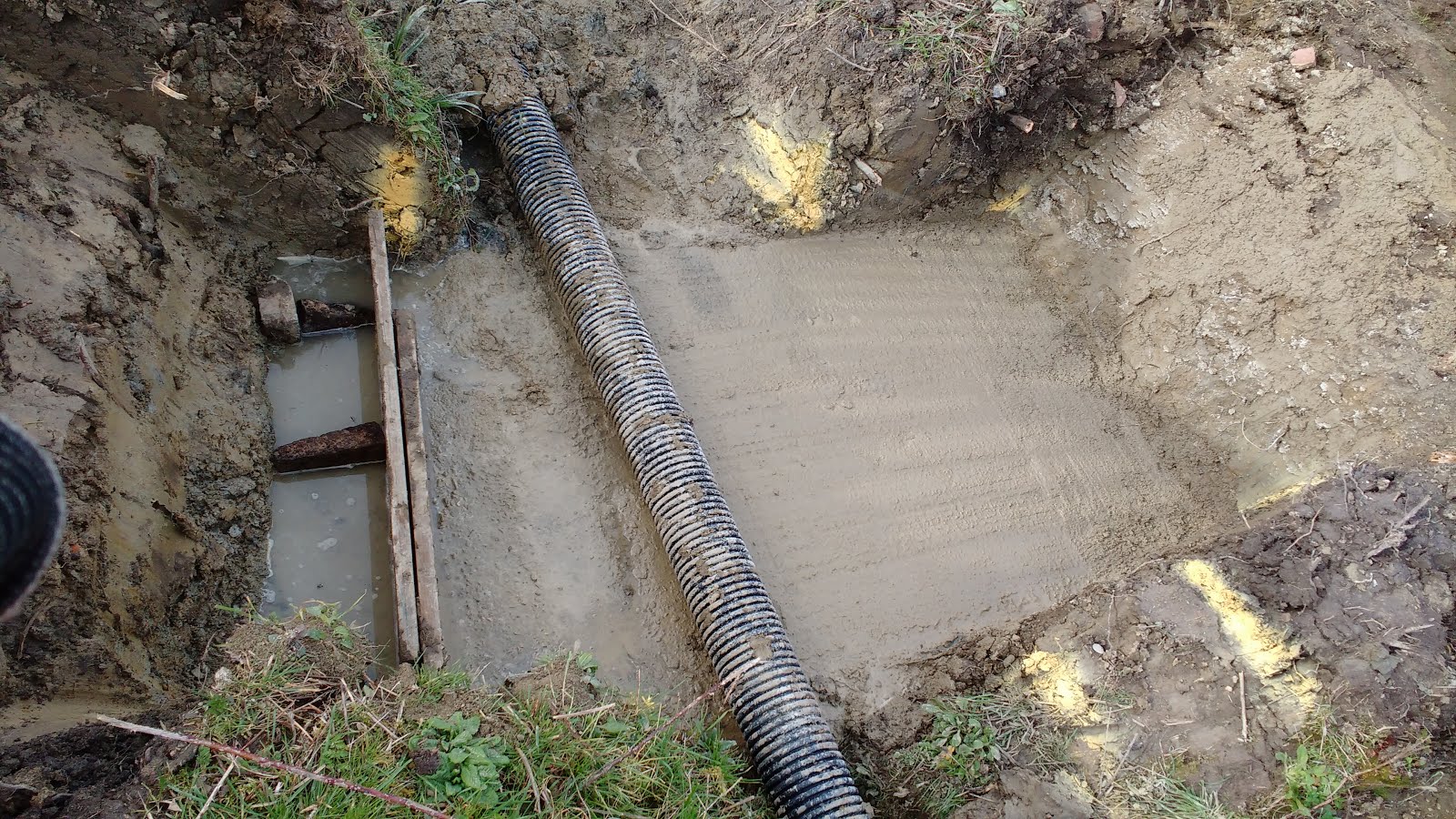
Here's a new mystery, the dye went in the cess and came out of the culvert but wasn't seen in between.
 |
| Andrew spotted a mystery pipe in the last chamber, hidden under the cess |
 |
| Second dye test appears at the culvert |
 |
| The dye runs in to the end chamber from the mystery pipe |
Our conclusion now is that BR must have realised the cess drain with the hollow blocks was a complete failure. Therefore, they installed a second pipe, or as we haven't found another pipe along the cess, probably just a permeable stone corridor. Finding this, has changed our plan slightly, it means more digging out behind the cess drain. We'll CCTV the pipe in the end chamber to see how far it goes.
 |
| Down side cess drain, excavations around the run-off entry |
While all this was going on the road was reinstated past the new joint
 |
| An extra load of spent ballast onto the haul road |
There was a train today, the Class 03 D.2182 took the rest of the 10m piles down to Gotherington
 |
| Class 03 D.2182 on the way back from Gotherington |
Michael got the headers onto the C24A crest chamber, but the rain meant the covers were on before the camera got there
 |
| Culvert 24A crest chamber brickwork completed |
The culvert 24A crest rebuild has taken more time that usual even for us, a search of the archive found that we dug it out and removed the loose bricks on 2 December 2015. Hopefully the rest of this job will not take as long.
 |
| 2 Dec 2015, Culvert 24A crest headwall excavated |
With the railway closed, the restrictions on travel and some of the team being in the 'Vulnerable' category. We wrapped up the job tonight. The Digger went back to Winchcombe to be collected by Elliott's.
 |
| Smaller excavation now the pipe is in |
 |
| Andrew, Martin and Michael cleaning the kit |
Gotherington slip work is being scaled back slightly. The hiatus in the Railway's income stream means that the Phase 3 nails will have to wait until September. A cross section drawing of the Bridge 37 up side slip at the face shows how the nails and the 10m and 5m piles are being installed.
 |
| Cross section trough the embankment at Bridge 37 Gotherington |
The 10m piles are being installed now
 |
| Bogie flat with the next batch of 10m sheet piles |
 |
| Another 10m pile going in |
 |
| Lining up the joints |
 |
| The 35t excavator holding the pile |
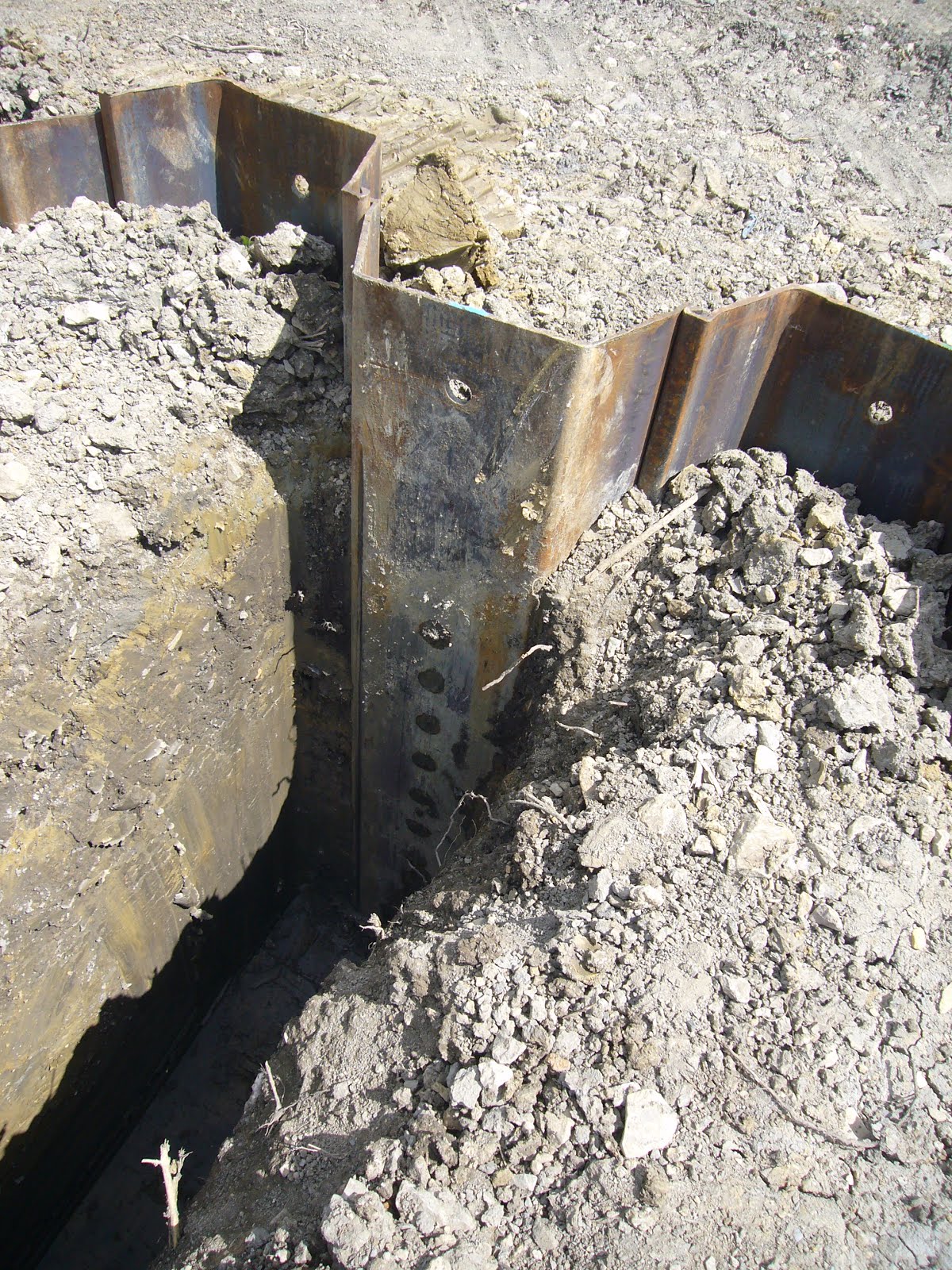
The clamps on the piling head leave marks where they nip into the steel...
 |
| Jaw mark on the pile |
 |
| Trace marks from the piler jaws |
The piling is a multi stage process, first the vibration head clamps onto the pile and threads it into the previous pile joint. Then the pile is pushed down to ground level, the head is moved up a bit and the pile driven in a bit further. Eventually it gets in deep enough to move the piler onto the top of the pile to drive from there
 |
| Driving the pile down |
 |
| Driving from the top |
 |
| The 5 m piles are all installed some will be cropped |
 |
| Second machine for feeding the pile forward |
 |
| The vibration hasn't destabilised the toe snout |
 |
| Pile being driven down as into the clay |
 |
The 5m piles have drain holes pre-cut into the top end
(See the pile sticking up) |
Phase 2 soil nails, mesh and plates are all in.
 |
| Phase 2 soil nails finished |
 |
| Phase 2 soil nails |
 |
10m piles will follow the line
of the slip face |
 |
| 10m piles installed so far |
Lastly, a short video of the vibrating pile head in action...
Not sure when we will be back, it's possible there will be some odd jobs done over the next couple of weeks. It all depends on the severity of the COVID-19 lockdown.
Here's hoping that all the gang, the wider GWSR community and all our supporters will get through this episode unscathed; take care out there, it's a cruel old world
Bye for now, Stuart and the Drain Gang