Friday, 25 April 2025

Easter Holidays

With a late(ish) Easter this year, and the promise of reasonable weather, quite a number of the team decided on holidays for the week before or the week after Easter (or both). The exotic holiday destinations included the North Yorkshire Moors, the Lake District, the Isles of Scilly and Birmingham (for a Genesis tribute band concert).

We can confirm that all the mentions of old railway items on the Isles of Scilly in a recent Heritage Herald blog (https://haylesabbeyhalt.blogspot.com/2025/04/sunshine.html) were April fools (or fake news). However we did spot this shed. Maybe it is a magazine store!

Thursday 17th April

Just three of the team attending on Maundy Thursday – Martin, Jonathan and John. However, as very successful day with the added bonus of no passenger trains to worry about.

First task was some dye tracing at Stanton Aqueduct. Three and a half minutes after adding dye to the down side inlet, dyed water emerged from the up side outlet, as expected. Shortly after they noticed a small dyed flow running back to the inlet channel underneath the pipe and into the crack between the channel and the down side abutment. This did not immediately appear in the ground crack underneath the aqueduct. So on the assumption that in heavier flows more water would run back from the exit of the pipe they simulated a heavier flow scenario by pouring dyed water around the crack in the inlet channel. After a coffee break they noted dyed water in the ground crack underneath the aqueduct. There was also water seeping out lower down the cutting, but no dyed water had reached there by the time they left. Thus it looks like all of the water getting into the cutting side comes from the crack in the inlet channel. We have passed on these findings to the bridges team and the Infrastructure Manager to determine the repair plan.

Dyed water flowing into the pipe on the down (inlet) side... [Photo by Jonathan]
 
... and seeping back towards the crack between the inlet channel and the trough. [Photo by Jonathan]

The other task for the day was preparing vertical and horizontal poles for culvert/cross drain safety marker rails. We are using old scaffold poles for these – some of which were part of a condemned scaffold tower. Eight horizontal and sixteen vertical rails were cut to the required sizes – these are for the structures 37B to 37G between Gotherington and Bishops Cleeve. Only one requires a marker on both sides, hence then eight sets for these six structures.

Whilst Martin and John were busy cutting the scaffold poles, Jonathan cleared out the drains behind the workshop in Churchward House yard.

Finally the three paid a visit to Stanway Watermill, one of our neighbouring heritage attractions. https://www.stanwayfountain.co.uk/the-watermill.html

Stanway Watermill [Photo by Jonathan]
Thursday 24th April

Back to a more normal number of attendees – 7. (Jonathan, Dave, Andrew, Nigel, Stuart, Peter, John). A single task for the day – beginning the infill around the one length of 600mm diameter twinwall pipe in the down side crest ditch which carries the stream that comes down from Cleeve Hill alongside the former Bonsai World site at Bishops Cleeve.

First job was to remove a section of boundary fence and undergrowth to allow access from the field track and footpath at the top of the cutting. Then we reversed the tipper Transit loaded with some spent ballast along the track almost to the access point. However the uneven surface of the track and the overhanging branches meant we had to stop a few yards short. So the ballast was unloaded into barrows and manually wheeled into place. This was to level up the ground around the circular concrete manhole, under which the stream makes a 90 degree bend). Pushing loaded wheelbarrows is much easier over level ground!

Gap in the fence and ballast to level the ground around the manhole to make barrowing the pea gravel infill easier.

We then collected three one tonne loads of pea gravel from Elliots (Cheltenhand) Ltd, for the initial infill around the twinwall pipe. Roger Kentfield, the owner of the adjacent field, very kindly let us bring this in across the field from New Road; thus avoiding the bumpy and narrow track from Two Hedges Road. Conveniently Elliots are located on Stoke Orchard Road, just the other side of Bishops Cleeve.

The final barrow load of the first tonne of pea gravel. With a short barrow run and a team of 7, shifting one tonne does not take too long. [Photo by Jonathan]

Stuart makes sure the pea gravel is level and compacted around the pipe. The rest of the infill will be more spent ballast.

As a footpath runs along the track and into the field, we were able to chat with some of the hikers and dog-walkers passing by. One of whom was Andy Protherough, the first Head of the Drainage department, with his dog Jaz. Andy can remember some of the previous attempts to prevent this stream overtopping the crest ditch following very wet weather.

Finally we erected two sections of heras fencing to temporarily plug the gap in the hedge/fence; will will need this as an access point for quite a few more weeks to bring in a lot more infill.

Wildlife report: Very definitely we are into late spring. Apple blossom abounds, Horse chestnut in full flower and Hawthorn blossom is starting. We spotted a pair of house-martins (or maybe swifts, they were zooming too quickly for a positive identification). Also in the adjacent field were some crows and a hare. Strangely the noisy gulls of Cleeve did not appear – even at lunchtime. Back at Winchcombe, this time the circling raptor at tea break time over the station was a buzzard.

Underneath a spreading chestnut tree - not the village blacksmith but the end of the track from Two Hedges Road and where the stream runs under it.


Friday, 11 April 2025

Replanning

Thursday 10th April

Always have a plan B, and a plan C. A good mantra for any activity; though sometimes the formulation of the alternative plans takes place ‘on the hoof’. Today was a good example.

First of all, a job that we had expected to undertake but we found another team had already completed it. This was the replacement of some fencing alongside the Wychavon footpath near bridge 2, Childswickham Road.

Secondly our plan to use both of the Transit vehicles had to be changed. The white tipper Transit was out of action requiring repairs to the tail lights. Jonathan in his capacity as chief vehicle maintenance person spent the day sorting that out.

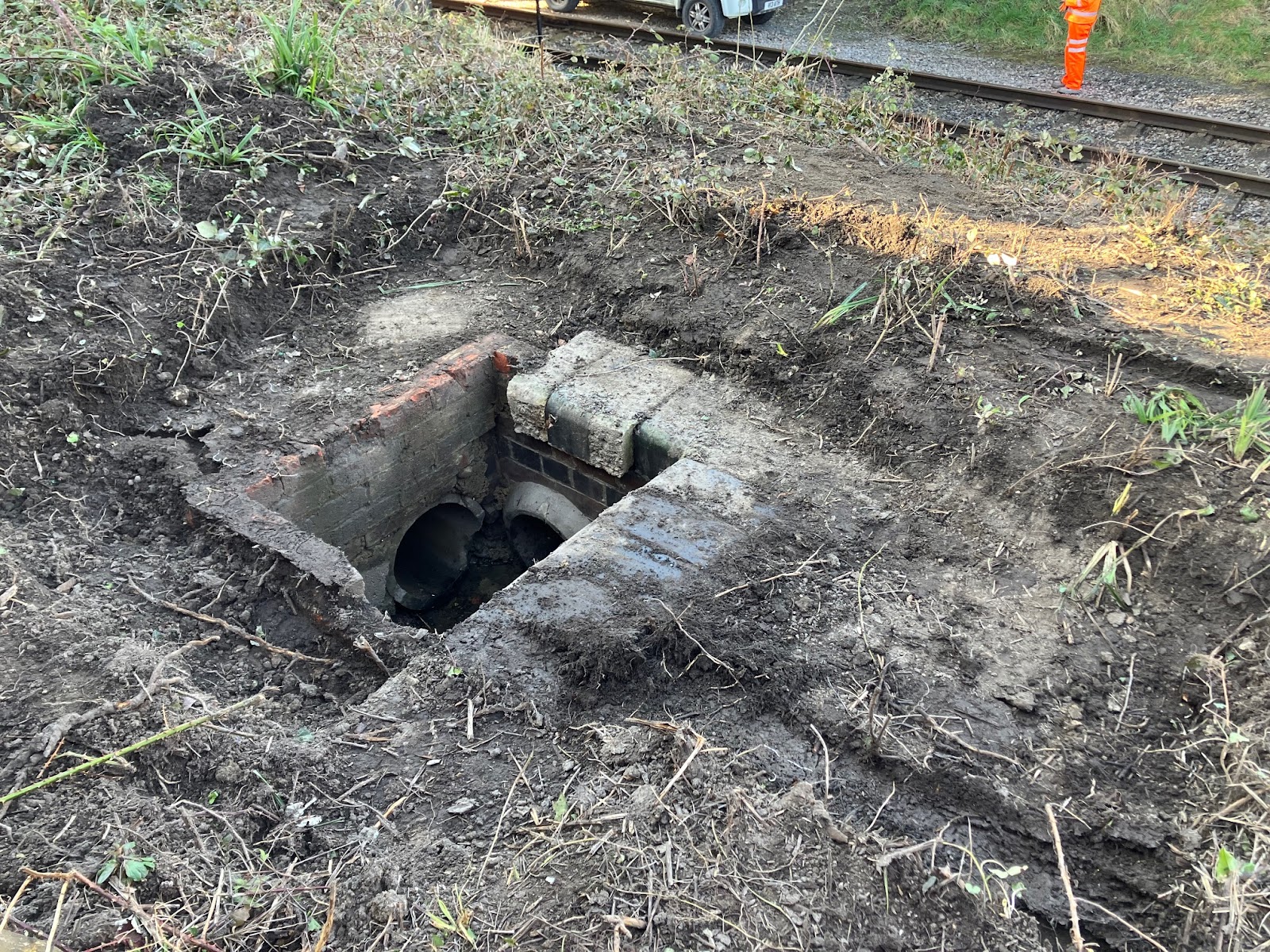
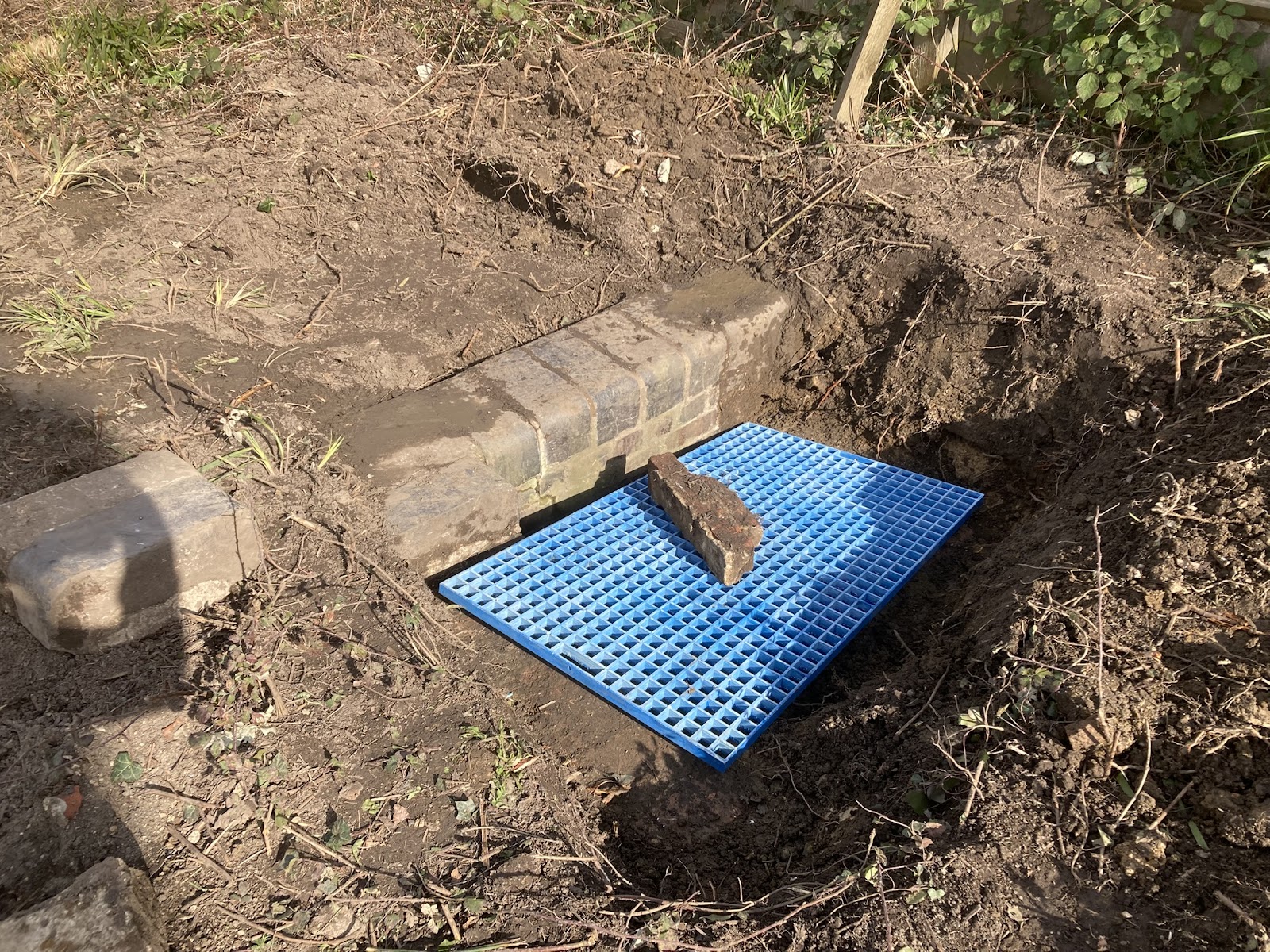
Final item of replanning was the rebuild of the down side syphon inlet chamber of cross drain 39B at Two Hedges Road. To obtain level brick courses with even mortar joints, we decided to remove a few more of the existing coping bricks. Hence the plan is now an all brick chamber with concrete lids, instead of GRP catch pit rings and a blue mesh lid.

Whilst the Toddington to Stanton section of the B4632 road was closed for gas main replacement, a lot of traffic diverted along Laverton Meadow Lane. This prevented us from working under bridge 6 to clear the silt traps. Now the main road is open again, we could safely attend to this. Hence, Dave, John and Martin just managed to squeeze two wheelbarrows, traffic cones, road work signs, shovels and rakes into the Ranger for this task. Almost a month of dry weather made this task a bit easier than usual; however the silt in the traps on the low mileage (Broadway) side of the road had the consistency of thick soup. Then back to Winchcombe to clear out the final Drainage items from the office in the old wooden C&M workshop that is soon to be demolished.

Martin and John attending to the low mileage silt traps at Laverton Meadow Lane bridge (6). [Photo by Dave]

Nigel, Stuart and Roger were deployed on the rebuilding of the 39B inlet chamber at Two Hedges Road. Again the effects of the dry spell was obvious, no water was flowing through this. However, a work platform was required in the chamber to keep the bricklayer feet above the sump. The removed coping bricks were taken back to Winchcombe to join our stock of spares.

Roger working on the revised brick building at 39B syphon inlet.

Peter and Andrew also headed for Two Hedges Road, but south of the bridge. They inserted some more sandbags around the end of the length of 600mm diameter twinwall pipe in the down side crest ditch which carries the stream that comes down from Cleeve Hill alongside the former Bonsai World site. Next was some careful measuring of the ditch further south. The plan here is to pipe the stream for around 60m to avoid the sections where water is seeping into the cutting side. We also noticed some damaged lids on cess chambers where a non-railway drain pipe under the line. So these were measured up for replacement lids and additional chamber rings to raise their height.

Sandbag headwall slowing rising around the Bonsai World down side crest ditch pipe.

After lunch all nine of the team attended a presentation from Gareth Mead of Severn Trent Water. Gareth explained the somewhat opaque division of responsibility for drainage between water companies, Environment Agency, high ways authorities and landowners. He also showed us a water testing kit that Severn Trent use to determine levels and type of contamination in water courses. The main item was revising the internal Severn Trent maps of all the pipes and water courses which run alongside or under (or over) our railway. This was very useful, as we now know what some of the pipes are; and know of some more (such as one running under the filled in bridge 41). [This included the pipe we inspected earlier between cross drain 40A and culvert 40B, this is a combined foul water and surface drain pipe, which does belong to Severn Trent.]

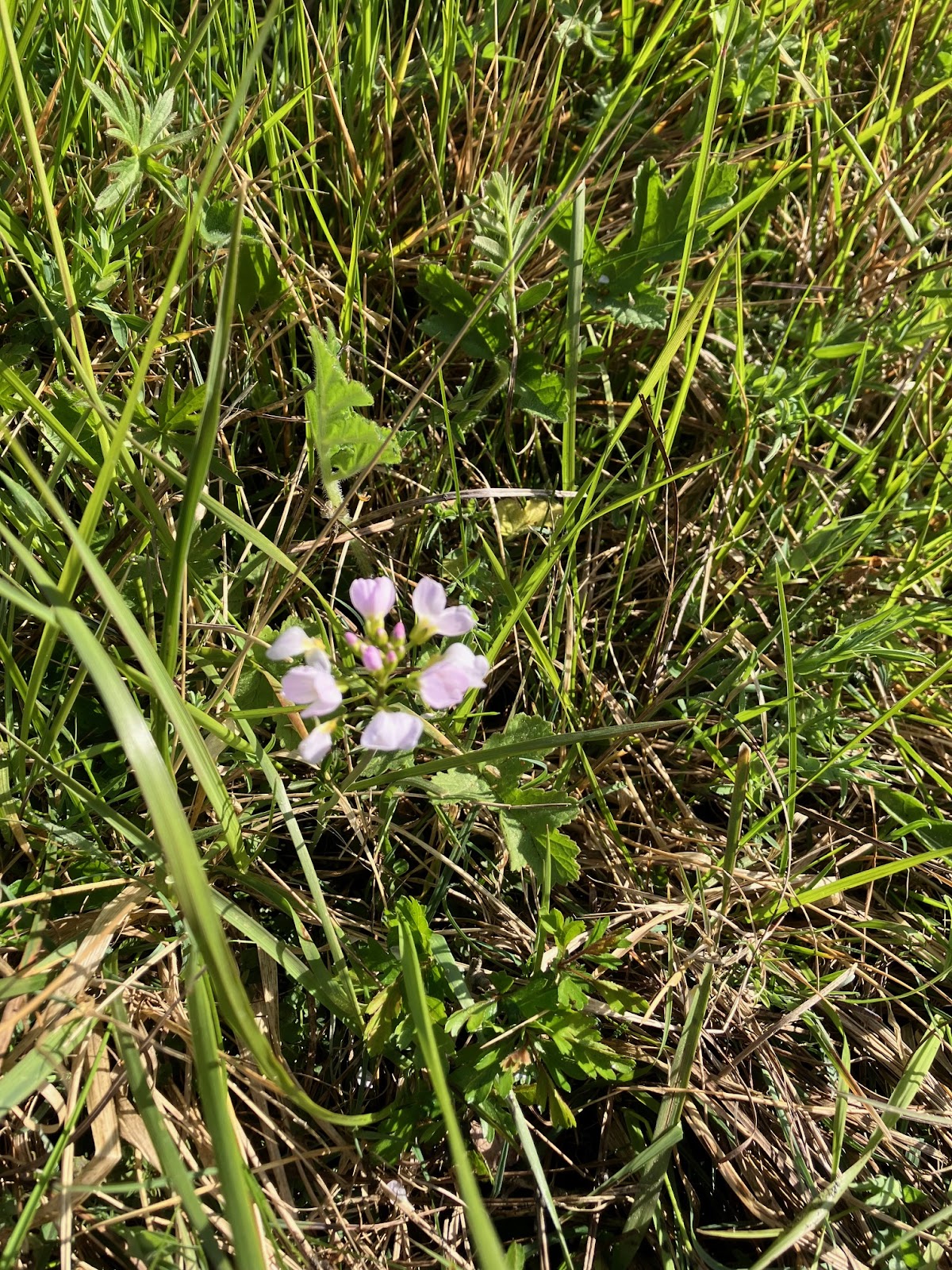
Wildlife report: The team at Laverton Meadow Lane spotted Cardamine pratensis, the cuckoo flower, lady's smock, mayflower, or milkmaids; plus the expected primulas in flower. Whilst at Two Hedges Road, the resident flock of gulls was noticeable fewer and quieter. On the ground we spotted a hairy-moth caterpillar taking advantage of a flowering white dead nettle plant. Very early signs of blossom was seen on some apple trees, whilst blackthorn and some other varieties of Prunus (which includes ornamental cherries) are in full bloom. Also noted was the first sighting of a cabbage white butterfly this year.

Cuckooflower (Cardamine pratensis) also known as: Milkmaids, Lady's smock, Cuckoo bittercress, Whitsuntide gilliflower, or mayflower. [Photo by Dave]
 
Hairy caterpillar on a white dead nettle plant.

Another result of the dry spell - a burnt patch of cutting side at Bishop Cleeve.

A flowering ornamental cherry tree nicely frames the single unit DMU at Two Hedges Road.  


Friday, 4 April 2025

On the beach?

Sitting in a deckchair in warm sunshine, eating sandwiches for lunch, with gulls circling and screeching above, we could almost have been on the beach! However, it was old ballast under our feet – not sand or even pebbles. Plus no ice cream sellers in sight at Two Hedges Road.

Tuesday 1st April

More overtime for two members of the team! Roger and Martin, attended a training course on the use of abrasive wheels and cutting discs. This was run by Greenway Training, conveniently at Guiting Power, not that far from Winchcombe.

Thursday 3rd April

Seven of the team attending today.

Jonathan continued with the repair work on the Ford Ranger. The towing hook electrics are now reinstated in a way that should reduce damage when traversing rough ground or changes of slope. He also started repairing the Timberwolf chipper, this had failed after ingestion of some hard materials. Unfortunately he was unable to complete this repair as it required access deep into the engine area. A useful odd job accomplished was relocating our stack of concrete chamber lids – use of the telehandler made this much easier and safer. This is part of the tidy up of Winchcombe yard; associated with the demolition of the old C&M wooden workshop. This is very much a multi-department project; also involving PW, C&W, C&M and S&T.

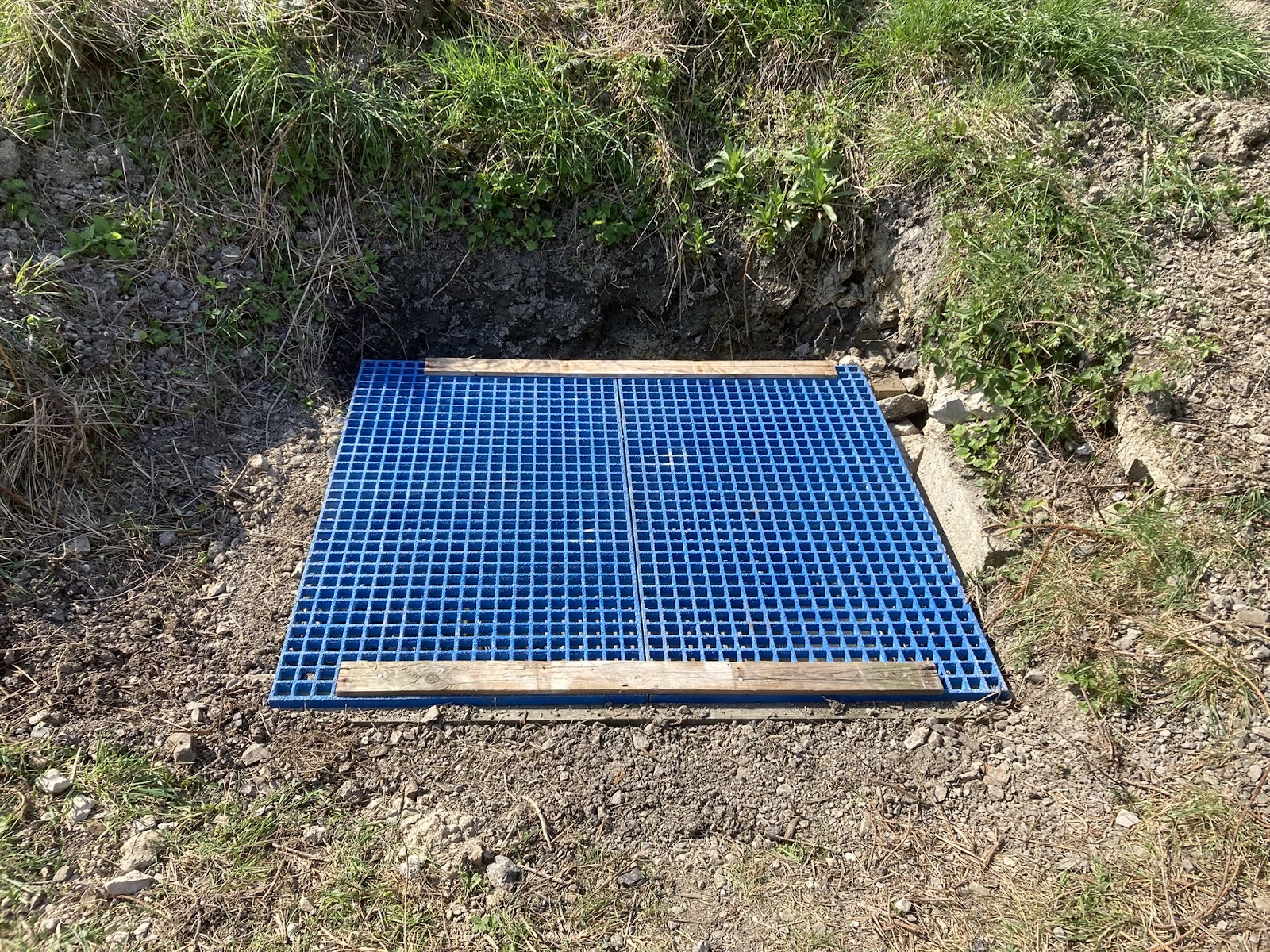
The other six of the team headed for Two Hedges Road at Bishops Cleeve. Martin and John first fitted a removable cover over the up side washout lid of the (pseudo) syphon cross drain 40A. Constructed from two blue mesh chamber lids and four lengths of wood; this will adequately mark the location for now. We have abandoned the attempts to undo the seized nuts and bolts of the washout lid for the present.

The removable cover over the washout lid of cross drain 40A in the up cess.

Nigel and Dave commenced cutting back vegetation on the vehicle track on the down (Cotswold) side at the top of the cutting. We are going to need to bring in bulk materials along this track in the next few weeks.

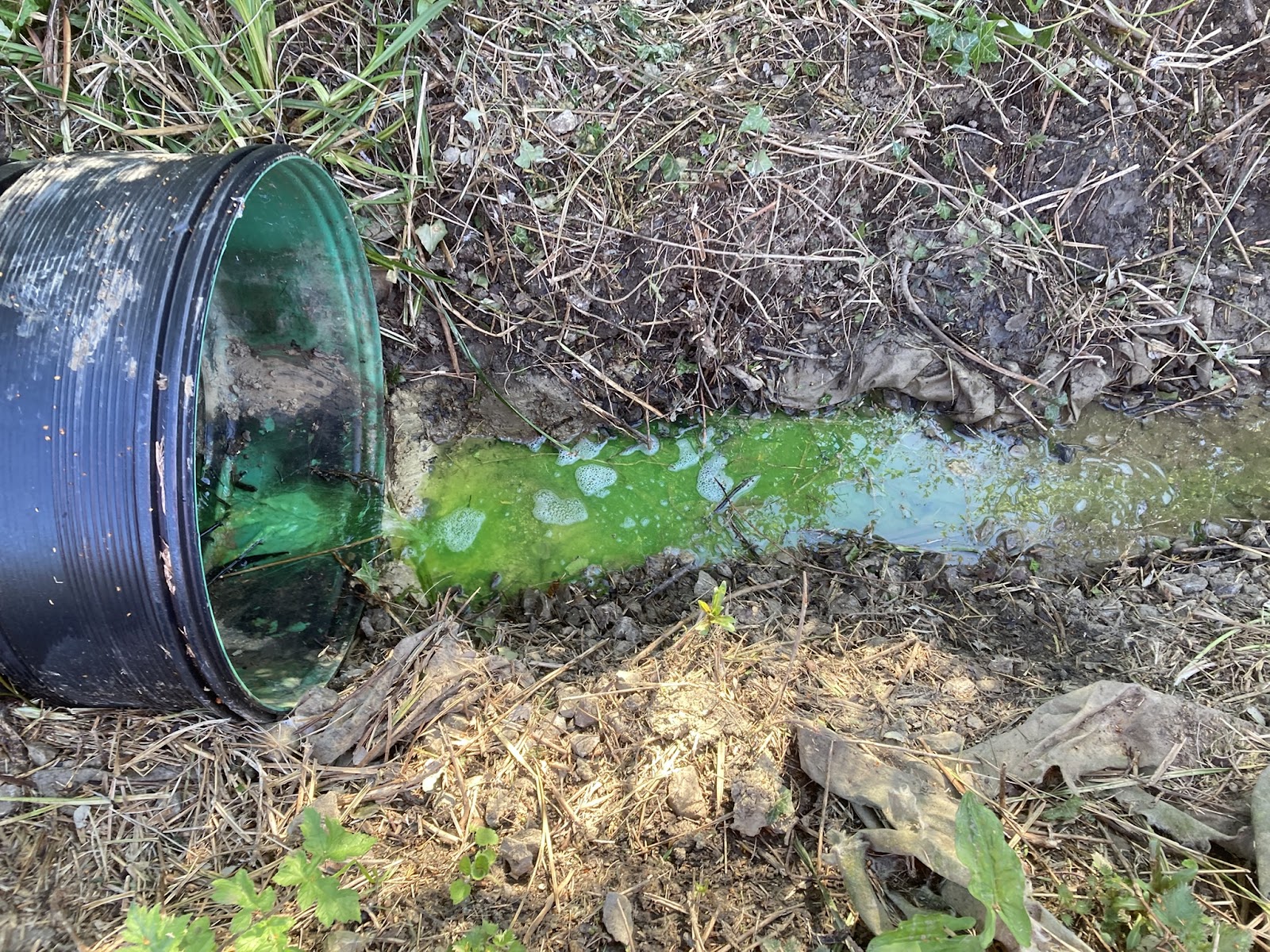
Peter and Andrew started on the main task for the day – the inlet of the stream that comes down alongside the former Bonsai World site. First was a dye test, this time adding dye to the circular chamber with the 90 degree bend at the top of the cutting. Even after half an hour; the water tricking into the down side cess chamber in the cutting was still clear. So this indicates the source of that water is further upstream; we suspect it is leaking around the inlet bore. However, to check that we need to first arrange access to the adjoining property.

Green tracer dye added to the 90 degree bend chamber.
 
Coloured water quickly appears at the pipe exit.

But no green water appearing in the cess chamber.

Then the commencement of the laborious task for the day – excavating under the one remaining length of 600mm diameter twinwall pipe in the crest ditch to get this to sit with a 1 in 80 fall. Removing large stone, clay and hessian liner from under a large pipe in a ditch is not at all easy. With the other jobs completed; the team size grew first to four; then to six.
Team effort resetting the section of 600mm pipe - wellingtons required for those at the exit end.
Our first working day of the year with normal passenger trains running. Martin looks on from the top of the cutting whilst class 121 bubble car 55024 passes. The maroon BR carriage livery does suit this single unit.

Finally we removed sufficient material to get the section of pipe to sit correctly. Then after lunch, we excavated a bit more around the exit of the pipe. Then we laid hessian sand bags filled with a sand and cement mix around the base of the pipe. Hopefully this will prevent any backflow of water there.

End of day state at the pipe exit - more sandbags around the exit to be added; then backfill to bury the pipe. Plastic twinwall pipe will eventually degrade if left in sunlight.

Last job of the day was to examine the rest of the crest ditch – a task made easier by the dry conditions in March leading to a much reduced flow. Before the end of the cutting; all the water seeps into the cess through fissures in the cutting side. Our current plan to deal with this is to install a pipe in the affected section of ditch. We will need to widen, but not deepen, the ditch in places to enable use of 450mm diameter twinwall pipe, That is the diameter of the inlet pipe to the 90 degree chamber – so we are not introducing any further constraints.

Another benefit of passenger trains running is that the Coffee Pot cafe at Winchcombe is open. Thus our end of day cuppa tea is al fresco. (Left to right, Nigel, Martin, John, Dave, Jonathan).


Wildlife report: There is certainly a large diversity of bird life at Bishops Cleeve, probably because of the combination of habitats – woods, fields, gardens. We positively identified the flock of lunchtime gulls as Lesser Black-backed gulls. Earlier in the day a single Red Kite swooped very low over us. Other birds noted were wood pigeons, blackbirds, robins, magpies, crows, blue tits, nosiy sparrows, and great tits. On the vehicle track / footpath at the top of the cutting we spotted a muntjac deer. Insects noted included bees, tortoiseshell, brimstone and an unidentified blue/black species of butterfly. On the vegetation front the most apparent sights were the abundance of flowering dandelions and celandines; plus the blackthorn blossom which was probably at its peak. On the way back to Winchcombe, we spotted the first signs of pear trees blossoming. Less welcome we noted quite a few brambles and ash sampling sprouting along the section of the down side cutting which our clearance contractor had cut back in the autumn. The wet winter and warm (so far) spring is ideal growing conditions for a lot of our lineside vegetation.

Blackthorn blossom


Friday, 28 March 2025

Test and trace

Thankfully not a return to the first wave of the COVID-19 pandemic five years ago!

Tuesday 25th March

Drainage team leader Andrew accompanied Sarah Clayton, Infrastructure Manger, and contractor Tom Clarke on a site visit to Stanton cutting. The objective was to develop a plan to deal with the water run off from the fields on the down (Cotswold) side of the line between bridges 8 (B4632) and 10 (Stanton Road). The railway is in a cutting here, crossed by the Stanton Aqueduct. There is a short retaining wall just north of the aqueduct, probably installed over 50 years ago following a cutting side slip.

Thursday 27th March

Eight of the team in attendance. Well, strictly nine – as Roger was also at Winchcombe attending a First Aid course.

Six of the team departed for Two Hedges Road, leaving two at Winchcombe. In his role as fleet vehicle inspector, Jonathan, was occupied with the weekly vehicle checks. This took a bit longer than planned due to some rewiring required on the towing socket of the Ford Ranger. Ian also remained at Winchcombe to host the Railway’s PAT testing team (Mike and Alan) who were testing all of our portable electric appliances. None were failed. Ian, with the help of C&W Works Manager Stuart, also sorted out some issues with two of the brush cutters. Jonathan and Ian joined the others at Two Hedges Road before lunch.

On arrival at Two Hedges Road, the team of six split into three pairs. Nigel and Peter first attended to the washout cover of cross drain 40A in the up (Malvern) side cess. They found a spanner that both fitted the nuts and could be inserted in the gap between the cover plate and our recently added concrete surround. Then with a torque wrench they attempted to shift the bolts. Only one would move! Additionally access with the spanner to the nuts on the underside of the flange at the back of plate is very restricted. Hence we have changed our plan for this item; we will install an easily removable cover. Then when (or if) the washout lid does ever need to be removed, something more powerful than human muscle will be deployed.

Dave and Martin’s first task was to cut back some of the lineside vegetation to enable parking of vehicles a safe distance from the running line. From next week we will have passenger trains running whilst we are working – so give us a wave if you are travelling.

Parking space created allowing parking of vehicles at least 3m from the running line and with the up side cess chamber lids visible.

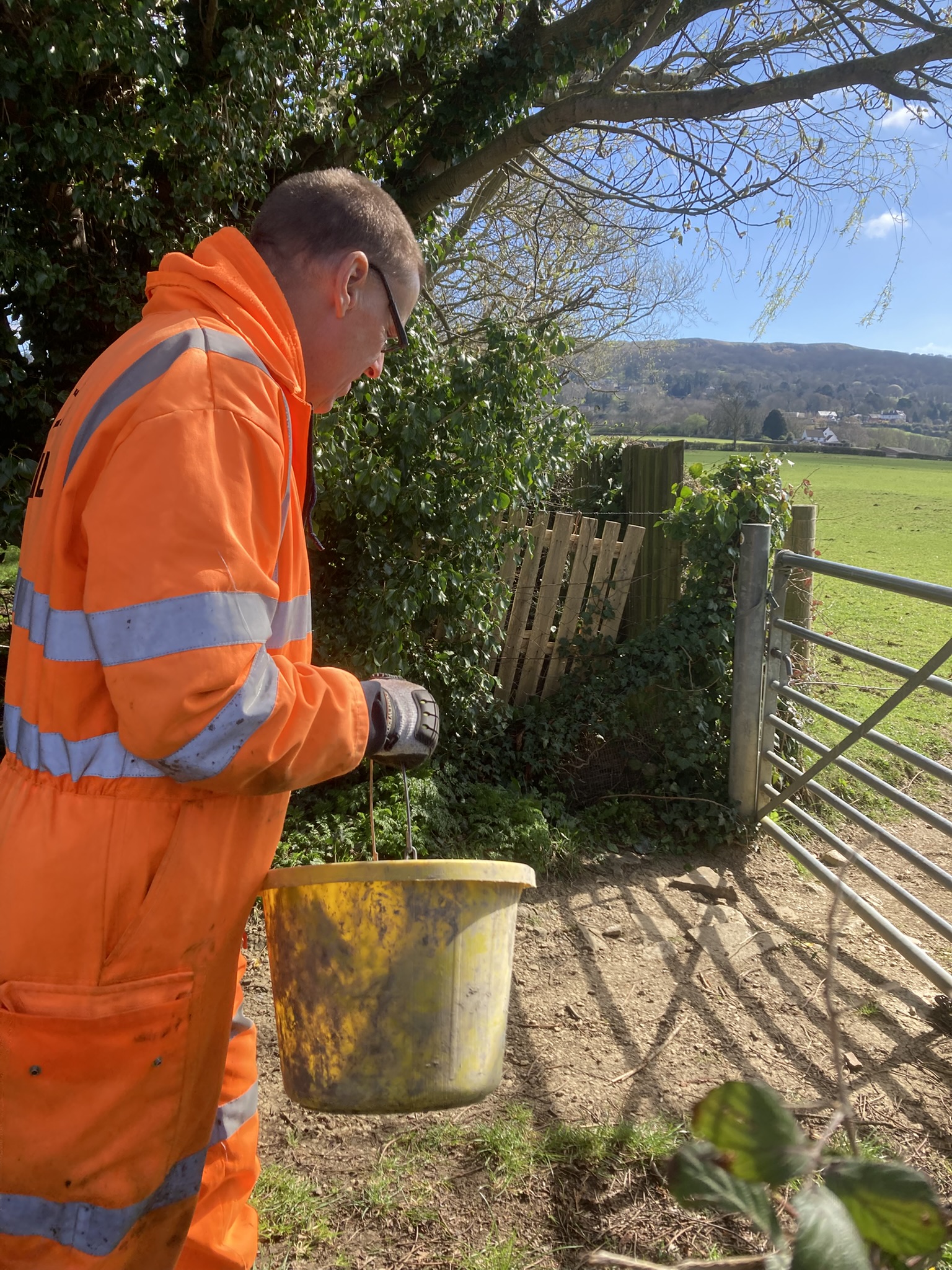
Andrew and John started the main task of the day; tracing where water is percolating through the down (Cotswold) side of the cutting south of Two Hedges Road. The ultimate source of the water is a spring on Cleeve Hill, this runs in a stream which enters railway land under a footpath by the former Bonsai World site. Jonathan arrived in time to insert the first bucket of tracer dye upstream of the footpath.

Jonathan with the first bucket full of tracer dye; inlet from the stream is in the corner of the fences to the left of the gate.

Two minutes later this emerged from the incomplete 600mm diameter pipe in the crest ditch; then after five minutes we also noted green water dripping into the cess chamber at the trackside.
Dyed water running out of the crest ditch pipes...

... and seeping into the cess chamber.

Excavation around the join between the two lengths of pipe also revealed green water. So that is one source – but the flow there was much less than into the cess chamber.

Peter (l) and John excavating around the crest ditch pipe.

After coffee break, all eight of the team then removed the second section of 600mm pipe. A prerequisite was some ditch clearance and moving two other lengths of pipe which have not been connected for several years. A check with a spirit level (actually a virtual spirit level app on a phone!) showed that the first section of pipe certainly did not have the required 1 in 80 fall – the end of it pointing slightly uphill.

Debris which had collected at the badly formed and leaking join in the two section of 600mm twinwall pipe.

Then a pause for lunch and to start considering the options for this problem.

Not expecting it to be warm and sunny at lunchtime, we did not bring our deck chairs. Hence the use of the tail lift and bed of the Transit - and the ground. [Photo by Jonathan]

After lunch, four of the team continued with the clearance of the crest ditch, reaching the point where the cutting transforms into an embankment and the ditch becomes a toe ditch. (It eventually runs down to cross drain 40B). The others then started the task of removing material from under the first section of pipe, with the aim to get this to the correct downward inclination. As the material surrounding the pipe is clay and ballast sized stone; this is a slow and tedious job. Not surprisingly, we will need to return next week to complete it.
Three probably now redundant lengths of 600mm twinwall, with most of the team digging around the remaining length behind. [Photo by Jonathan]

We then added a further dose of tracer dye, this time into the manhole where the flow makes a 90 degree bend downstream of the footpath. This dye quickly flowed out of the one remaining length of pipe and then away down the crest ditch. But this time no green water was noted seeping into the cess chamber. So we think there is another leak from the stream, probably around the pipe running under the footpath and then under or around the base of the manhole. Further investigations here will be another task for next week.

Before the end of the crest ditch, most of the water has seeped away into more fissures in the cutting to emerse into the cess or the cess drain. Options here are lengths of pipe or an impermeable lining to the ditch. [Photo by Jonathan]

Wildlife report: Certainly spring has now fully sprung. Plenty of magnolia trees in full bloom in the gardens of Gotherington and Bishops Cleeve. As an ornamental tree, there are none lineside. At Stanton on Tuesday, the first signs of plum and pear blossom were noted. The volume of birdsong also indicates spring is in full swing – a very vocal great tit was heard then easily spotted. At lunchtime, Bishop Cleeve’s resident flock of gulls was in full cry. We think these are Lesser Black-backed gulls, as they have black wing tips. Or they might be Herring gulls, who also feature black wing tips. On our departure, several robins and blackbirds moved in to take advantage of the quantity of earthworms exposed in our excavations.

Some clumps of daffodils are still in their prime.

Friday, 21 March 2025

Spring again!

Thursday 20th March

Today was the 2025 Spring or Vernal equinox, so the start of the astronomical spring season. Also with plenty of sunshine, and afternoon temperatures way above average, it felt like spring had returned. Certainly we packed the deckchairs for use in our coffee and lunch breaks.

First we were please to welcome our new Infrastructure Manger, Sarah Clayton, to our morning briefing. To keep the briefing short, no buns or doughnuts today, but we did use the mess room inside Churchward House.

Two groups at work today. The first task for the smaller group of three, Jonathan, John and Martin, was to fit a mounting for a fire extinguisher by the row of containers in Churchward House Yard. Initially the plan was to install a post; but the ground proved to be very hard. So with valuable assistance from Operations Manager, Neil Carr, the mounting was attached to a corner post of the container nearest the S&T building. Next was to load some spent ballast in to the tipper Transit and deliver to Working Lane. This was to fill some more ruts and potholes in the haul road leading up to opposite the Royal Oak pub. For various reasons, the delivery of the spoil from the Broadway platform 2 excavations to Royal Oak will now use lorries, with the wagons unloaded at Toddington. Hence, the requirement to improve the haul road. Final task for the gang of three was back in the yard at Winchcombe, relocating our stock of former GWR broad gauge bridge rail. This is part of the preparatory work for the demolition of the old wooden workshop building in the yard.

A telehandler with forks does make moving bridge rail easier - Jonathan carefully manoeuvrers into position whilst Johan and Martin wait to unload.

Sarah accompanied the other four attendees, Roger, Nigel, Peter and Andrew, to Bishops Cleeve. Here Roger, Nigel, and Peter commenced the rebuilding of the syphon inlet chamber of cross drain 39B. This is going to use more bricks than we first thought – mainly because we have decided not to replace the fake concrete coping stones and we don’t have any of the required 14” copings in our stock. However, once raised with GRP catch-pit rings and a blue mesh cover; the mix of bricks and copings will not be visible.

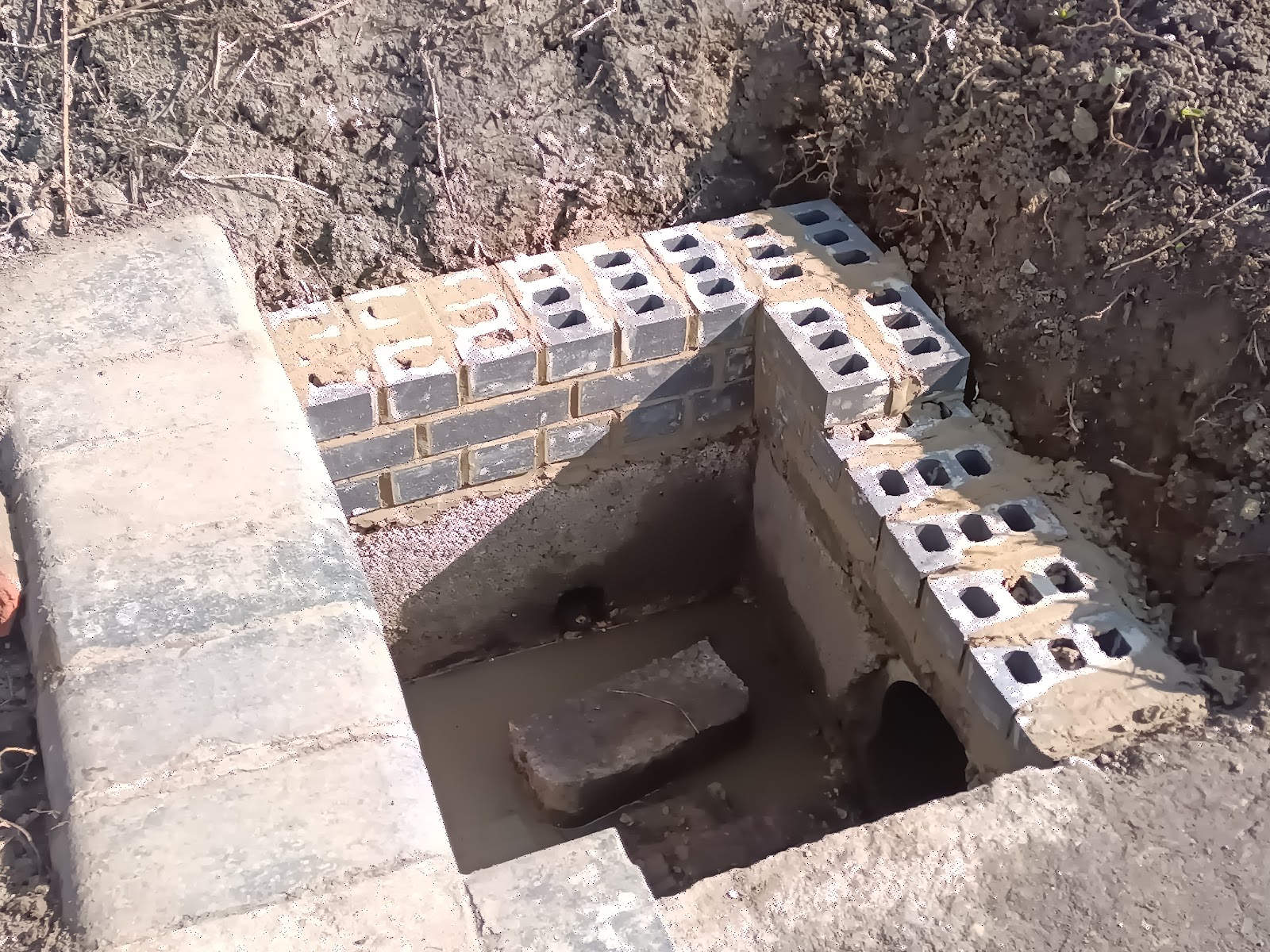
The partially rebuilt 39B inlet - move bricks needed to raise three sides to the level of the copings on the left. [Photo by Roger]

Meanwhile Andrew and Sarah inspected the northern inlet of culvert 40B, just before milepost 17½. This is the stream which enters a crest ditch at the top of the cutting. After a week of no rain, there was no water emerging from the cutting side; but still quite a flow through the joints in the concrete rings of the cess chamber. They discussed several possible methods for tacking this, and the leaks in the crest ditch further south. Exactly which method we choose will depend on some further investigations to be made after we have cleared the ditch of vegetation and removed the partly fitted 600mm diameter twinwall pipes. Andrew took some measurements – the full length of the crest ditch is around 125m (or 410feet in old units). The cost of pipes or other ditch lining materials is also an important consideration.

All dry on the surface today at the 40B inlet stream location - but water oozing still into the cess chamber in the foreground.

The after lunch task for the team of four was at cross drain 40A. We first removed some of the concrete footing that two weeks ago we added around the metal syphon wash out cover on the up side. This was to enable access to the nuts on the bottom of the flange with a spanner. Unfortunately our toolbox did not contain a spanner of the correct size for the nuts. Also to check the bolts are not seized, we will need a very sturdy wrench. After a liberal spay of WD40 on all the bolts, we called it a day. It is going to take a few more weeks to become acclimatised with warm weather again!

40A syphon washout lid with WD40 on the bolts and a spanner width gap around the flange.

Arrival back at Winchcombe was just in time to help the other three team members move the final lengths of bridge rail. Also to witness the unusual sight of a steam locomotive propelling a full length train of coaches through the station and away towards Greet Tunnel. This was a photographic charter event using 6880 Betton Grange. With the glorious sunshine the participants will have taken some stunning photographs – we look forward to seeing some published soon.

Wildlife report: The highlight of the day was the large number of butterflies observed; we identified tortoiseshell and the pale yellow brimstones. Other insects noted were solitary bees and wasps – probably queens looking for a nest site. As ever at Bishops Cleeve, the resident flock of gulls were observed circling above the school playing field. But once again, no sign of any hedgehogs.

Friday, 14 March 2025

Not Spring!

Maybe last week was a false spring. Certainly this week we did not even pack the deckchairs for lunch break and we all needed an extra layer of clothing. No snow, unlike Wednesday morning at Cheltenham Racecourse, but a cold wind and a couple of short, sharp, heavy showers. One was of sleet, and one contained some hail. So for a very short while sheltered edges on the ground did turn white.

Thursday 13th March

An unusual working day for the Drainage team. Firstly we started with a tea break, complete with buns, in the mess room at Churchward House. The reason for this was to say good-bye to our departing Infrastructure Manager, Ian Scholey.

Andrew presents Ian with a leaving card (bespoke production by team member Nigel). [Photo by Jonathan]
To remind Ian of the large JCB digger that he was not able to acquire for us, we presented him with a model one! In the other box was some scale drainage items and a few small rocks we removed at Gretton. [Photo by Jonathan]
 

On departing Winchcombe, all eight of the team attending headed for Stanton Yard. With special trains running for the Gold Cup Race meeting at Cheltenham Racecourse, continuing with our in progress jobs at Bishops Cleeve was not practicable. Likewise, starting a task which requires excavation at Didbrook was out of the question. Additionally, with the Toddington to Broadway road closed for gas main repairs south of Stanton, we were not able to take our Telehandler or other plant north of Toddington. So for today, it was some odd manual jobs at Stanton!

First task for Nigel and Martin was to attempt rodding of the crest to cess pipe on the down side low mileage of bridge 10. Not unexpectedly, this was not successful. From the top the rods reached around 9 feet in; from the bottom less than 3 feet. So, the whole pipe will require digging out and replacing. Meanwhile, Ian, Roger and John recovered some lengths of scaffold and other metal tubes from the yard. We can reuse these for headwall safety markers and handrails. The other three attendees, Peter, Jonathan and Andrew, checked on the down side cutting side either side of the aqueduct (bridge 9). Even with over a week of fairly dry weather, there is still water draining off the adjacent fields down the cutting side to the down (Cotswold) side cess. We will keep this area under close surveillance this spring.

The whole team then cleared the cut brash and logs from the up (Malvern) side cess between bridge 8 (B4632) and bridge 7 (Stanton Fields). This was removed to Stanton Yard; our esteemed colleagues in the Clearance teams will then be able more easily use the Timberwolf chipper to deal with the brush. Keeping this section of cess clear of debris is important. The outlet from syphon culvert 7A leads to a ditch on our neighbours property. This ditch is badly silted; so following heavy rain it backs up, causing the culvert to overflow into the down side cess. Keeping the cess clear of debris reduces the time any overflow water takes to percolate into the cess drain below.

Sunshine .... but note the woolly hats. Clearing the down cess at Stanton Fields; Martin & Roger in the foreground, Jonathan, John and Peter at the rear of the Ranger.
... and showers. Five minutes after the photo above a heavy hail shower makes for a wintery scene. Bridge 7 (Stanton Fields) in the distance.
 

Even though clearance of the up side cutting between bridges 7 and 8 was only a few weeks ago, there are signs of regrowth. Lots of new grass shoots and a few arrowhead plants (probably one of the varieties of Sagittaria) are visible. Some mammals seem to be happy with the new landscape too, we noted quite a lot of burrows.

Finally, we undertook a little more recovery of surplus material from Stanton Yard. This was several barrowloads of small stone, extremely useful for packing around plastic twinwall pipes. Recovery of the whole pile will need to wait until we can take the Telehandler to Stanton again.

Wildlife report: The most unusual observation was of a black male pheasant just up the Stanton Road from the yard. Also we noted the first spring lambs – proving that nature knows it should be spring! We spotted rabbits hopping across the line by bridge 7; possibly these are the creators of the burrows noted in the cutting. A Red Kite swooped very low at one point, perhaps it was eyeing up the rabbits.

Friday, 7 March 2025

Spring!

The weather and the metrological calendar certainly agreed that it was spring for our first working day in March. Even at 8am, there was warmth in the sun, which was well above the roofs of the Winchcombe sheds. Plus with no significant rain for over a week, most of the puddles in the yard had disappeared. However, the ground is still wet, very wet in places as we found out.

Thursday 6th March

Eight of the team attending today; the group formation was 1-2-5.

Jonathan was the solo man – he spent the morning working on plant maintenance at Winchcombe. (This does not count as lone working, as plenty of folk from C&M, S&T, C&W and Admin were in close proximity). The major job was the replacement of the battery on the mini-digger; this involved quite a lot of dismantling to access it. He also fitted a battery charging point; this will avoid all the dismantling if the battery goes flat in the future.

Roger and Andrew headed for Stanton. The bridge inspection team had reported water seeping down the down (Cotswold) side cutting between the main B4632 road bridge (8) and Stanton Road bridge (10). Additionally the team from Walsh’s, our contractors, who were rebuilding two wing walls of bridge 10 reported a ‘spring’ close to the down side low mileage wing wall about half way down the cutting side. We established that the ‘spring’ was a leak from the pipe that runs from a crest chamber to the cess chamber by the bridge. This takes run off from the road; we suspect the pipe is blocked with limescale at its lower end. We then investigated the whole of the down side cutting back to bridge 8. There are quite a few damp patches, particularity where land drains enter the cutting. Some of these drain into french drains, which require cleaning out. Additionally the crest ditch just inside the boundary hedge/fence requires attention. In places this was damp – and there was one pool of water remaining from the last wet spell. The area around Stanton Aqueduct (bridge 9) is by far the wettest. Just north of the aqueduct there is a small concrete retaining wall, probably installed in the BR era to stabilise a previous slip. The ground here is mainly clay, which does not make for stable conditions. We shall discuss plans to address the issues with this cutting with our (new) Infrastructure Manager and the Civil Engineering director; avoiding a slip here is amongst our high priority items.

Tracer dye added to the crest chamber low mileage down side of bridge 10.
Over an hour later no dyed water has reached the cess chamber. Note the limescale deposits.
A fissure in the clay which is filled with water.

North of the B4632 road bridge (8); our vegetation contractor [Tom Clarke] and our Lineside Clearance colleagues have cleared the up (Malvern) side bank. This time next year we should see a lovely grassy bank covered in wildflowers. But in the meantime all that cut material needs removing from above the cess drain!
 

Meanwhile, the famous five (Nigel, Dave, Polly, John, and Peter) headed south to Two Hedges Road. Their first task was to demolish the poor brickwork on the syphon inlet and outlet chambers of cross drain 39B. On the outlet (up or Malvern) side; this turned out to be relatively simple. Hence they were able to rebuild the offending wall and install blue mesh covers. So a task completed!

39B outlet, damaged bricks removed and spoil dug out. Ready for rebuilding. [Photo by Dave]
Polly soon has the replacement bricks in. [Photo by Dave]
Job done - now hidden under blue mesh lids. [Photo by Dave]
 

The inlet on the down side was not quite so straightforward. Two walls which consisted of a single thickness of brick came apart easily. But the other two walls, which we think were originally an L shaped headwall, resisted demolition. So a slight change of plan. We removed the three displaced coping bricks. We will now rebuilt these three walls to match the level of the retained copings; and then we will add new GRP rings on top. This will reduce the number of GRP rings required (which we don’t have in stock) at the expense of more bricks (which we do have in stock).

39B inlet before demolition started. Original strong headwall to right and bottom, note the three displaced coping bricks. The later added crumbling brick walls left and top. [Photo by Dave]    

Ready for rebuilding, we will use new blue engineering bricks here. [Photo by Dave]

Temporary fitting of blue mesh cover to prevent animal ingress.

Another sign of spring was the use of our deckchairs for lunch break. But with the sunshine not quite so strong as earlier; and a stiff breeze, it was soon back to work. Andrew joined the group after lunch, Roger in his other role in the First Response Team spent the afternoon providing fire extinguisher training. The afternoon task was excavating around the syphon washout cover of cross drain 40A. This at the edge of the up side cess. The excavation was to enable a concrete footing for a small retaining wall; this will make the cover easier to spot – both by us and by our contractors with their remote controlled flail. The excavation revealed a buried SGP pipe close to the syphon washout. This pipe appears to be the cess drain, diverted away from the syphon. The presence of hollow figure of eight concrete blocks seems to indicate this was another item modified in the BR era. One section of the GRP cess pipe has a piece missing from the top; the reason for this became obvious when after a bit more excavation water started oozing out of the cutting side. So again, we changed our plans slightly. The concrete for the footings was placed either side of the SGP pipe; when we build the wall there will be a lintel over the pipe. Hence we had a barrowload of mixed concrete spare. A quick decision was made to transport that a couple of hundred yards south to use as backfill on the small down side headwall where the cess drain enters the toe ditch leading to culvert 40B. Waste not want not!

40A syphon wash out cover (circular metal lid); SGP pipe alongside with hole to take water seeping from the cutting side. Not a recommended arrangement!
 
Concrete footing poured (well placed carefully with shovels) ready for the small retaining wall.

Finally we added some tracer dye to the inlet of syphon 40A to check that there was no leakage from the syphon into the down side cess drain.

Wildlife report: A regular blog reader has been in touch with a concern about harming hedge hogs when strimming or brush cutting. When we are strimming or brush cutting any area; we always do a visual check before hand to spot any obstruction on the ground. However, we have never found any hedge hogs – only items like soil nails, fence post remains and tree stumps. In fact, we have never seen any hedge hogs along the line – probably because they are mostly nocturnal. Today the only mammal evidence was several rabbit holes, some deer hoof prints and deer runs through the undergrowth. Horticulture wise, it is definitely spring. We noted the first signs of early blossom on some blackthorn trees, full bloom daffodils of various varieties (including narcissus), and several patches of primroses (Primula vulgaris).

Primula vulgaris at Stanton.

At Stanton birdlife noted included jays, robins, long tail tits – whilst at Bishops Cleeve several black headed terns were noted circling above.