Friday, 28 June 2024

Digging deep

The team’s main task over the next few weeks is building a new structure for the inlet of cross drain 11B near Gallery Farm crossing at Stanton. As is often the case, the preparatory work revealed the task will be a little more complex than when initially planned.

Wednesday 19th June and Thursday 20th June

Three team members paid visits to the RAIL Live trade show at Long Marston. There were lots of interesting items, a few of which are relevant to drainage. New companies we made contact with were:
Demco (Marton Geotechnical Services Ltd) - make add-ons to GRP catchpit rings from Cubis which enable easier pipe connections; also make solid pipes with integrated sealing rings and tough solid pipes which can be placed as little as 300mm below running lines.
Geveko Markings - adhesive material for ground and structure markings; potentially a better way to attach identification numbers to structures and marker posts. We have got a small sample to try.
On-line On-track / Super-Rod - have ro-rail jet blasting machines and offer other culvert clearing services

A road/rail jet blasting machine of On-line On-track

Pulsar – a leading manufacture of certified, hi-visibility protective clothing. Founded over 40 years ago manufacturing clothing for deep sea fisherman. A productive piece of persuasive bartering has resulted in the donation of new hi-vis jackets and trousers for all the drainage team members; plus a supply agreement for the rest of the railway on advantageous terms.

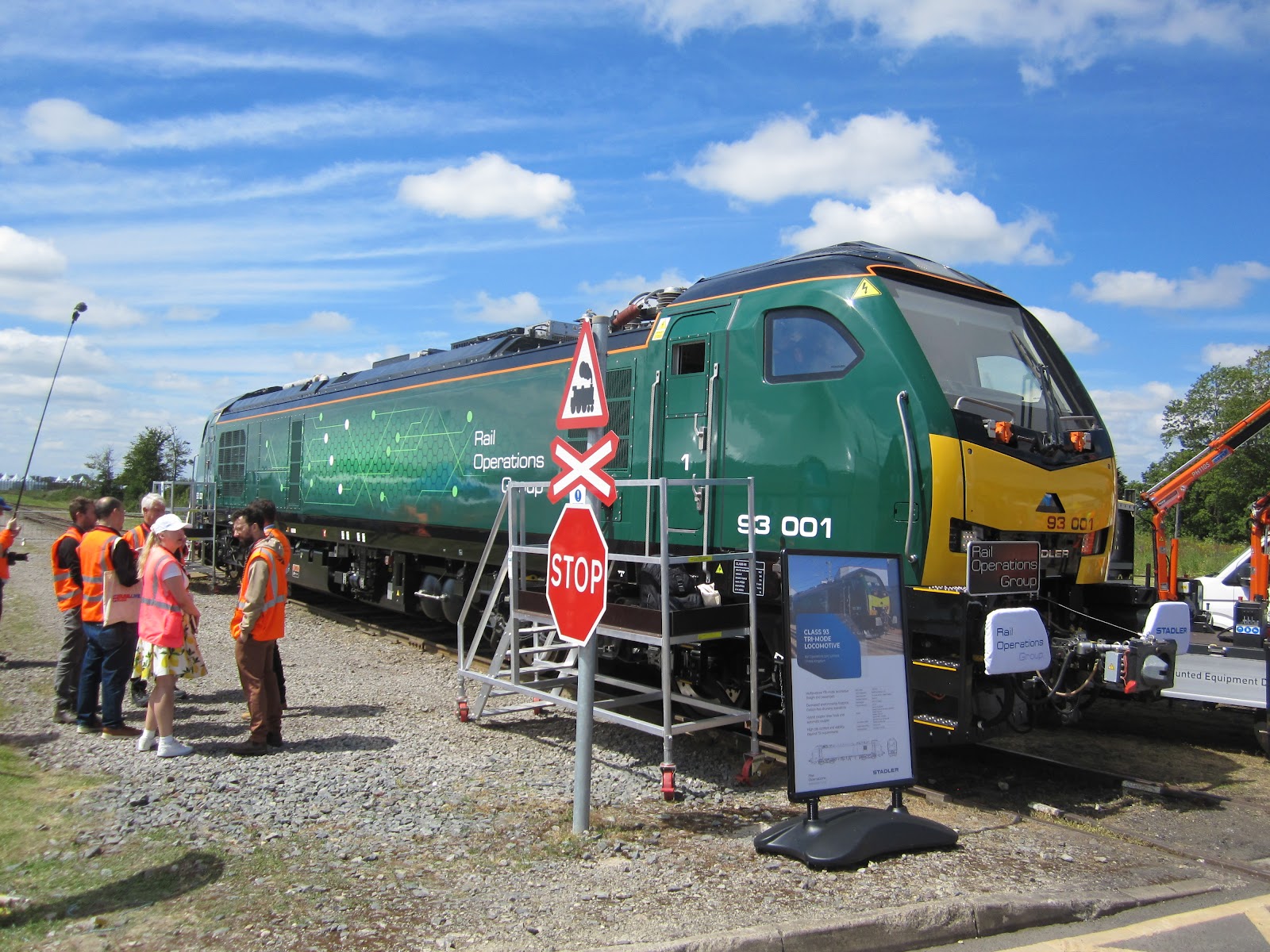
93.001, the first tri-mode (25kv electric, battery and diesel) UK locomotive. Maybe a diesel gala visitor in the future?
 

Thursday 20th June

Five of the team attended on the day of the summer solstice. However, we did not start work at sunrise!

The focus was on preparation for the build of a headwall on the cross drain 11B entry on the down side at Stanton.

Ian and Martin spent most of the day on vegetation clearance - first the remaining part of the down side boundary hedge/fence line from bridge 11 up to 11B. This is now sufficient to enable the dumper and mini-excavator access. They also pruned around the entrance to Stanton yard.

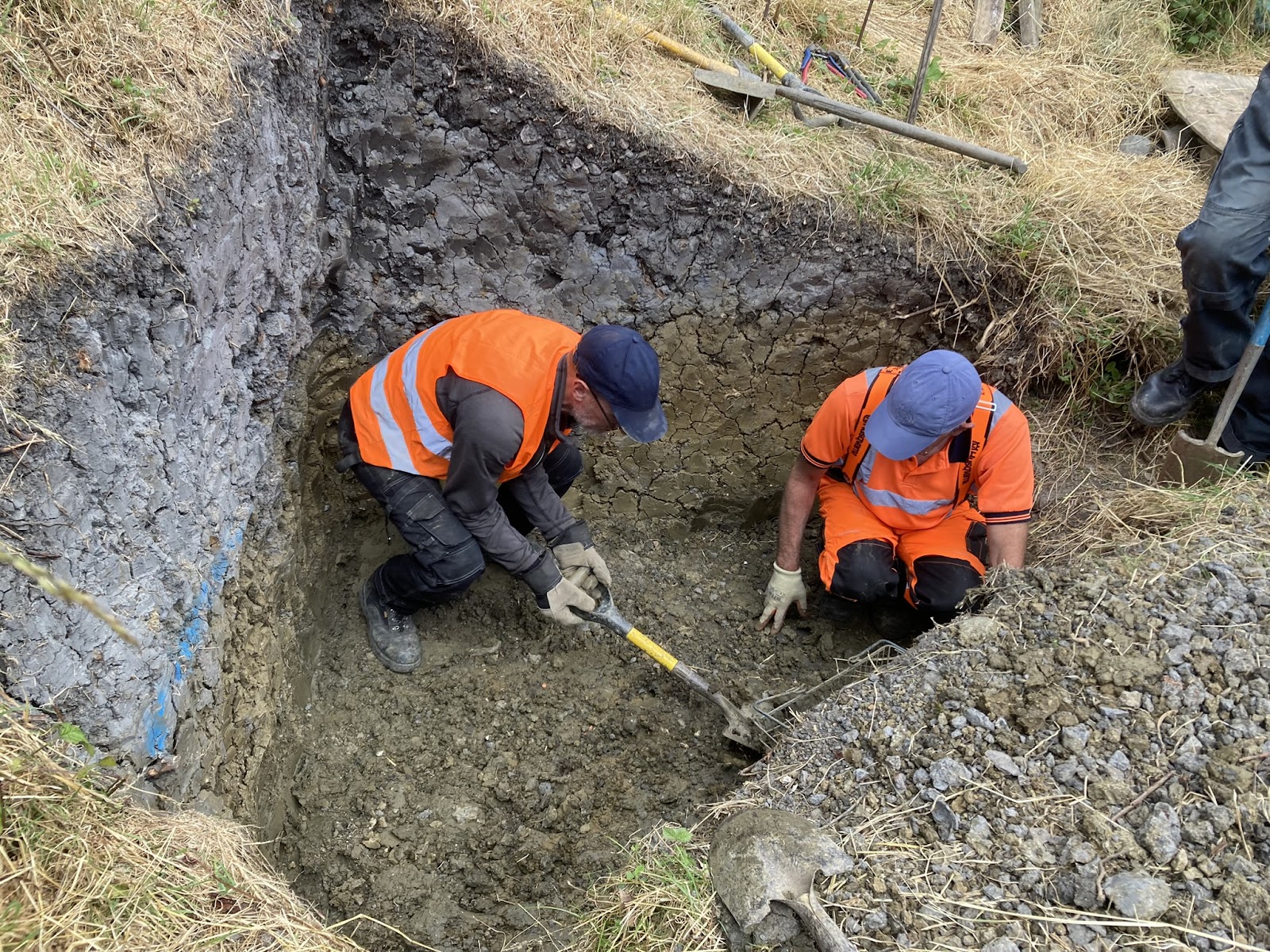
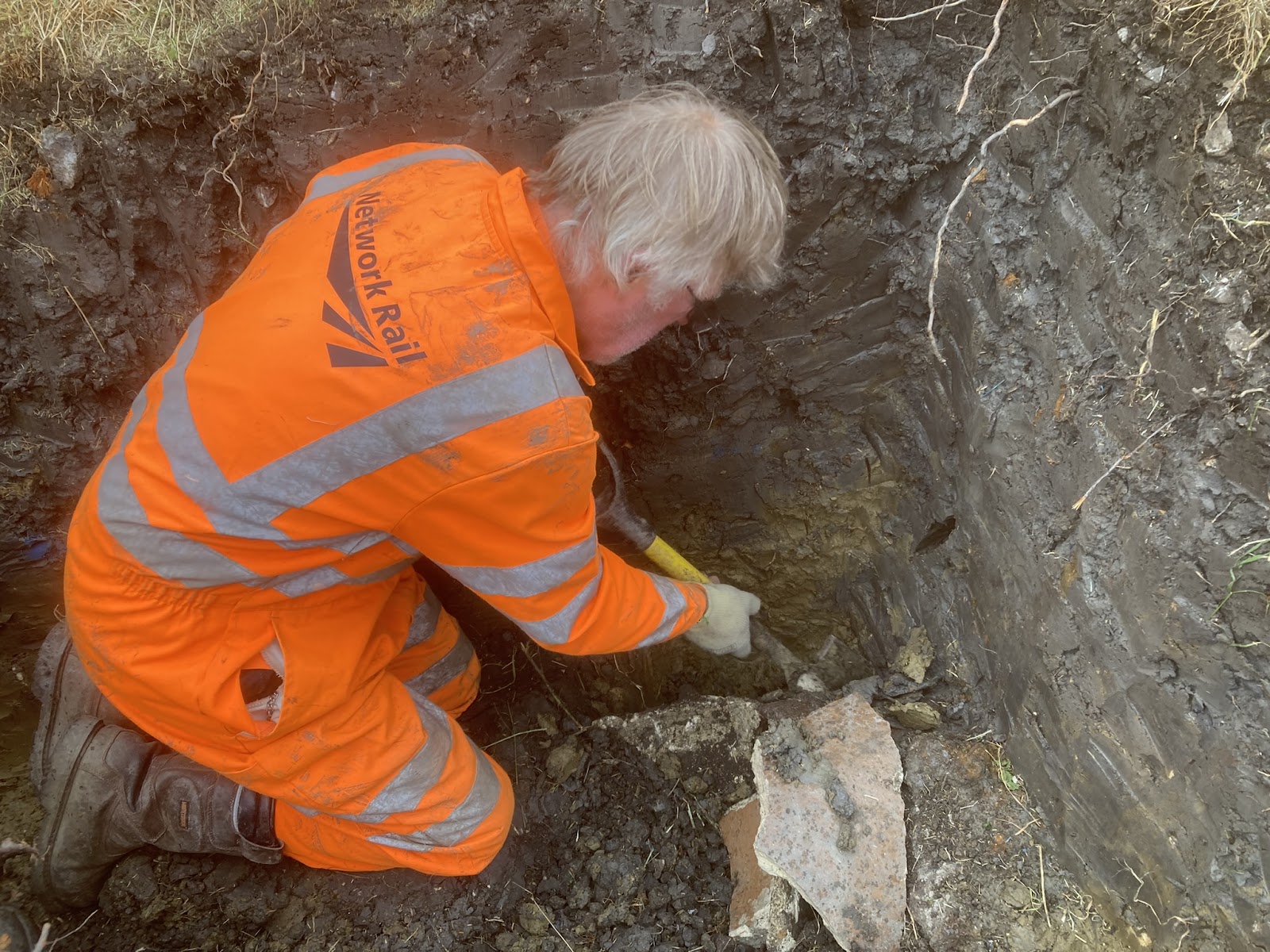
Roger, Dave and Andrew spent the day further excavating the area around the 11B inlet - mainly digging down to enable 100mm of concrete foundation below the bottom of the bore. This revealed that the first length of pipe we had left in the bore last week was actually broken, plus has a bad join to the second section and there was a large void above it. So it came out. This has meant a rethink on the alignment of the new headwall, but does enable a lot more concrete infill between it and the embankment. Even with assistance from Ian and Martin on completion of vegetation clearing, we still have some more spoil to shift next week. Despite the clay probably being the optimum consistency for digging, it was tough going work, especially in the heat of the afternoon.

Access along the boundary hedge/fence from bridge 11.

The old supermarket basket is now a temporary grill to prevent unwanted animal access.

Wildlife report: Solitary bee collecting damp clay; bumble bee; lots of unidentified insects in the long grass. Positively identified plants - Solanum dulcamara (Bittersweet/Woody nightshade) which is poisonous; Stachys sylvatica (Hedge Woundwort).
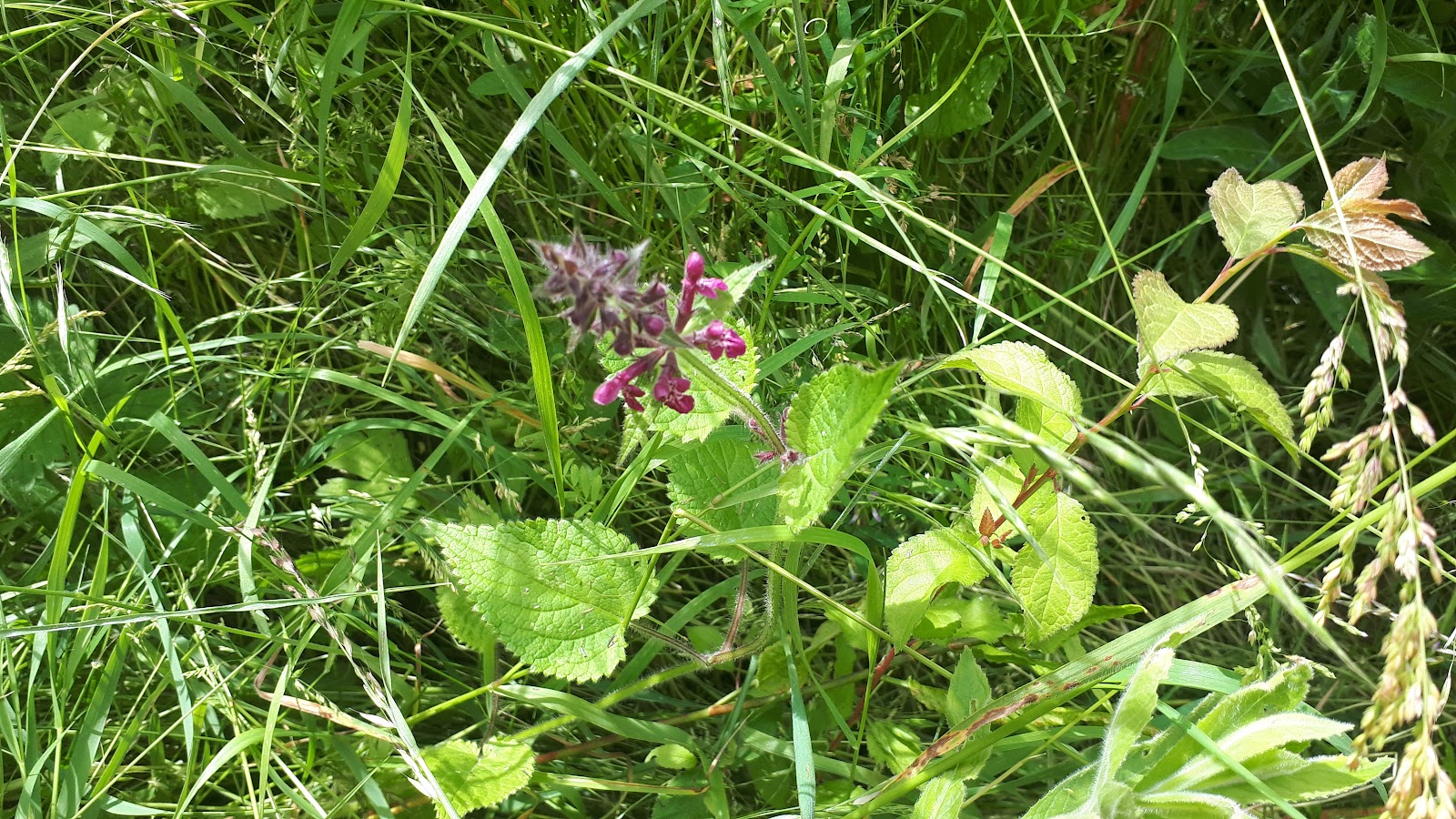
Hedge Woundwort [Photo by Roger]


Thursday 27th June

Seven of the team attending for a very productive and pleasant day. The weather was ideal for working outdoors, warm but not hot. It was also ideal conditions for concrete to set without drying out quickly.

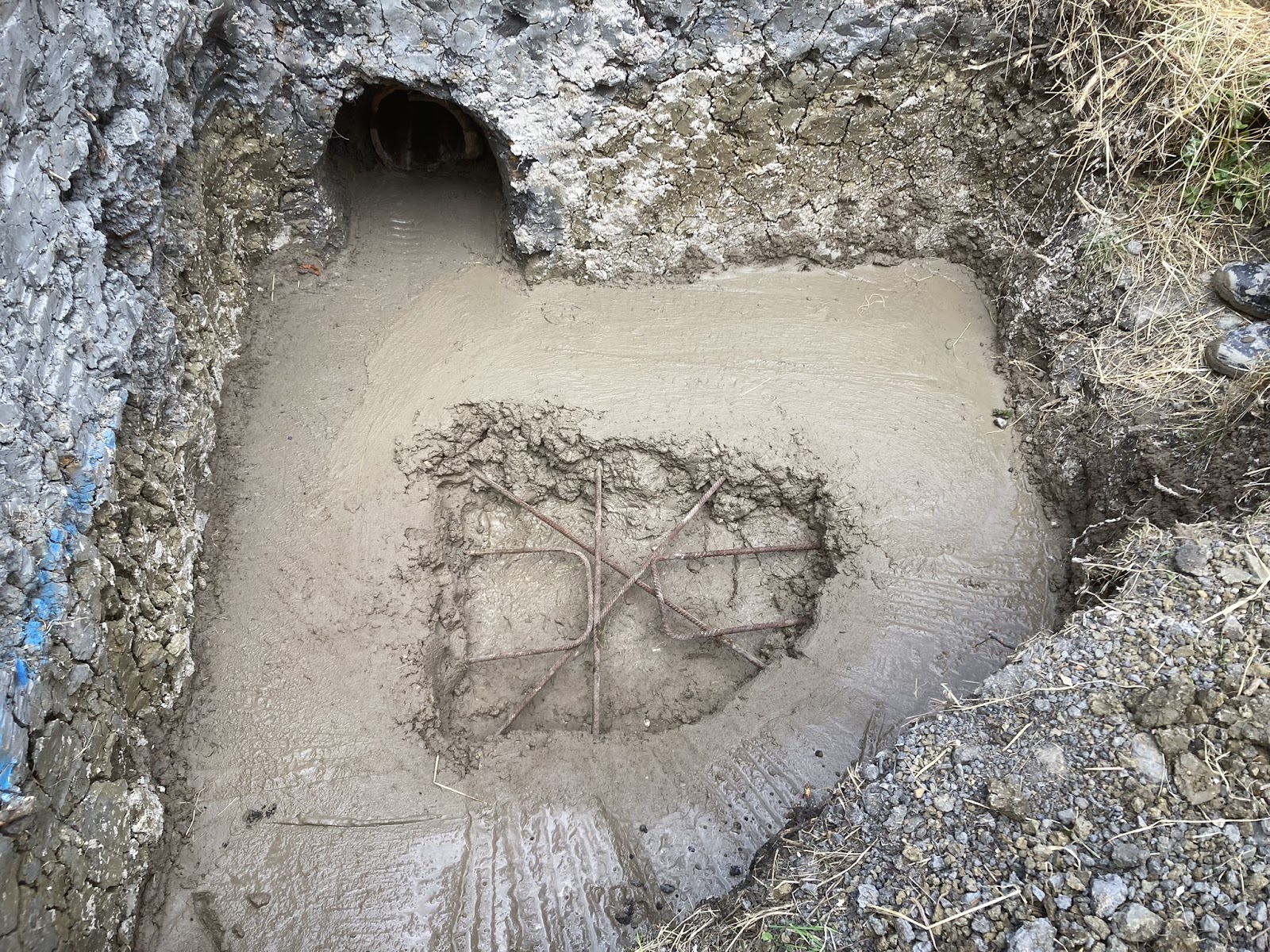
The main task was to complete the excavations of the cross drain 11B inlet at Stanton and to start the concreting of the base for the new walls. First item was to get all the materials and tools to the site. Unfortunately the slope up from the farm access track under bridge 11 to the down side boundary proved too steep for the dumper to negotiate safely. Hence we had to make an entry from the adjoining field through the fence near to the cross drain. The landowner of the field having granted access – actually he is keen to see us complete the work as it will improve drainage of his field. We used the dumper to bring in all the materials and with the cement mixer setup near the pit; this made the concreting straightforward. We modified a length of 9" diameter twinwall pipe to fit the remains of the original SGP - that will be inserted and grouted in next week. Also next week will be the final part of the concreting – this had to be achieved in two pours as the whole of the base of excavation will be filled. Doing that in one pour would not leave anywhere for someone to stand to tamp the surface. We placed reinforcing bar in the hole in the middle to strengthen the join between the two pours.
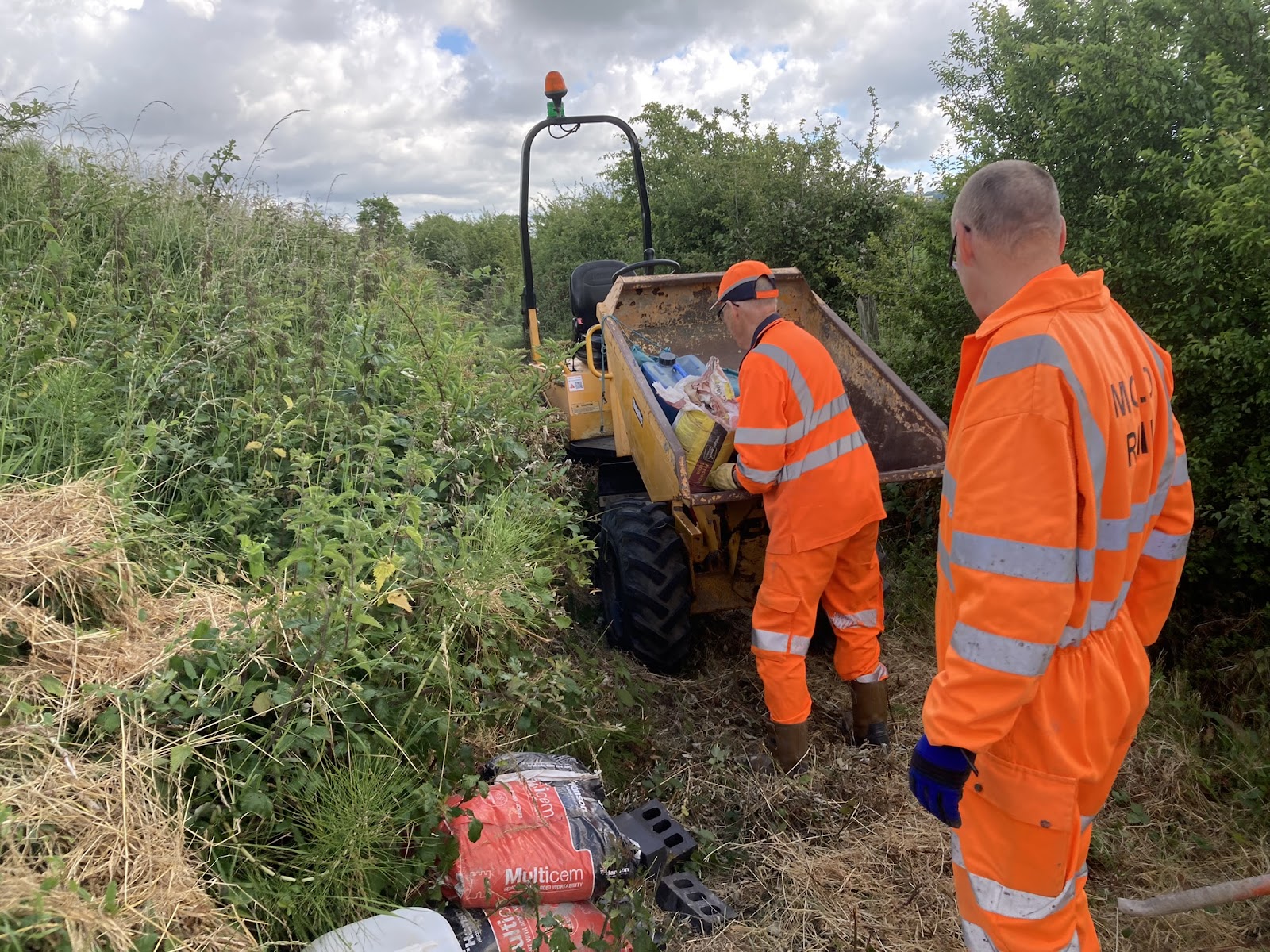
Ian and Jonathan unloading the dumper.

 
Further excavation around the damaged original SGP pipe.

Stuart and Martin complete the excavation of the pit.


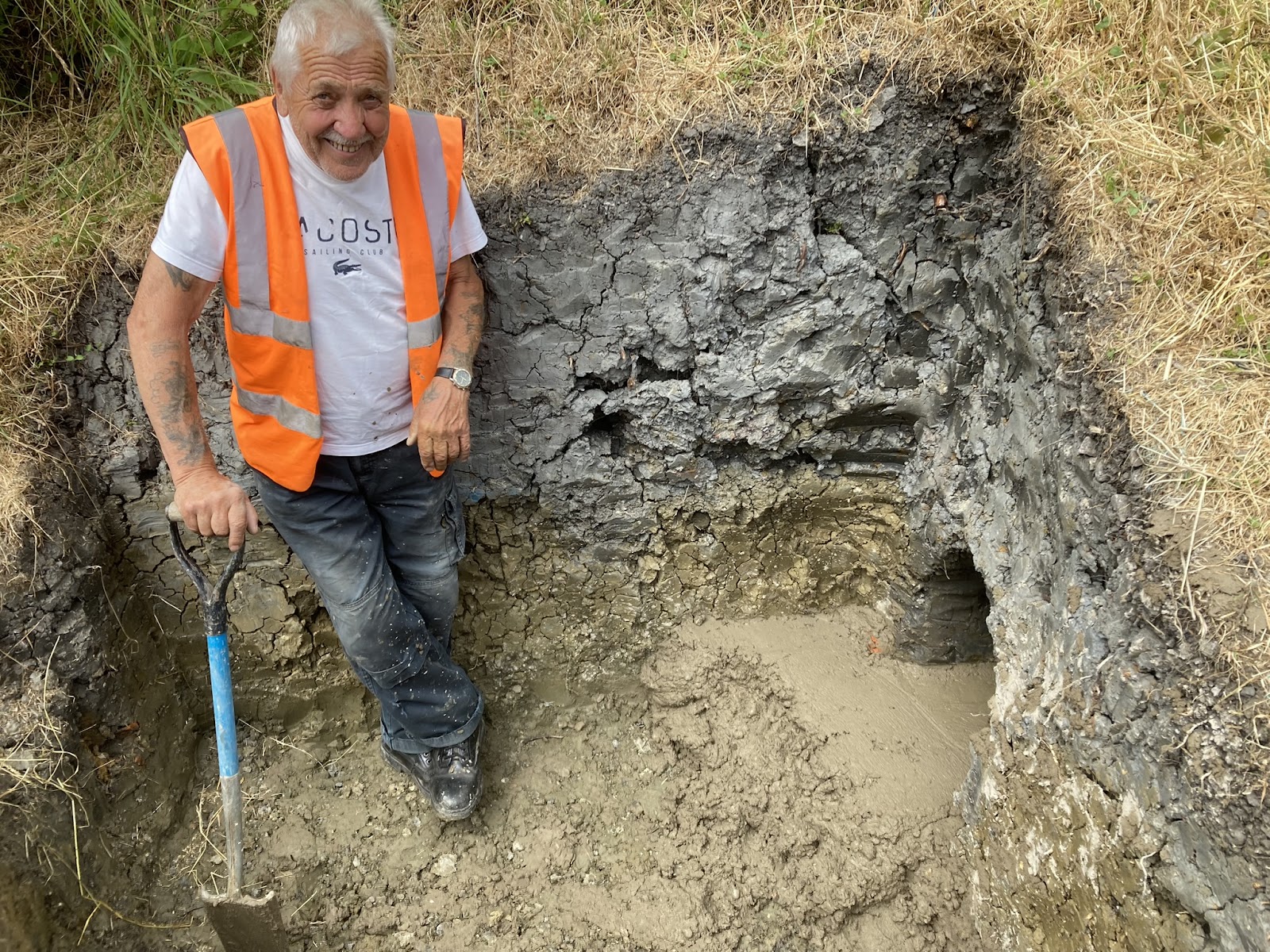
Polly takes a breather whilst awaiting more concrete for the footings.

Nigel, Stuart and Ian on concrete mixing.

Completion of the first pour of the concrete base. Reinforcing bar in the 'hole' for the second pour next week.

An odd job attended to was to refit the trespass sign on the low mileage gate of Gallery Farm crossing. At Winchcombe we took delivery of an order for more cement, now stacked in the old wooden shed. The 11B inlet build will use up quite a bit of this.

Wildlife report: Lizards and plenty of insects on the sunny embankment at Stanton.


Friday, 14 June 2024

Here and there


This time last year we were in the middle of our major project at Stanton, the up side diversion of the outlet of cross drain 11B. And the weather was hot and sunny! Finally in the past month we have commenced the work to improve the entry to 11B on the down side; plus alternating visits to Gotherington.

Thursday 23rd May

Another day with a magnificent seven in attendance! The very heavy rain of Wednesday daytime and evening fortunately had stopped - but its legacy was a lot of water flowing in all the watercourses, so we had to abandon all the planned jobs that required dry conditions.

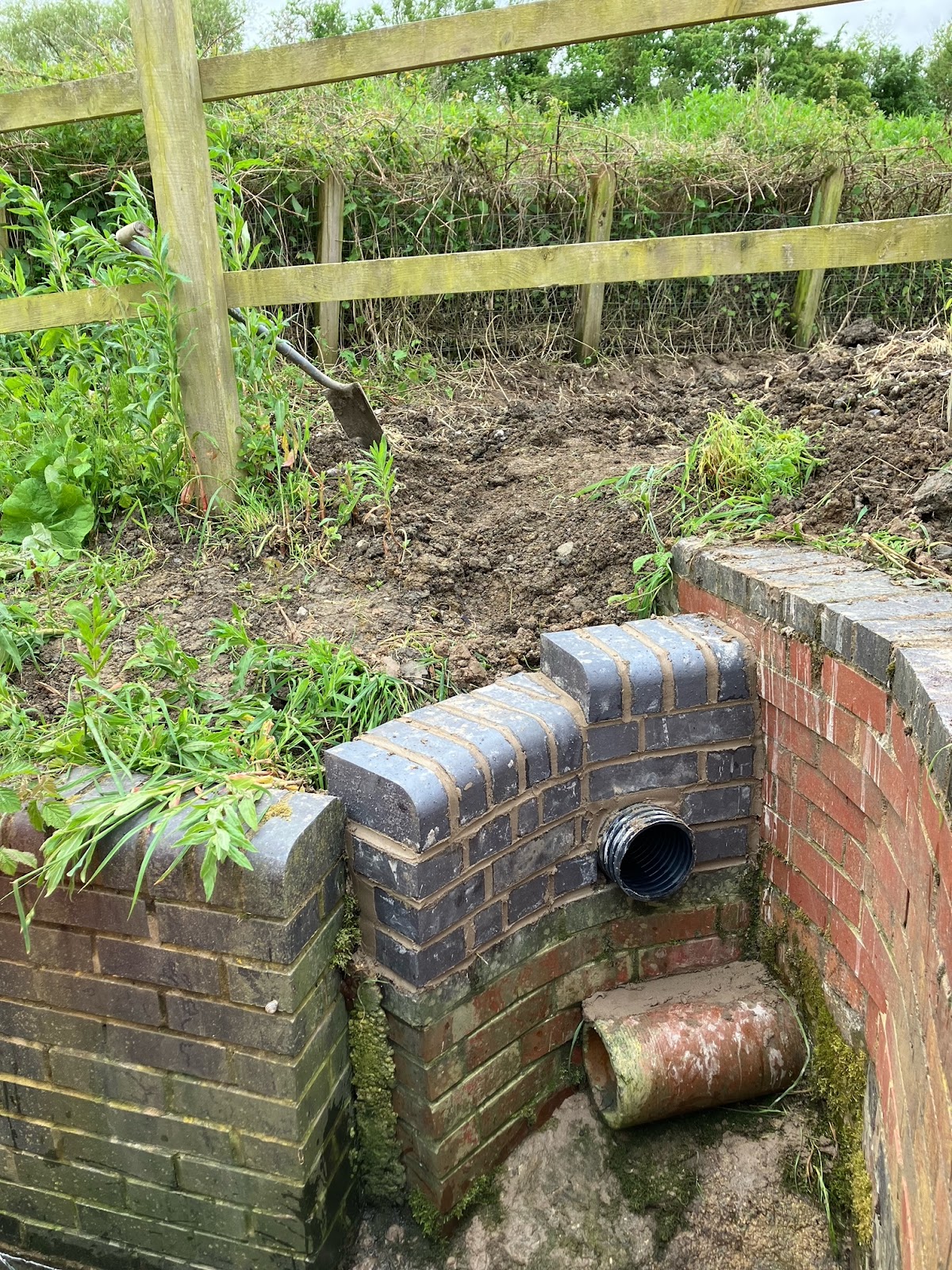
Dave, Nigel and Polly completed the additional brickwork on the inlet of cross drain 33A at Gotherington. This is where the pipe from the re-excavated boundary ditch on the high mileage end enters. What a neat job from out professional brickie!

Master bricklayer at work. [Photo by Dave]


The finished job - very neat. [Photo by Dave]

Martin, Jonathan, Roger and Andrew went to Bishops Cleeve to collect a part used dumpy bag of red building sand which had been donated. This was probably over two thirds full - so financially around £50 at least. Then on to the Rugby Club at Southam Lane to view the proposals for the cycle way which will cross the line at Cheltenham Racecourse on Evesham Road bridge 43. This is now going to be a shared cycle way and footpath on the east (low mileage) side; at normal kerb height (125mm). The road carriage way will be narrowed to accommodate it. As far as we are concerned the plans look good - there will be only one drain off the cycleway leading down to our down side cess. All the run off from the road will go into the existing road gullies.

All of the team then met up at Manor Lane. Here the most obvious sign of the previous days heavy and prolonged rain was the backing up in the entry of cross drain 36A. Water was flowing out from the exit at a similar rate to that we noted last week - but obviously the obstruction in the bore reduces the flow so hence the build up during wet spells. We were able to rod from the outlet side a greater distance than last week. The sticking point is approximately under the down side running rail - which was where the rodding from the inlet side stuck last week. We were not able to rod from the inlet side this week as the camber was full of water. However, it was very slowing going down. We also dis some investigation of the road side and field drains further up the hill to Manor Farm. Most of these seem to feed into the roadside drain which runs under bridge 36 on the high mileage end.

Inlet of 36A with water overflowing the chamber.
 

One task we did manage to complete was to repair the fencing on the up side of the foot crossing by cross drain 37C at 16m 28c. Finally back at Winchcombe we unloaded the acquired sand - now in two strong dumpy bags that have proper telelhandler loops. We also moved a recent delivery of GRP chamber rings from Aqua Fabrications, so all the drainage items are neat and tidy for when the gala visitors are in the yard.

Fencing repairs at the foot crossing at 16m 28c.

And on gala visitors - we we very pleased to see 6880 Betton Grange on a test run from Toddington.

Every blog has to have a picture of 6880!

Thursday 30th May

A smaller team of six attending due to holidays and post gala recovery for our multi-department members.

Polly, Nigel and Dave rebuilt the very end of the up side high mileage wing wall of Stanton Road Bridge.

Bridge 10, Stanton, repaired end of up side high mileage wing wall. [Photo by Dave]
 

Jonathan, Stuart and Ian inserted clamps on the blue mesh lids on the chambers of the 11B to 11A up side diversion at Stanton. So that part of the 11B project is finally complete. They then made a start on the down side by rodding the bore of 11B. This removed a lot of mud and other debris, but the rods stuck somewhere in the bore. Then they used the CCTV to examine the bore, this showed quite a few broken pipe joins near the inlet end.

Blue mesh lid clamped down. [Photo by Dave]


 Wildlife report: a very colourful scarlet tiger moth.
Tiger moth. [Photo by Dave]

Thursday 6th June

An even smaller team of four today, maybe those absent were attending D-Day 80th commemorations.

The work site was Manor Lane, Gotherington.

Jonathan used the mini-digger to reinstate the ditch in Manor Lane above the top gulley on the down (Cotswold) side. This will prevent some of the water running down the road to the lower bridge gulleys.
 

Cleared roadside ditch in Manor Lane.


Roger, Martin and Polly worked on clearing the bore of cross drain 36A from the down side chamber after pumping out the standing water. They removed around 150mm of silt from the bottom of the chamber. Unfortunately, all attempts with our two sets of drainage rods did not shift the obstruction. An attempt to use the CCTV was also abandoned; the CCTV cable is too short to use from the up (Malvern) side; and there is too much standing water upstream of the obstruction on the inlet (down or Cotswold) side. The obstruction is in the most inconvenient place, under the running line. We are now considering some options to ensure the bore is cleared and water flowing freely before yet more wet weather arrives.

Inlet of 36A, now no water overflowing the chamber.


Thursday 13th June

Seven team members in attendance. Jonathan and Polly went to Tewkesbury to collect sand bags which the borough council has supplied. They then joined the rest of the team (Nigel, Stuart, Ian, Martin and Andrew) at Stanton. Here we took advantage of a non-running day to have possession of the Broadway-Toddington section to enable excavation on the down side at Stanton. This is the rebuilding of the entry of cross drain 11B.

First task was to rod through from the up side using our heavy duty (red) rods to check for any obstructions in the bore. We temporarily removed the blue mesh cover and the top two concrete rings on the first chamber on the up side diversion constructed last year to enable a shallower angle for the rods.

Rods entering from the outlet (up or Malvern side).

42m (or 137 feet 9 inches for the heritage folk) of rods later the plunger emerges from the inlet (down or Cotswold side) - so the bore is clear.

Looking into the bore, before we removed the first length of SGP pipe.
Then some serious digging - by hand to minimise any damage to the 100+ year old SGP pipes and to ensure no collapse of the embankment. Actually the latter item was not applicable, the embankment at this point is mainly clay apart from an inch or so of spent ballast on the top, so it is stable. We removed the first length of broken SGP pipe, the old supermarket basket which had been the grill and the short length of big diameter SGP pipe which was the entry from the low mileage ditch. Probably this had been installed about 20 years ago as part of the build back to Broadway work. We discovered that alignment of 11B does follow an old field drain - the clays pipes for that are still there, slightly below and on the high mileage side of the bore.
High mileage inlet excavated - the supermarket basket was the inlet grill for this. Low mileage inlet in bigger SGP pipe was probably added during the Broadway extension work.

Nigel on archaeological digging revealing the old clay pipes of a land drain.


End of day - with the old supermarket basket as temporary grill. Our plan is to build an L shaped headwall here.

View from above - with safety marker tape in place.

Additionally we started clearing along the down side boundary hedge/fence back to bridge 11 to allow access by the minidigger and the dumper. We did not quite get back to bridge 11 - as the vegetation was quite extensive. The dumper will be used to bring in all the materials as the embankment is too steep; plus other work days will have trains running. (One team member did remark the team's productivity is higher on non-running days as we don't have to stop working when trains pass!)

Partially cleared route alongside the down side boundary hedge/ditch to enable access with the mini digger to excavate the ditches and with the dumper to bring in sand, cement and bricks.
 

Wildlife report: a surprisingly high number of worms and various insects in the clay; plus spiders in the bore. Skylarks singing overhead and rabbits encountered before work started.


Tuesday, 21 May 2024

Cuckoo

In April,
Come he will.
In May,
He sings all day.
In June,
He changes his tune.
In July,
He prepares to fly.
In August,
Go he must.

The Cotswold cuckoos may have arrived in April, but it was the second week of May before we heard one singing. That was at Bishops Cleeve. The same day we sighted swifts for the first time this season. All we need now is one swallow to make a summer!

Thursday 2nd May

The heavy overnight rain on Wednesday night/early Thursday morning, coupled with a reduced attendance, meant a slight alteration to the day's plans. Five of the team arrived at Winchcombe in pouring rain, at which time working indoors seemed preferable. But within an hour, the rain stopped so we headed to Gotherington Yard. However, we did not take the excavator as planned.

The first task of the day was to repair a down side boundary chamber on the low mileage of culvert 33B. This involved removing a small ash tree - it was dying with ash die back. The rebuild of the top two courses was achieved mainly with the original bricks. The left over mortar was then used to repoint a down side cess chamber and the up side exit chamber of cross drain 33A.

Repaired boundary chamber at Gotherington; stump of ash tree shows how close that was to the structure.

In preparation for the re-excavation of the down side boundary ditch to take field run-off back to the inlet of cross drain 33A, we cleared some overhanging vegetation (ash, hawthorn, bramble and elder). Also we began cutting a shallow trench to take a pipe from this ditch into the 33A inlet.

Martin digs the trench for the pipe to take the water from the ditch into the entry of cross drain 33A.

Finally whilst at Gotherington we checked on the condition of the up side slip in Dixton cutting. All posts upright and inline and no obvious signs of further movement.

The Dixton slip (Malvern, up side). A couple of miles away there is a much bigger slip in one of our neighbour's field.

35006 P&O SN Co. approaches Gotherington Yard.

 After lunch we carried out an explorative trip to Millham Park at Bishops Cleeve. This is on the up side, and the southern boundary is where the stream which flows through culvert 38A exits. The parish council have given us permission to take a vehicle across the playing field upto the railway boundary so that we can clear the stream and view the outlet of the culvert. The objective of the trip was to determine the best vehicle access and to see what is going to be involved in clearing the stream. It certainly is a job for wellies - and best when the water level has dropped.


Milliham Park before clearing - the extension to the exit of culvert 38A is under there somewhere.

Wildlife report: Gotherington - woodpecker heard (but as usual not seen); crows and rooks. Blue-grey worm (Octolasion cranium). In the undergrowth near the boundary hedge/fence we identified Snakeshead (Arum maculatum), and Solomon’s Seal (Polygonatum multiflorum).
Bishops Cleeve - flock of starlings.
River Isbourne - wild garlic  (Allium ursinum) in flower (and aroma!)

Thursday 9th May

Six of the team enjoyed on the warmest and sunniest work day so far this year. An ideal day for working near, and with wellies, in water courses.

Jonathan, Dave and Martin initially headed to Millham Park, Bishops Cleeve to tackle the clearance of the exit of culvert 38A. At some point in the past this culvert was extended beyond the railway boundary and the garden of the last house on Oxmeads Close constructed on top. Bishops Cleeve Parish council have granted us permission to take a vehicle across playing field from the parking place at Bootenhay, off Millham Road. The task was to clear vegetation from around the exit and to visual inspect the extension. Also obstructions downstream alongside the park were removed and partial clearing of the area between the boundary of the park and a gate which leads from Oxmeads Close. This exit is now accessible for external and internal inspections, however a close inspection of the original headwall is not possible without entering the extended culvert.

Milliham Park after clearing - the garden is over the top of the extension of culvert 38A.[Photo by Dave]

Looking inside the extension of culvert 38A.[Photo by Dave]

Meanwhile Polly, Nigel and Andrew went to the Rive Isbourne bridge to complete the replacement of the coping stones on the low mileage up side wing wall. Also undertaken was re-pointing of some cracks in the wing wall - at least as far as could be reached. Measurements for the missing portion of safety fence were take - this is the part that was left during the flood alleviation works a few years ago. Apart from installing this section of fence; the wing wall repair here is now complete.

The gap for the last coping stone to be replaced.

All complete.

 
Chief bricklayer Polly (l) and chief mortar mixer Nigel with the results of their labour.

After lunch the combined team worked on removing silt and debris from the River Isbourne adjacent to both banks on the exit (up or Malvern) side. Also we improved the steps down from the vacant track bed to above the up side headwall. And finally we tightened the bolts and grub screws on the fence around the end of the down side bay platform at Winchcombe station (by the Father Christmas coach).

Thursday 16th May

Seven of the team in attendance, split into two groups either side of Gotherigton Station.

2807 on a down train at Manor Lane.

Jonathan, Roger and Martin used the mini-digger to excavate a boundary ditch on the down side high mileage of culvert 33A at Gotherington. This will take the run off from the field into the inlet of culvert 33A. The final connection is a length of 225mm twinwall pipe - completion of bricking around the exit of this to be done next week.

The new (or rather reinstated) boundary ditch on the high mileage down side of cross drain 33A.

Nigel, Polly, Stuart and Andrew went to Manor Lane at Gotherington. First task was to effect a repair to the top brick course of the roadside chamber of cross drain 36A. This is on the up side by the corner in the road and the field gate. This is where the ditch flows into and joins roadside gullies in a pipe under the corner of the field. Two blue mesh lids were added - with the old thick concrete ones on top as weights.


Roadside exit chamber of cross drain 36A with repaired top course.

Blue mesh covers deployed - with the old concrete lids as weights.

The rest of the day was spent rodding the under railway section of cross drain 36A. This has got an obstruction - somewhere! The inlet chamber on the down side has standing water to over half of the bore diameter - so this prevents use of CCTV unless pumped out first. We rodded 11m from the down side entry (12 lengths of our black rods); before hitting an obstruction. This is approximately underneath the down side rail. On the up side we rodded 27m from the exit (30 lengths of the black rods); this gets to inside the current fence line. Potentially there is a bend and/or join at that spot; as we believe the bore was extended some time in the past. (Location approximately at end of rods in photo below).


Nigel holds the drain rods to show the approximate location of the obstruction on the up side of cross drain 36A.

Wildlife report: Small toad at culvert 33A; Wild roses in bloom at Manor Lane; and yet another woodpecker heard but not seen!

Toad - but not a GWR brake van! [Photo by Martin]