As one year draws to a close and new one beckons, the current
convention is for publications to publish a review of the year. So
the next paragraph is our short review of 2023.
Wet.
Strictly not wet every day or even every working day. However,
with the rainy and unsettled period in the summer (coinciding with
the school holidays from mid July to end of August) and the early
autumn storms, just wet seems an apt summary. Few people will
remember the fine, sunny, warm spells which we did experience;
particularly the mini-heatwave at the beginning of September.
One advantage of such wet spells is that we can see how well the
railway’s drainage system is working, and where the bottle necks
are.
I hope you have enjoyed reading our posts this year. Wishing you
all Season’s Greetings and have a healthy, peaceful and prosperous
2024. And join me in asking Santa for more drier weather next year.
Thursday 16th November
Contrary to my introduction to this post, for the first time in a
number of weeks we had a working day with no rain.
Roger, Martin. Stu and Ian were attending a brush cutter operative
course provided by Greenway, all achieving the LANTRA qualification.
The course also covered user maintenance, and as a result we are
making some changes to our procedures. This should reduce the visits
to a Stihl main dealer to once per year per machine.
Dave, Nigel, Jonathan and myself had a varied and productive day
at a variety of sites on the railway. First of all was the raising of
a crest chamber on the down side between Winchcombe and Greet tunnel.
This had been hit by Tom Clark's robo flail. Four additional concrete
rings were added - the vegetation will have to grow a lot to obscure
it now. The other crest chambers towards the tunnel were checked -
all will need raising, but only be one or two rings.
 |
Raised crest chamber on down side between Winchcombe and Greet tunnel.
|
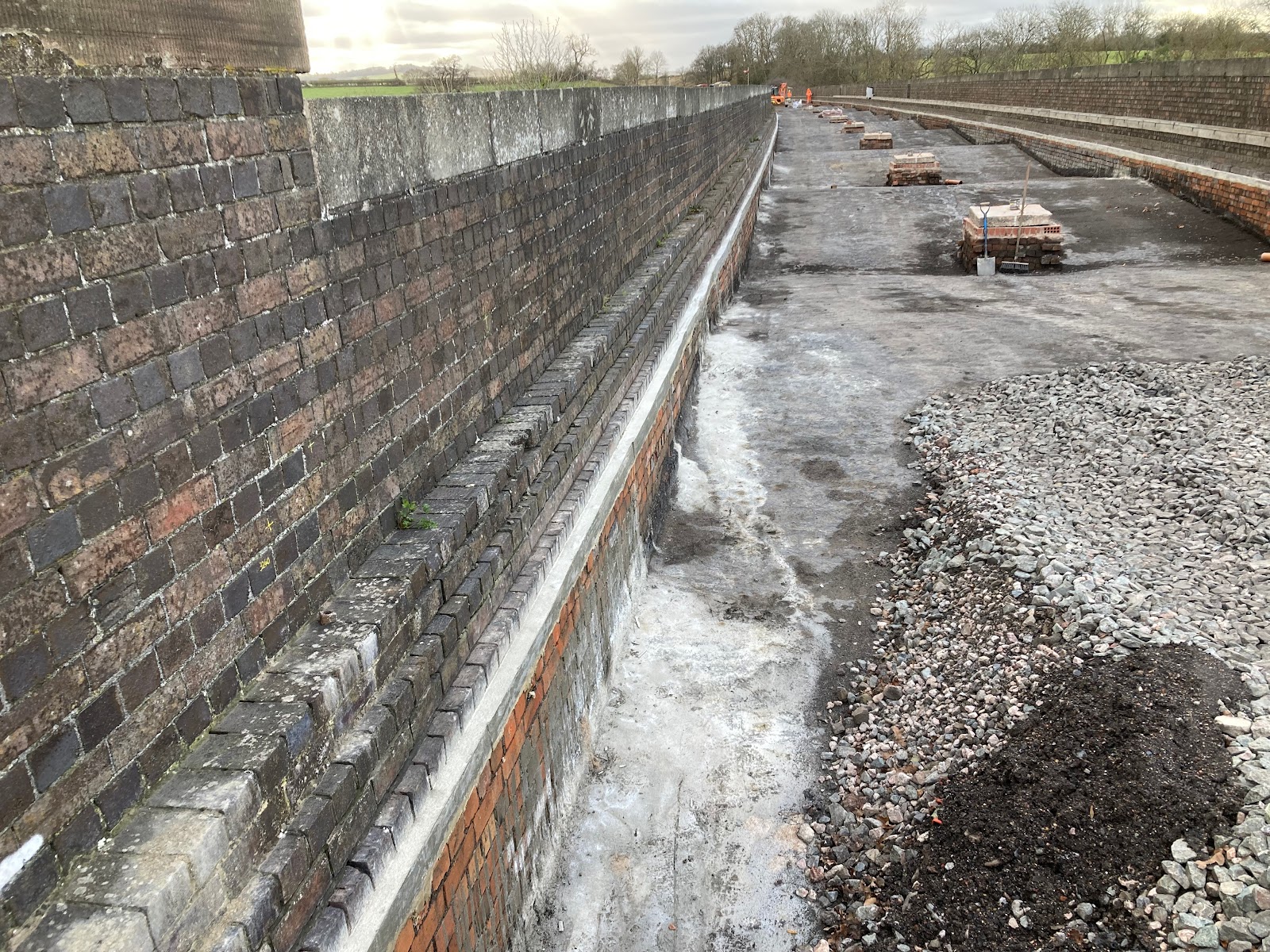
Second item was to Stanway viaduct to collect some material that
Walsh had surplus after constructing the set of steps on the low
mileage end of the down side. This consisted of different lengths of
galvanised tube and substantial timber boards; plus handrail
fittings. These are now stored - they
will be ideal for making some headwall safety handrails or makers.
 |
Stairway to Heaven? No - the new steps to Stanway viaduct down side low mileage end.
|
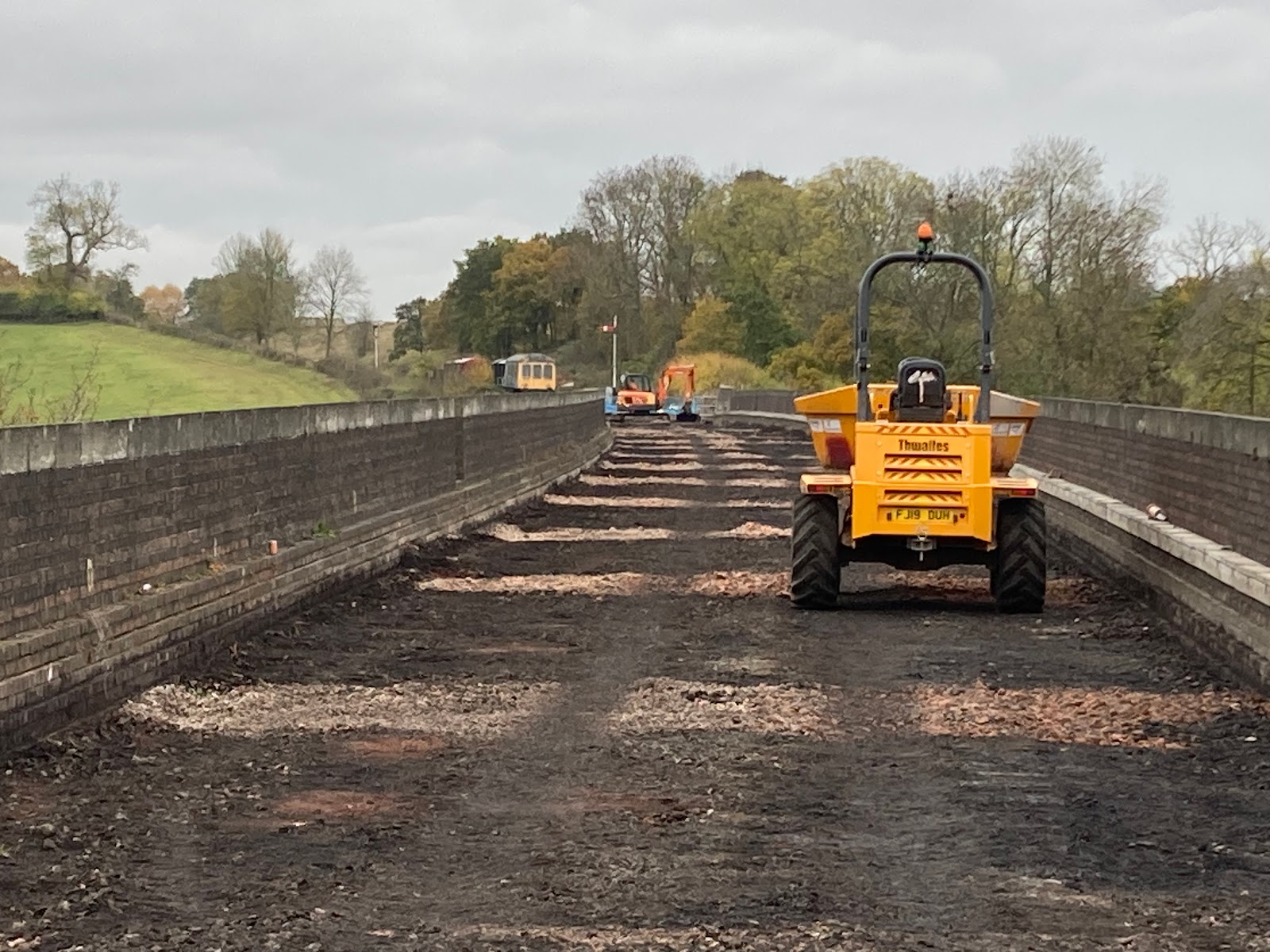 |
Walsh's progress on the viaduct (as of 16 November); just after the extra work on the parapet was discovered.
|
Third item was to continue with the culvert/cross drain internal
visual inspections and clearance. Cross drains 25B and 25C which were
cleared last week were inspected. Cross drain 27A and culvert 27B
south of Gretton were cleared and inspected. On the later two there
was significant vegetation growth on the down side alongside JJ
Farms. Very apparent how much more water there is this autumn. This
is making photographing the inside of the culvert bores difficult or
impossible in some cases. Perhaps we need to invest in a selfi-stick!
Photo of culvert 27B up side (below) was taken by reaching down from
the headwall.
 |
Looking into culvert 27B from the exit end (up side).
|
On the way back from Gretton we stopped at Prescott Road bridge
(32) for a quick inspection of culvert 31B. Following the work
earlier this year on the exit to the roadside pipe/ditch this is
flowing much better. Clearing the build up of debris on the grill to
the roadside pipe and racking out some reeds from the pit increased
the flow even more - essentially no standing water in the pit.
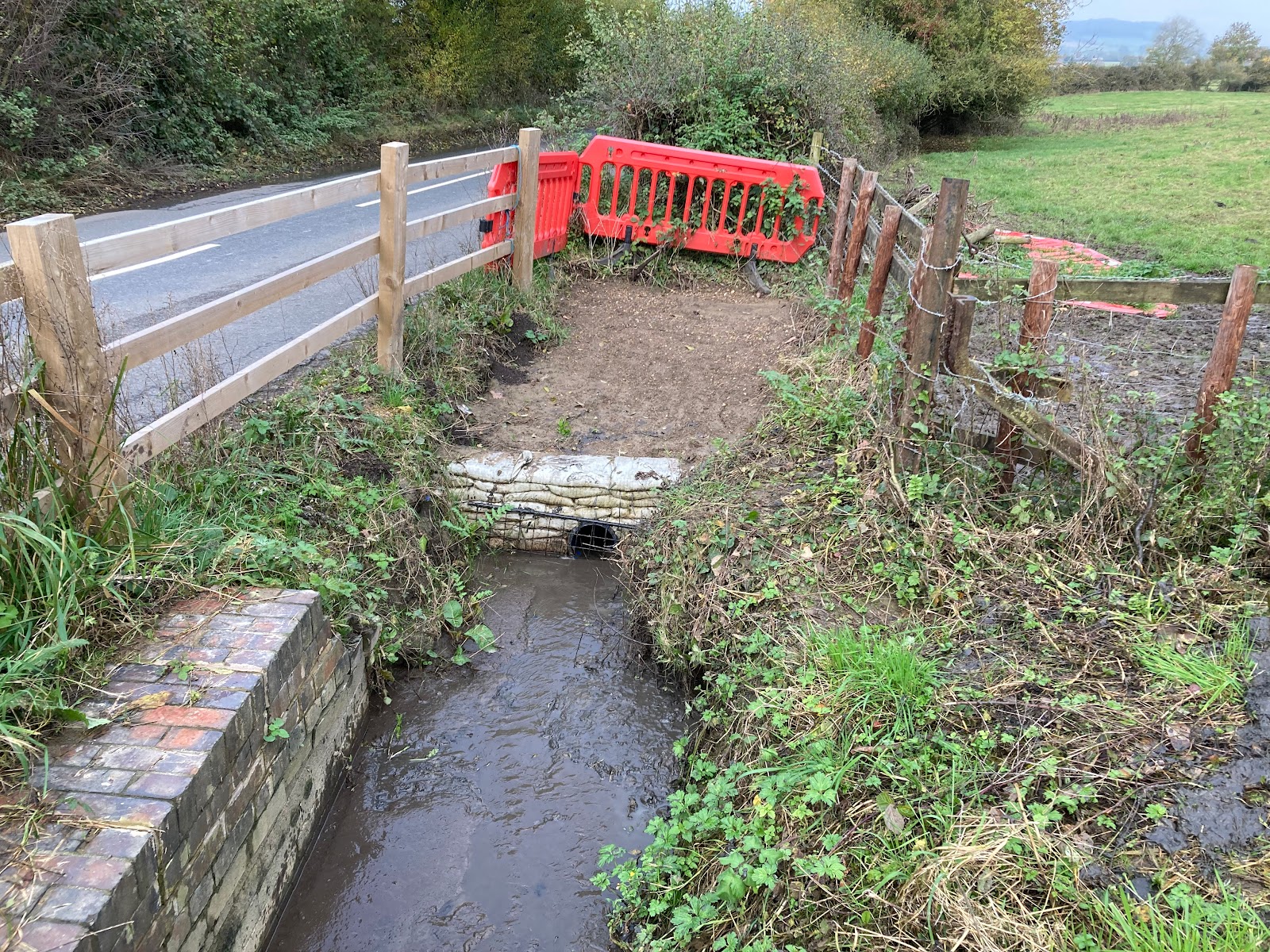 |
Culvert 31B outlet, the entrance to the roadside pipe, Prescott Road. Just needs some replacement fence.
|
Finally near the Tirle Brook culvert (32A) we found a cess chamber
which also had had a close encounter with a robo flail (or was it the telehandler?) We reset the
displaced top concrete ring. It will require a further visit to add
another ring on top and to fish out the heavy thick lid which has
fallen into the chamber. Despite these chamber hits, the robo flail
provides some impressive results - picture below shows the cleared up
side embankment at Working Lane.
 |
Working Lane showing the cleared embankment on the up side low mileage end of bridge 25. Amazing what a robo flail can do!
|
Wildlife report (all Gretton)
Rabbits - with quite a bit of
evidence of burrowing mainly on the down side cross drain 27A and
culvert 27B.
Kestrel.
Woodlice - underneath a toe ditch slab,
which was useful to show that this was just damp and not flooded.
Thursday 23rd November
Just a small team of four (Nigel, Martin, Dave and myself) working
on drainage items - plus another two members of the team involved
with the accident exercise (Jonathan as a casualty and Roger as first
responder). At least this meant we could comfortably fit into one
vehicle.
First item was to measure the ditch in Winchcombe Yard behind the
site of the new S&T building. This is to get accurate estimate
for quantity of concrete canvas to order; this to make the ditch
water tight from the exit from Churchward House to beyond the new S&T
building.
Then out to Gretton for the main tasks of the day; clearance and
visual inspections of cross drains 27C, 28A, 30B and culvert 30A. The
good news is that there is no obvious deterioration in these
structures. What is obvious is the vegetation growth this year has
been more than last year; and that all the water courses are flowing
faster or deeper - apart from 28A inlet. (Picture below shows the
small dribble entering the inlet chamber).
 |
Inside the entrance chamber of cross drain 28Aon the down side at Stanley Pontlarge. Input from the stream brings plenty of sand and gravel which eventually collects in the outlet chamber several hundred yards away.
|
At cross drain 28A we removed a lot of sandy silt from the exit
chamber (by the roadside entrance to the small holding). At
culvert 30A we created a new access from track level to the boundary
fence of the private road which runs under bridge 30. This is on the
down side high mileage end. This embankment is steep here - there are
sudden drops nearer the bridge and all four wing walls of the bridge
are high and narrow and have no fences. The new access terminates at
one of the headwalls of the down side toe drain that runs between
cross drain 30B and culvert 30A. This would be a sensible site for a
new set of steps such as that at Stanway Viaduct.
 |
The new access route by bridge 30, down side high mileage.
|
Then it was on to Prescott Road bridge to measure up for the
replacement fence sections around the exit of culvert 31B.
Finally at Dixton cutting just on the low mileage side of the
Tirle brook (culvert 32A) we recovered the thick heavy chamber lid
from the cess chamber which the robo flail (or telehandler) had hit. We also raised
the height of this chamber by one additional concrete ring.
 |
Dixton cutting up side cess chamber - raised in height but still using the heavy (BR or even GWR era) thick lids.
|
Wildlife report
Being a sunny day there was plenty of bird
activity. Raptors in particular, we spotted a red kite, a buzzard
being mobbed by crows, and a kestrel who appreciated the clearance of
30A improving visibility of small mammals from his perch on a dead
tree. There were lots of pheasants on the lineside (and in the four
foot) undisturbed by trains.
Thursday 30th November
Certainly the coldest day for a long time and almost a full
turnout (8), the best for a couple of months.
First an unplanned job - to fix yet another cess chamber that had
had a close encounter with either the robo flail or the telehander or
one of the road vehicles. So Roger, Jonathan, Stuart and I headed to
Chicken Curve where we found the chamber where the up side cess
drains off to cross drain 20B at 11m35c. Two lids were broken; so as
a temporary repair these were removed and a blue mesh grid placed on
top weighed down with the one unbroken lid.
Meanwhile the other four (Ian, Dave, Nigel and Martin) had headed
to JJ Farms Bridge to commence the internal inspections and clearance
of cross drains and culverts for the day. First off was cross drain
31A. Then on to Prescott Road bridge where the other four arrived to
tackle culvert 31B. Here the operation was recovering the sections of
red barriers which were the temporary fence and to erect a new
section of roadside fence and restore the railway boundary fence
which runs over the new sandbag headwall of the roadside pipe. The
roadside chamber on the inlet side (down side, low mileage) was
cleared and inspected - significant amounts of Hydrogen Sulphite
detected. The source of this was traced to foul water in the roadside
ditch on the other side of the road (high mileage); this flows into a
small pit together with the (dry) down side high mileage toe drain,
then under the road to the chamber. Source of the foul water is
outside of the railway boundary - we reported this to Severn Trent
(which took some effort!).

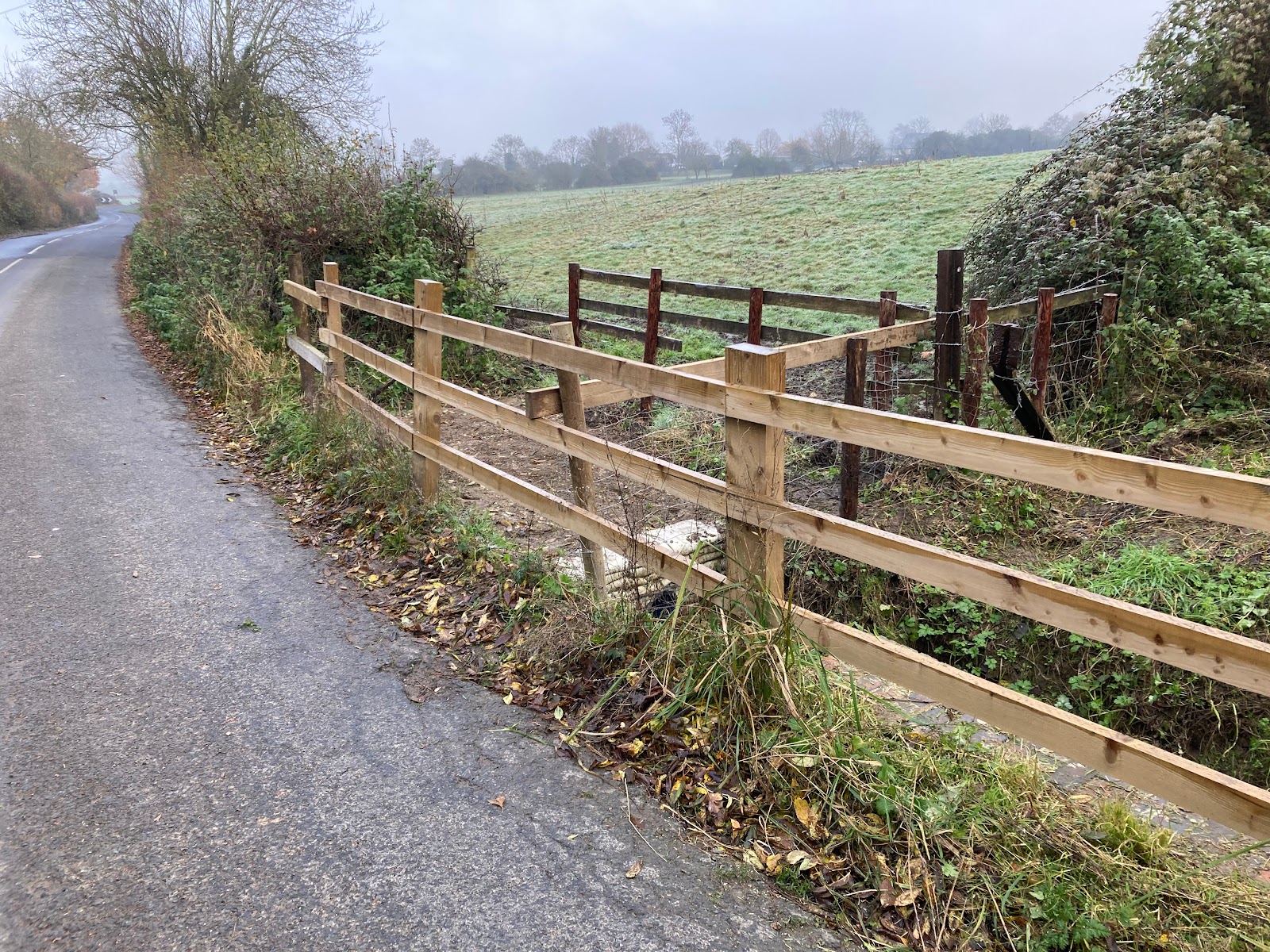 |
All done at culvert 31B, Prescott Road, with the new sections of fence.
|
Then on to culvert 32A, Tirle Brook flume culvert in Dixton
Cutting and finally after a short lunch break cross drain 33A and
culvert 33B at Gotherington Yard. All required significant vegetation
removal, otherwise no apparent deterioration in condition. One
exception is a chamber by the down side boundary fence on the toe
pipe leading to culvert 33B. This needs a course of bricks replaced
by a concrete ring or two and a new lid (or blue mesh). Also there is
a small tree growing on the line of the pipe which needs needs
removing - a job for our chain saw operatives, probably after
Christmas.
 |
Jonathan and Dave clearing out the inlet (up side) of Tirle Brook flume culvert 32A. Fortunately although the flow was fast, it was not deep.
|
 |
A lovely small and neat outlet headwall - and in good condition. Culvert 33B at Gotherington.
|
 |
The inlet of 33B is on the west side of the road, one of the few headwalls constructed from stone (or fake stone) blocks. This is just inside the railway boundary of the triangle of land forming the high mileage down side wing wall of bridge 34.
|
Thursday 7th December
Unlike last week, this week saw only a small team of five. So we
did not split into groups. Additionally to avoid a soaking in the
afternoon, we finished outdoor work at lunchtime. The afternoon was
indeed one of the wettest this year.
First we headed to Stow Road Bridge (13) at Toddington to
investigate raising the down side cess chamber. We cleared some of
the silt that comes from under the side arch of the bridge during
heavy rain. Then measured up for plan A, which is to add a concrete
ring modified to pass the S&T cables underneath. The S&T
cables run directly above the existing grill. Then with a metal or
blue mesh cover; the chamber will be at the same height at the S&T
trunking enabling additional ballast to create a better walkway as
this is right by the uncoupling point for 7 coach trains.
Unfortunately checking against a concrete ring has meant a move to
plan B. The cutout to clear the S&T cables would completely wreck
the integrity of the concrete ring.
 |
Down side cess just by Stow Road bridge at Toddington showing the two issues. (1) S&T cables passing over the top of the grill. (2) Plenty of silt washed down the cutting side from the road above.
|
Next was the continuance of the culvert/cross drain clearance and inspection programme. The first
one this week was cross drain 14A - no need for clearance here as the
Wednesday clearance team have done a splendid job all along the down
side fence from Toddington Signal box. What we did need to do was to
reset the top five concrete rings as these had become displaced and
unstable. This was not an easy option with several inches of
potentially foul water in the ditch. We applied our additional PPE
and disinfectant procedures when dealing with potential foul water.
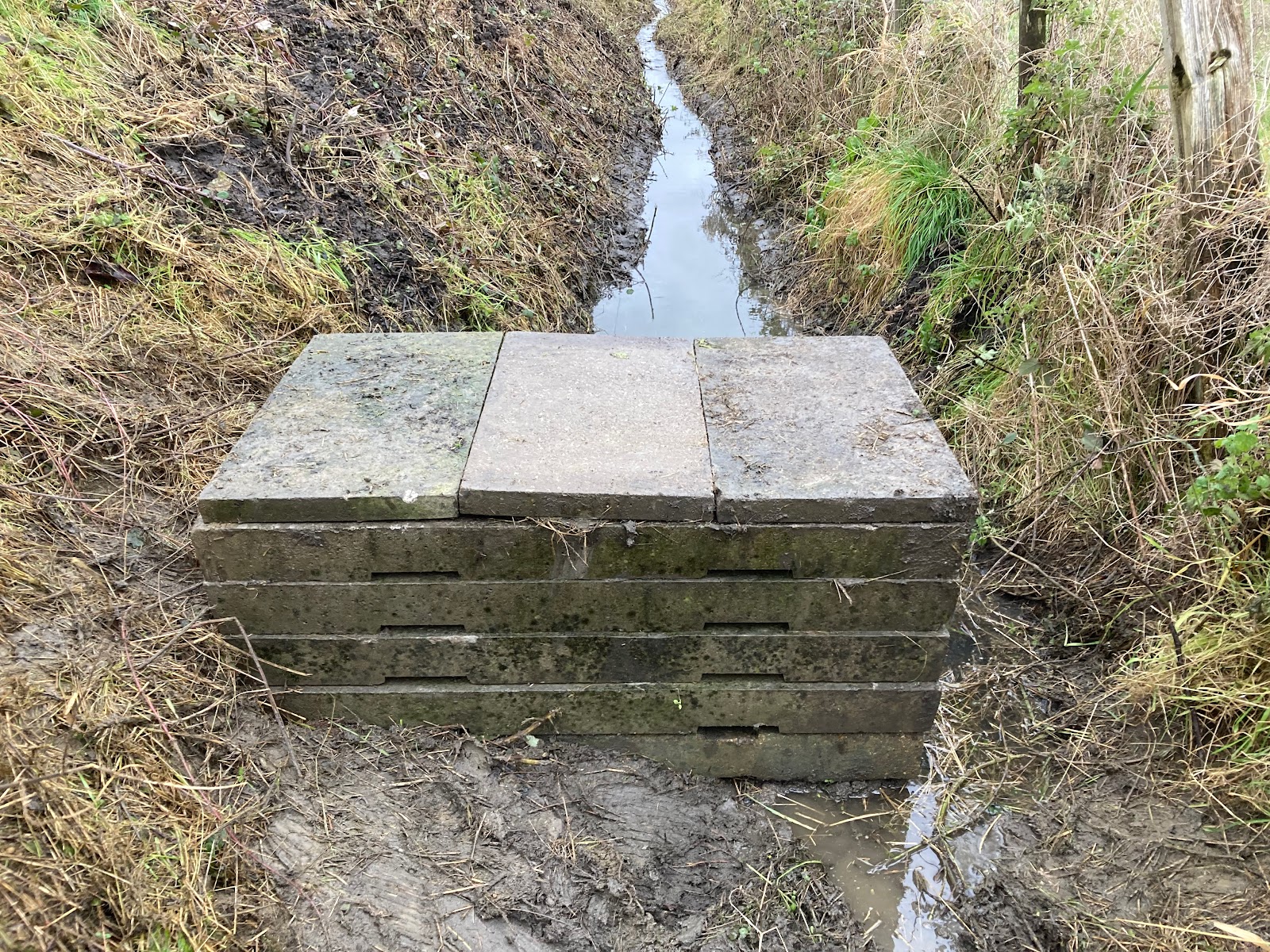 |
Cross drain 14A, stack of rings on the inlet rebuilt. This is in the long ditch that runs all the way almost from Toddington Signal box to Didbrook No1 bridge.
|
Then on to culvert 14B. Another good job by the Wednesday gang
meant the down side access was already clear - so we just had the up
side to clear. The up side exit pond here is currently very deep, we
estimate at least 8 inches, and water is flowing fast out of the pipe
under the adjoining land. Hence seeing what is happening on the high
mileage wing wall was not possible. Finally onto culvert 15A - also
flowing very fast. This will need a visit when the water has subsided
to reset the concrete slabs on the low mileage side of the entrance
channel.
 |
Culvert 14B outlet - there is a small wing wall but the deep water makes inspection impossible!
|
Finally just before the afternoon rains set in, we added two
concrete rings to the up side cess chamber near cross drain 20B on
Chicken Curve. This was one of those damaged by a vehicle (or the
robo flail) - it now has a blue mesh lid so should be more visible.
The wrecked concrete lids were recovered to the rubble pile in
Winchcombe Yard.
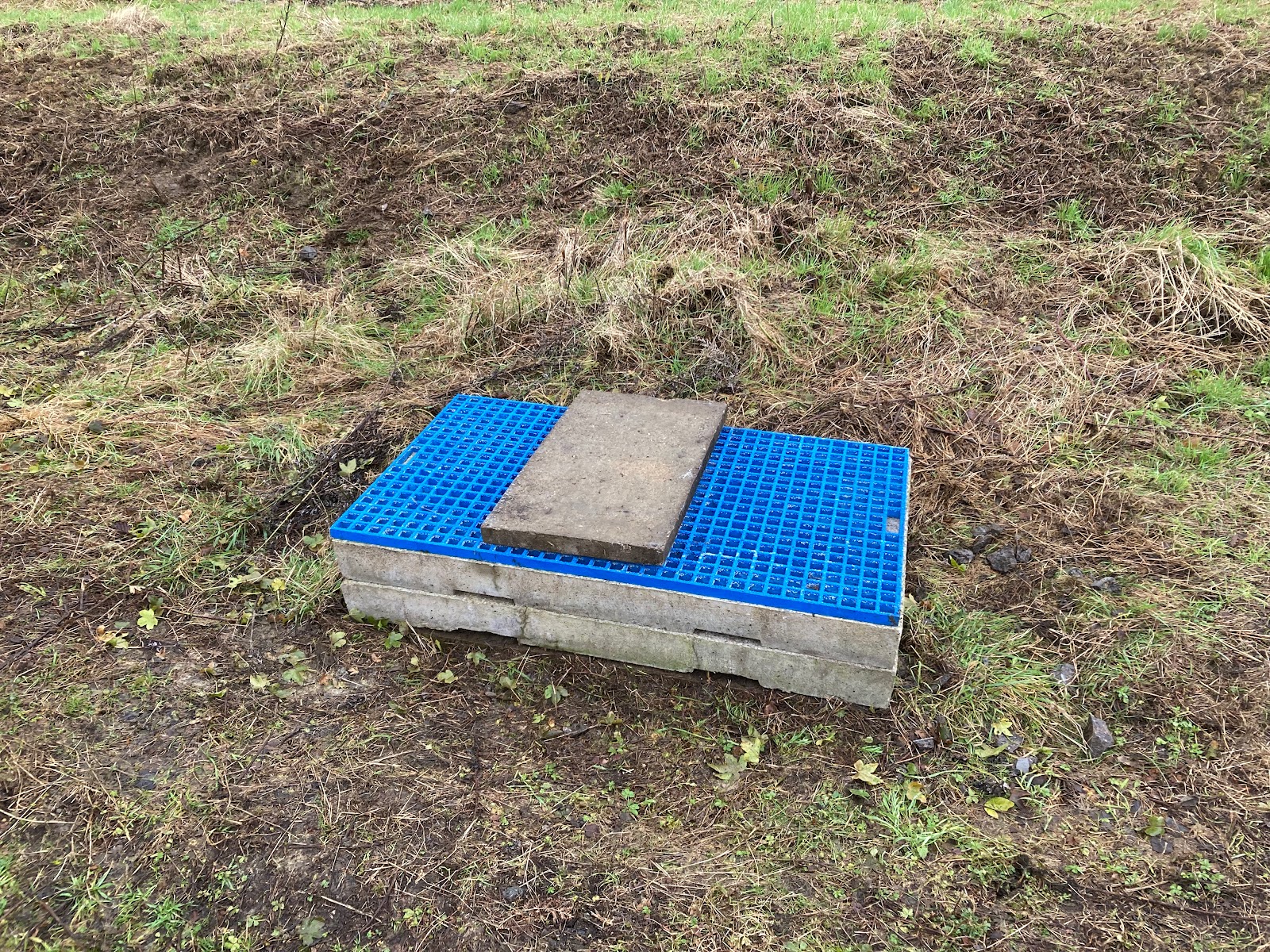 |
Chicken Curve up side cess chamber fixed - raised and mess lid added. All fixed even before the defect report reached the team!
|
In the afternoon in the comparative dry of the Estates Management
container in Winchcombe Yard we spent some time performing preventive
maintenance on some of the brush cutters. At this time of year, some
of these machines get considerable usage on Thursdays and by the
clearance teams on Saturdays and Wednesdays.
Wildlife report
Most wildlife was sensible not to venture out
in the rain. We did however get a very close look at a kestrel on the
power lines at Didbrook; and disturbed some pheasants on the up side.
Thursday 14th December
With seven team member attending and a dry (even sunny in the
afternoon) day we achieved more than the work plan!
Culvert and cross drain visual inspections and clearance covered
16A, 16B, 16C, 18A, 19A, 19B, 20A, 20B and part of 20C. That is from
Didbrook No 2 bridge (16) down to Chicken Curve. We also cleared
the roadside gullies under Didbrook No 2 bridge - this is
where some of the flow from the down side high mileage cess which
does not go into 16A empties. During the rains over the previous
weekend the road under the bridge had very deep puddles.
 |
By the roadside on the down side high mileage of bridge 16 is where some of the cess drains flows out and into a roadside gulley.
|
 |
Plenty of blue paint on the lids of 16B outlet should make this more visible.
|
Our clearance also covered all the cess chambers, mileposts and HP
gas main markers on this section. In most cases this was the last few
inches that our clearance contract’s robo flail can not reach.
 |
Cross drain 19A is another one of our small and neat structures. There is no stream at this point, so the pipe is essentially to route the down side cess and boundary water to the up side and then off to the adjacent field. In dry years we see no water here!
|
A gulley drain in the farm track under Old Farmers Accommodation
Bridge (20) also cleared - this reduced the standing water under
the bridge.
Three of the team undertook a second inspection of the down side
cess chamber intermediately under Stow Road bridge (13) at
Toddington. This was in order to develop plan B, after determining
that cutting slots into standard concrete chamber rings was not going
to be feasible to raise the height the chamber without moving the S&T
cables. Increasing the height with brick courses will need 120 bricks
- and is a couple of days work. So perhaps we move to plan C –
using GRP catch pit rings which are quicker to install and easier to
cut the slots required for the S&T cables.
Wildlife report
Plenty of robins attracted by the cleared
access points to culverts/cross drains.
Large flock of birds
noted performing murmurations over towards Wood Stanway - but too far
away to determine if starlings or fieldfares.
Rabbits at Hayles
Abbey.
Voles at Didbrook.
Thursday 21st December
Another week with last minute reduction in the team strength to
five. So we had to re-plan the work as the original idea was three
groups. (A very valid excuse from our chief first responder, Roger,
he had to cover a last minute gap in the first aid team for the Santa
trains at Winchcombe.)
First task for the two early arrivals was to use the telehandler
to extract the final stack of concrete catch pit rings from the items
at the back of Winchcombe yard. This had to be accomplished early as
the yard became full of parked Santa helper's cars by 9am. Six of
the rings were then taken to the down side crest between Winchcombe
Greet Road bridge and the low mileage portal of Greet tunnel. Five
were used to raise the height of two crest chambers, the sixth was
placed ready to be used when we construct a proper chamber on the end
of the crest pipe. The opportunity was take to inspect the crest pipe
- it was flowing well, it picks up two streams and some land drains.
In the final crest chamber where some of the flow diverts down to the
down side cess (and then runs through the cess drain in the 6 foot at
the station) we removed a partial blockage of vegetation. We now only
have three concrete rings left in stock - our intention is in future
to use GRP rings as these are far easier to handle.
 |
Martin, Nigel and Dave contemplate the options for building a chamber at the down side crest pipe entry close to the south portal of Greet Tunnel.
|
On the way back from the crest we stopped to watch the first Santa train arrive at Winchombe. Normally we get a few waves from passengers - but with this train of excited children on the way to meet Santa we had a wave from every passenger. Maybe one or two of them will be the next generation of volunteers.
Two team members also ventured to Chicken Curve to complete the
clearance and internal inspection of cross drain 20C. Water from the
balancing pond in the down side orchard is trickling into the inlet
here - the stream is running well. We discovered that there is a gap
on the outlet (up) side inside of our fence so we could see that the
flow in and out the bore is equal. Fortunate as looking into the bore
from the down side shows there is something stuck in it. So we will
have to return when the water level is down to attempt some rodding
out. But this gives and excuse for our Christmas Quiz - what is it
that is stuck in the bore? Picture below. We will reveal what the mystery object is when we extract it in the New Year.
 |
| What is that oblong shape partially obstructing cross drain 20C? Hopefully we will find out next year. |
 |
The last Thursday before Christmas does mean we have service trains to watch. Foremarke Hall runs over Chicken Curve light engine to Winchcombe to take the second Santa ECS to Cheltenham.
|
Then up to Stanton Aqueduct (bridge 9). The plan here was to seal
the cracks in the down side concrete inlet and between it and the
trough foundation with some flexible mastic sealant. However this
does require the crack to be clean and dry - it was certainly not
dry. Although the water from the stream is running in through the
pipe and then right through the trough - there was signs of dampness
in the cracks. Again, another task to reschedule for the New Year,
with either a method to dry out the cracks or with some sealant which
can go down wet. On the up exit side of the aqueduct we cleared the
grill on the exit pipe into the adjoining field - this was well
clogged with twigs and leaves.
 |
Grills like this one on the exit of the aqueduct stream to the adjoining field do stop large objects from entering the pope. However they get obstructed with leaves and twigs, so regular clearing is needed.
|
Whilst at Stanton we took the opportunity to inspect the 11B to
11A up side diversion we constructed earlier this year. The real good
news is that this is working well - there is very little standing
water on the down side in the adjoining field; the low mileage inlet
to the 11B bore was running slowly; flow in the new up side pipe was
steady and increasing towards the exit into the 11A ditch. This
suggests it is collecting water from the old land drains - good news
for the toe of the embankment. Also good news is that there is no
standing water at all on the up side, either on our side or our
neighbours side of the hedge.
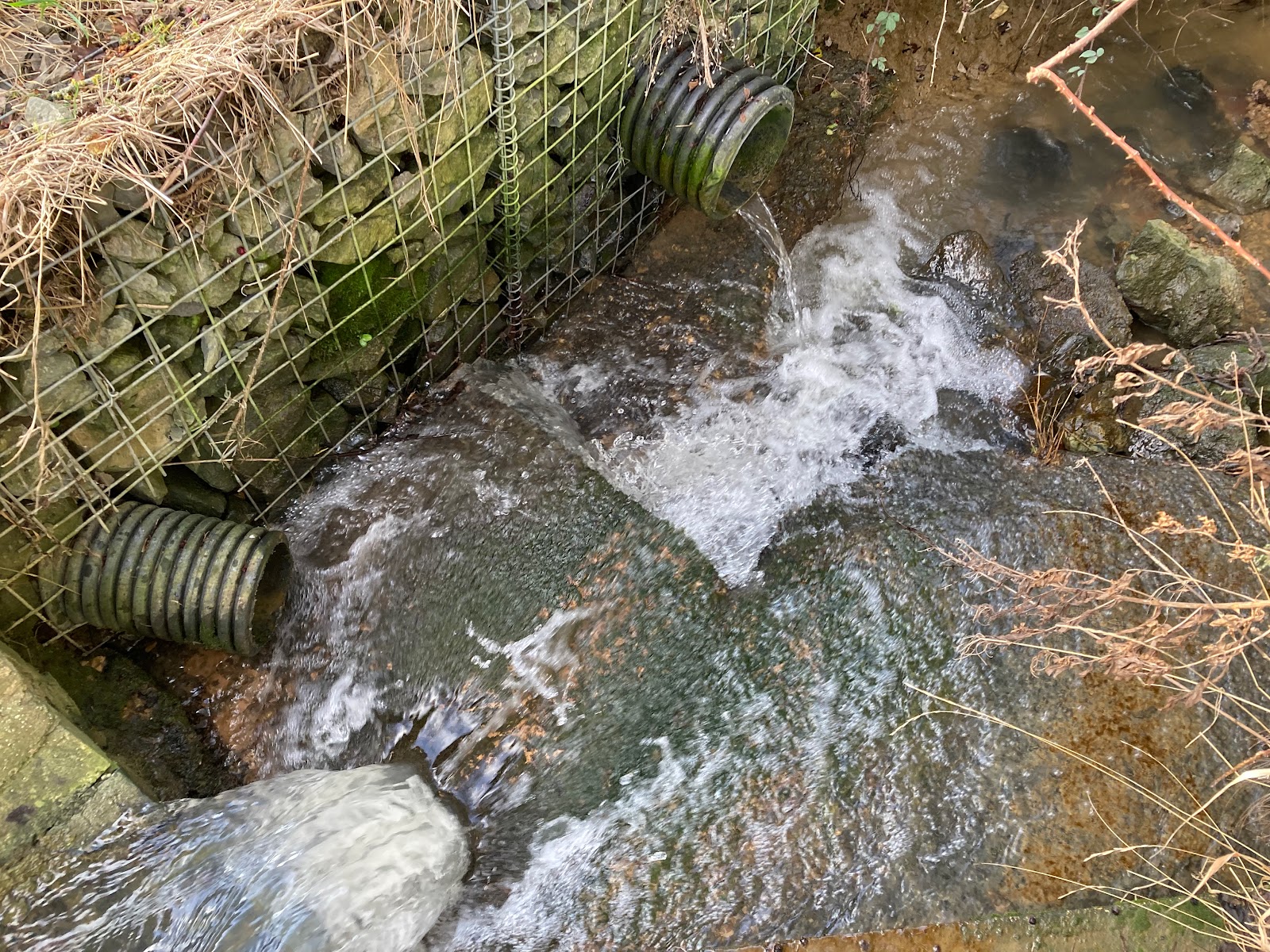 |
The pipe at the top of the picture is the outflow of the 11B to 11A up side diversion - flowing well. The second pipe on the left is from under bridge 11, and the main flow at bottom is culvert 11A.
|
 |
| Just a small stretch of standing water in our neighbours field on the down side at cross drain 11B. Earlier this year this was a large lake - so although we have only completed the up side work at 11B, the results are already noticeable. |
|
As we were at Stanton, we took another peek at the work on Stanway Viaduct. The appeal for funding is still open, if you have not donated yet then please do so. Click this link. The additional work to secure the parapets has added to the cost of repairs.
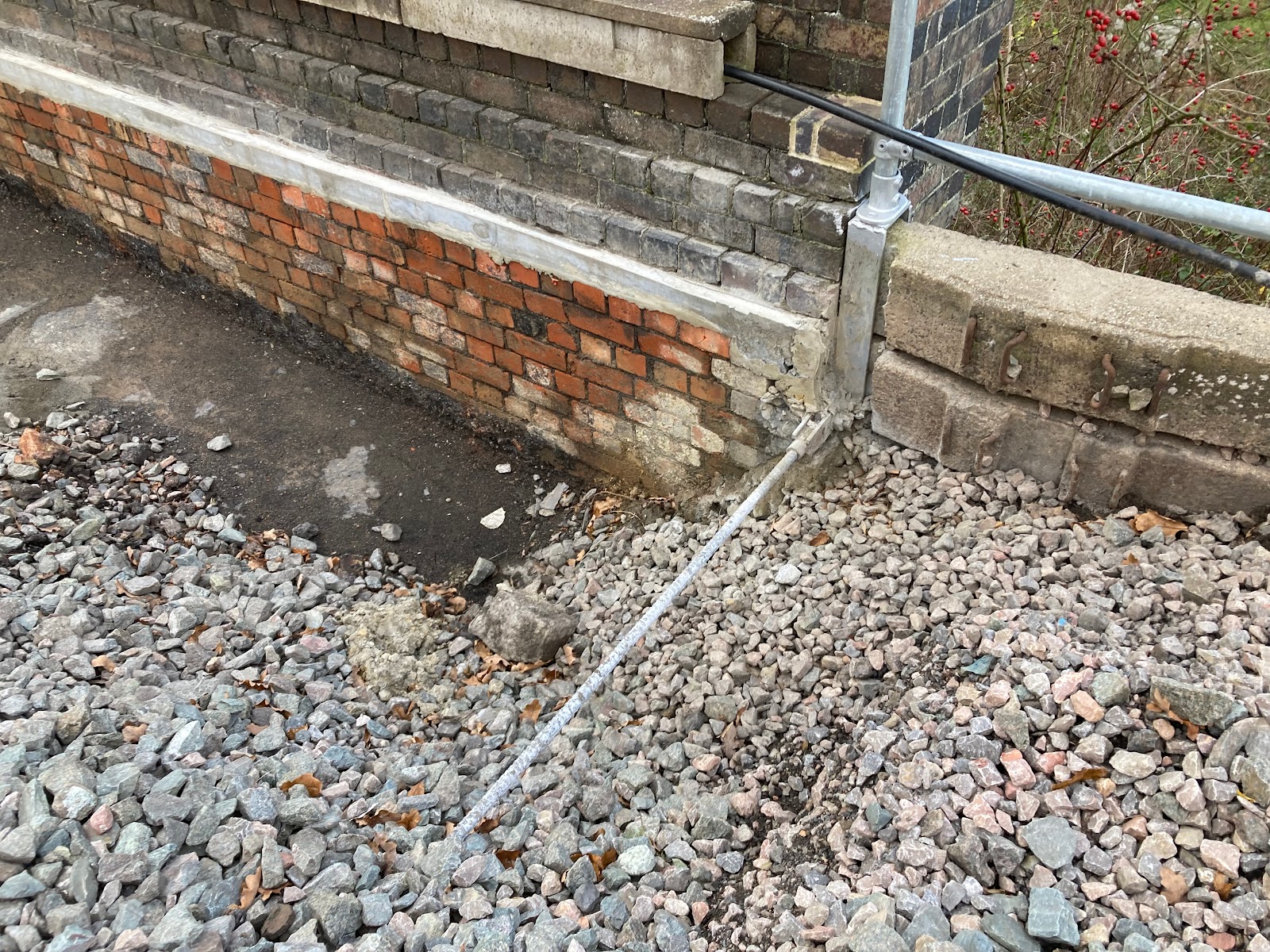 |
| Finally some pictures of the good work Walsh are doing on Stanway Viaduct. The first stage of the extra work to stabilise the
parapets is complete and the first of the horizontal retaining rods at
the end of the viaduct is in place. |
Back at Winchcombe we completed the day with some more machinery
maintenance; fixing a problem with a brush cutter reported by the
Wednesday clearance team.
Wildlife report
Chicken curve: Herons
Stanton: Deer
(probably roe, not rein as none had red noses); Red kite, Buzzard,
Kestrel, crow, hibernating queen wasps (in discard child's jersey)
 |
| About the only time of the year when taking close up pictures of wasps is possible. |
Winchcombe station: Penguins (very tame and of a strange species
which can sing in English!)