Saturday, 20 November 2021

Climate change October

With the UN COP26 Climate Change Conference in Glasgow commencing at the end of October, the subject of climate change is very topical.

For us on the drainage team the warmer autumns have two main effects. Firstly, the higher daytime temperatures mean that we soon warm up when working. Not quite the tee shirt and shorts (plus PPE) of the summer, but certainly no need for the several layers of woolies to keep the cold out. Mind you, when pausing for a breather or a coffee break, you soon cool down, particularly if there is a bit of a breeze blowing.

The second effect is delay to the start of the main leaf fall season. Consequently we do not have to commence the regular checking of the drain grills and covers which we know are prone to leaf blockage until later in the year. The downside is when the first frosts do come, or we get a heavy gale, then the quantity of leaves and twigs can be greater.

Tuesday 5th October

First job today for the five team members present was to extract our mains powered kit in order for it to be PAT tested. Not helped by the fact that some of the kit was required for use at Royal Oak - so had to be brought back for testing.

The main items we needed at Royal Oak were the pump and extension cable. The hole we had excavated last week for the concrete base of the culvert 24B haul road inlet headwall was full of water from the previous night's heavy rain. After pumping and bailing out the water, and stopping most leaks from the temporary bypass pipe, three of the team poured the concrete for the base. Concrete goes up to 25mm below the base of the pipe under the road. This took 5 bags of cement and around 1 cubic metre of aggregate - plus quite a bit of labour!

Dave bailing out the culvert 24B concrete base excavation whilst waiting for the pump to arrive after being PAT tested.
End of day, concrete base poured and temporary pipes back in place. Read now for brick and block laying.

The other two team members undertook checks of the culverts at Gotherington loop; 35A 35B 35C and 35D. No evidence of culvert failure or blockages reported; all 'high tide' marks from the recent heavy rain were under half way up observed pipes. The reason for this check was to rule out culvert problems as the root cause of a minor track defect on the main line through the loop. However we did note that access to culverts 35A and 35B does need clearing - so these are at the top of the list for this activity.

What we like to see when inspecting a culvert, water flowing well, no very high tide marks and no sign of blockages. This is up side (or Malvern side or outflow side) of culvert 35C at Gotherington.

Tuesday 12th October

All six of the team working this Tuesday, so we split into two groups. Added a bit of changing around at lunchtime for variety.

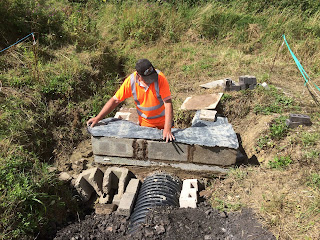
One group progressed the construction of culvert 24B haul road inlet headwall. All the concrete blocks and the first course of bricks were laid. No use of bailing today, the pumps were in place right from the beginning and ran all day.

Brushing away the last drop of water to the pump before building work commences.

The first two layers of concrete blocks in place. Water seepage evident, but not a wellie job yet!

The second group undertook vegetation Cutting and structure inspecting. They cleared vegetation from the track down to culvert 24C down side, all around the headwall and back to boundary fence. On up side they cleared the area around the outlet. This enabled the internal visual examination to take place, the report of which goes the the railway's bridge engineer and structures manager.

Culvert 24C down side (inlet) headwall. Requires some repointing work.

Looking inside culvert 24C from the down side. This is a long culvert as it runs diagonally under the Gretton embankment.

A second visual examination of culvert 25A, the one which runs under Working Lane bridge was completed. For a change this did not involve any clearance! After lunch the rearranged group started clearing the culvert 25B exit ditch on the up side, working back from the new headwall on the 25A/25B junction. There was a lot of growth in the two plus years since this was last undertaken, but the heavy weight brush cutters coped with it. The group reached as far back as where the ditch comes under the boundary fence. Further on the ditch is back on the railway land, clearance of this will be a task for a future week.
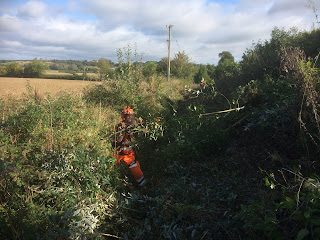
Clearance team almost lost in the growth of the up side ditch from 25B back to 25A.
 
Vegetation fights back! Photo by Dave.

Same spot as photo above, an hour later. We can now see where the ditch is. Photo by Dave.

Also in the afternoon we met with a prospective new team member. More on that next month.

Thursday 14th October

The first working day for the joint Estates Management (Drainage) and Permanent Way milepost replacement project team. One member from each department today.

Photographic surveying of the existing mileposts progressed by checking all between Didbrook (mp 10) and Greet Tunnel north portal (mp 12 & quarter). Mile post 12 and half does not exist, it would be half way through Greet tunnel, so there is just a white mark on the tunnel wall.

Mp 10 at Didbrook requires major restoration. Half the head is missing and the post leans at a funny angle.
 
In contrast most of the posts between Didbrook and Winchcombe are in good condition, these were refurbished a few years ago. This one will only need the post, former GW broad gauge bridge rail, painted.

One that the public can closely inspect, it is on platform two at Winchcombe. In good condition, apart from missing a metal cap to the head. Without this the wooden head will rot quicker.

The first post the project will replace is 7 and quarter near the foot crossing at Stanton Fields. The numbers and marks for this received a first coat of primer.

For mp 7 & quarter we have original GWR cast iron numbers and quarter marks, and one horizontal divider. The other divider is a replica lead casting of the same thickness.

Traditionally, the GWR used lengths of former broad gauge bridge rail as posts for mileposts. These had 4 feet above ground and about 2 feet below ground. The GWR also used bridge rail for fence posts, and we have several lengths of this in various locations around the railway. Today three lengths were extracted from Winchcombe yard. Using the PW rail saw these were cut to six foot lengths, the short corroded bits which had been below ground went to the scrap bin. Four more lengths require extracting, but that will be more than a two man lift.

Three six foot lengths of bridge rail ready for de-rusting and painting.

Tuesday 19th October

Attendance reduced as one team member away on holiday and one on Jury service. So only 4 of us in today.

The morning was spent at culvert 24B up side new inlet headwall under the haul road. Six courses of brick were added to the brick face and in-filled with concrete in the hollows in the blocks and behind the blocks. Using two cement mixers, one for mortar and one for concrete was a big benefit.

Polly progressing the brick laying - water level on the base only just below boot level!

Dave was in charge of mixed number 2 for concrete production.

When rain stopped work at lunchtime this was the state of the construction. Cover sheeting about to go on.

As the weather looked like it would get very wet in the afternoon, plans to brush cut more of the culvert 25B outlet ditch were abandoned. Instead the milepost replacement project was advanced, by fettling the steel bars for the horizontal dividers and quarter marks, painting the numbers and marks for 7 & quarter and cleaning up the cut lengths of bridge rail.

Tuesday 26th October

Again a reduced number of the team were available today. The main task was progressing the build of the culvert 24B up side haul road inlet headwall at Working Lane/Royal Oak. Fortunately with the lack of rain, continually pumping out the base was not needed. Six brick courses laid today, including a lintel formed from an old concrete fence post. Plus the concrete back fill behind the blocks was completed.

Nigel mixing mortar and Polly laying the bricks.
24B up side haul road inlet at the end of day, just the coping layers to go.

Access on the down (Cotswold) side to culverts 24A and 24B was brush cut. This enabled the visual exams for these two to be completed.

Nigel (l) and Dave clearing around the down side of culvert 24A, Royal Oak pub in background.

Finally the monthly clearance of the grill on the outlet pipe of culvert 24C up side where it exits under the fence to our neighbours property. This has a grill which often collects twigs and other debris. Again lack of rain in the past week meant the level here was minimal.

Today was the last day the team will see passenger trains south of Winchcombe until the spring. 4270 passes with an up service.

Wednesday 27th October

An interesting day for the blog writer acting as PTS cover for the Brunel University team who were monitoring the vibrations of Stanway viaduct. Readings were taken with all the passing trains (4 steam with 4270, and 6 DMU) on the centre span, with sensors by the sleeper end and by the parapet wall. Also between trains readings of the background vibrations were taken on all 15 spans of the viaduct. It will be interesting to see the results. 

Dr Tomor of Brunel University setting up the vibration monitoring equipment on the up side of Stanway viaduct. The blue box is the sensor for the parapet wall, a second unit was placed by the sleeper end. Readings were taken for all trains of the day - first 10:23 DMU to Broadway, last 17:06 DMU arrival from Broadway. Good job it was a dry day!

 
The instruments are very sensitive, here is a plot from the test where we jumped up and down on the middle span.

Wednesday, 10 November 2021

A fruitful September

Many of us are familiar with the opening line of John Keats' poem To Autumn... "Season of mists and mellow fruitfulness". The beginning of autumn 2021 lived up to the second part, but not the first.

Like our colleagues on the Permanent Way and Clearance teams, we are able to closely observe the fruit growing on or by the railway. Blackberries are the most numerous, growing everywhere, particularly where not wanted! Tree wise there are several varieties of apples and pears. Most of the pears are the perry cider type, they ripen late in the season and even then are rock hard. Sloes, the fruit of the very prickly Blackthorn are quite common, whilst there are a few damson trees too. Damsons are bigger than sloes, and there no danger from thorns when picking them. Also they taste better.

Tuesday 7th September

Only three of us working again today, a different three to last week. This was a very hot day, hotter than any in August. Plus as the work was brush cutting which requires extra PPE, we certainly felt the heat.

We cleared the access at Bridge 6, Meadow Lane Laverton and all four of the wing walls. Makes a change to work here in the warm and dry; usually we visit this bridge in the winter or spring to deal with the flooding on the road underneath.

Low mileage down side wing wall, bridge 6 Meadow Lane, Laverton.

 
Diagonally opposite, this is high mileage up side wing wall. No trace now of the entrance to the long lost Laverton Halt.

We then went to try to find lost milepost 7 and quarter; it should be near the foot crossing south of Meadow Lane. The up side there has very thick brambles and other vegetation. We failed to locate it. The Permanent Way team who are numbering the rail lengths have estimated where it should be, the rail length numbers start at 1 for each quarter mile. This is the reason why the milepost replacement/refurbishment project is joint between us and PW.

35006 Peninsular & Oriental S. N. Co. with a down train passing where milepost 7 & quarter should be.

As ice cream was called for we headed to Broadway station for lunch.  Plus that was a good opportunity to catch up with the team there making progress on the footbridge and platform 2.

This will be a popular photographic spot once Broadway footbridge is open to the public. 4270 running around the train.
 

After lunch we cleared access to culvert 11C between Stanton farm crossing and Stanway viaduct. This is a good example of why the access needs clearing. On both sides the access down the embankment is very steep and there is a big drop over the headwall on the up side. Clearing this makes it much safer and easier for the external inspectors.

Culvert 11C up side, cut vegetation on left, uncut on right.

By then it was too hot for anything else!

Tuesday 14th September

A definite change in the weather, but not to a mellow mist! Low cloud and drizzle, but that does enhance the steam effects from the trains! At least the forecasted heavy rain held off.

35006 Peninsular & Oriental S. N. Co. again with a down train, here approaching bridge 20.
 

Four team members in today, so three brush cutters in action and the fourth person was the lookout. This is vital when train are running, brush cutting requires ear defenders so you can not hear much over the noise from the cutter.

We continued clearing access to the first set of structures that the external inspectors are examining later in the month. Today we managed one culvert (20A) and four bridges (Bridge 20 Old Farmers Accommodation, Bridge 19 New Farmers Accommodation, Bridge 17A the big culvert, Bridge 17 Hailes Halt). We also started on culvert 17B, but the depth of water on the up side (exit) required wellies.

Bridge 20 Old Farmers Accommodation Bridge, up side high mileage

 
The team in action clearing down side of culvert 17A

Bridge 17 Hailes Halt, high mileage up side. An unpleasant job clearing this one due to numerous plastic dog poo bags in the vegetation.

Another early finish, but this time to enable us to dry out. Hence a visit to the Coffee Pot at Winchcombe for a welcome cup of tea! 

Tuesday 21st September

Today we completed the clearing of the first set of structures that the external inspectors are examining this year, the final one was culvert 17B.

17A and 17B are large culverts, 17A is so large that is technically classified as a bridge. 17B is not much smaller, and it has a large area to clear on the down (Cotswold) side, which is upstream. The railway land extends to the side of the bridge which takes the footpath over the stream. Although this bridge is numbered 18, it is not GWSR owned and thus not our responsibility to maintain. A lot of thick growth in this area, mainly elder intermingled with a lot of brambles. As this was not cleared last year due to the COVID-19 pandemic, it was slow going.

Down side of 17B clearing back to the footpath bridge.
 

Five members of the team working today, so we were also able to attend to the loose coping stones on the low mileage end of both the up and down side headwall.


Culvert 17B up side, fixing the end coping stone. Photo by Roger.

All done - and all level (note the spirit level). Photo by Roger.


With the vegetation cleared, the view from the public footpath is now photogenic for passing trains! 4270 passes with a down train.

Whilst returning to base using the vehicle track alongside the running line to Toddington we cleared overhanging branches at Didbrook No1 and Didbrook No 2 bridges.

Tuesday 28 September

After spending the past few weeks mainly on clearance activities it was good to be back to construction today, and back to Royal Oak/Working Lane, Gretton.

The five strong team made a start on the next new headwall, this is culvert 24B up side entry to the pipe under the haul road. First job was to excavate for the concrete base which provides the foundation for the headwall. We transported the excavated material up the haul road to use as backfill on culvert 24A haul road exit. Most of the material was clay, heavy but fortunately not too wet. Before starting we inserted a temporary pipe to take the flow from under line exit, so that hopefully the work area will stay relatively dry.

Before the rains came, Nigel (l) and Roger digging out for the concrete base at 24B; Martin ready to barrow away.

We loaded the barrow loads of excavated clay on to the LWB Transit with the tail lift and then took it up hill to 24A haul road exit as backfill. Not sufficient to complete that, but we have a cunning plan, to be revealed next month!

Completed excavation at 24B for the concrete base for the new headwall. Too wet today to lay the concrete. Temporary pipe from the 2017 built railway exit headwall in place.
 

The weather was certainly not dry, so to avoid the heavy rain in the afternoon we returned to Winchcombe to commence manufacture of the replacement milepost heads. Activities included cutting steel bar for the new horizontal dividing line and the quarter marks, fettling the new cast lead numerals and painting some of the new wooden heads.

Roger (back) painting milepost heads and Polly fettling lead numbers.

Nigel (l) and Martin cutting steel bar for quarter marks and horizontal dividing lines for the mileposts.

Continued milepost manufacture will be our wet weather activity for the winter.

Tuesday, 2 November 2021

August and the resumption of a normal English summer

One of the variations of the famous "Sod's Law" is that the weather becomes less pleasant during the summer holiday of the English schools, from late July to early September. Summer 2021 certainly started off in that form.

Paradoxicality, we do need wet weather in order to observe how the various drains, pipes, culverts, streams and rivers flow during and after wet weather. But working in the rain is not pleasant; you get damp and dirty quicker; we can not use some of our powered equipment for safety reasons; and the windows of the road vehicles we shelter in for breaks and lunch steam up quickly.

Thursday 5 August 

The team was back to strength with six members attending. The main item was the continued build of the new headwall for culvert 24A up side exit from the haul road at Royal Oak, Gretton. We managed just two more brick courses before the onset of heavy rain at lunchtime meant an early finish. Our expert recycling operatives managed to extract another load of backfill from Gotherington, we thought that last weeks loads were going to be the last from there! This load was good quality size one Cotswold honey colour stone. 

The day's progress on culvert 24A up side haul road exit. Note the water level compared to previous weeks!
The brush cutters were in action as well. We cut the overhanging brambles and branches on the haul road between the gate at Working Lane and the flat turning area by culvert 24C. Also removed the vegetation around the culvert 24A exit on the the up side by the trackbed, this enabled a good view of the channel under the line.

Looking into culvert 24A from the up side. The last part is a 24inch by 18inch brick extension with a badly corroded steel plate over the top. All this will be replaced with a new buried 600mm plastic pipe. A substantial job, to be undertaken during the 'closed' season when no trains are running. But that is also the wet season!

With the rain getting heavier after lunch, we spent the afternoon in the Churchward House mess reading the new Personal Health & Safety Guide. Administration tasks have to fit in somewhere!

Tuesday 10 August

Down to five in the team today, it is still holiday season. As the weather had improved, we spent a full day on the construction of the new headwall for culvert 24A haul road exit . This included the tricky bit over the top of the plastic pipe and the concrete lintels in the block courses. This headwall is now almost complete, just the coping courses to get it to the correct height. 

Using the cantilever principle for the courses above the plastic pipe. The concrete blocks behind sit on a concrete lintel.

 
Roger covering up the work at the end of the day. This stops the mortar drying out too quickly and stops rain washing out the mortar.

Backfill added today came from a closer source, just a few yards away at the top of the haul road opposite the Royal Oak pub.

One benefit of working at the top of the haul road is that the trains are visible. 7820 Dinmore Manor with an up train passes during morning break. Loco crews and passengers appreciate a wave!

Yet more work with the brushcutters removed more undergrowth from the working site; and along side the haul road.

Clearing vegetation from the haul road is not just for visual effects - it is imperative to see where the road ends and the ditches and banks begin.
 

The next builds for the team are the headwalls where culvert 24B goes under the haul road. So we  measured this up for the additional plastic pipe required; fortunately we found some suitable lengths in our stock at Winchcombe yard. 

Hiding in the vegetation is the up side exit headwall of culvert 24B, built in 2017. Our next task is to put a concrete apron between this and the haul road, then build a new headwall alongside the haul road.
 

Tuesday 17 August

Back to a six man team today. Having finally exhausted the supply of infill material from Manor Lane, two of the team went on a hunt to Stanton Yard. Plenty there, and a good mix of soil, small stone and larger stone. Plus some tarmac, which was surplus from the verge repairs on the B4632 bridge at Stanton (bridge 8) - but that had gone very solid and needs a kango hammer to break it up. Three loads of infill transported from Stanton, so by the end of the the day the new pipe for culvert 24A under the haul road was buried. 

Martin demonstrates the usefulness of the tipper truck to place infill over the exit pipe of culvert 24A. Ten seconds to off load what took half and hour to load by hand!
The bricklayers completed the construction of the new headwall for culvert 24A haul road exit with the addition of the coping brick layer.  

Adding a coping layer with solid bull nosed Staffordshire Blue bricks really does finish off a headwall!

The vegetation clearance duo used the brushcutters to clear around culvert 24B up side under the haul road and down to the boundary fence. They also extended the clearance of the haul road further down towards Working Lane. 

Now you see it! With surrounding vegetation cleared we can see the extent of the work required on culvert 24B. Quite a bit of digging out for the concrete aprons - so three Shredded Wheats for breakfast next week!

Tuesday 24 August

For a change, some of the five team members present today did not visit Gretton!

The term 'Drainage team' is a bit of a misnomer, we get involved with almost anything on the Civil Engineering side. One task is ensuring safe access to bridges and other structures that are to be inspected by the teams of external inspectors. So today we were at Stanton Yard to deal with bridge 10, the minor road up to Stanton village. We also cleared the access into Stanton Yard; the vegetation has grown considerably since last cut over a year ago. This included several branches of a damson tree, the fruit not quite ripe enough to eat. Then we turned our attention to the four wing walls of bridge 10. Finally we cut back the growth on the sloping vehicle tracks which lead from the yard down to the running line.

Looking down on 7820 Dinmore Manor with the first down train of the day from Stanton Road bridge 10.

Cleared high mileage up side wing wall of bridge 10.

As our heavy duty brush cutters were away having their annual service and safety checks, we were using the light weight machines. These are much easier to handle on wing walls, but they do struggle a bit when encountering thicker vegetation such as blackthorn and ash. Consequently the saws and hedge trimmers saw quite a bit of use. We racked the bigger cut branches into a pile, that will be a bonfire later in the year when no trains are running.

Stanton Yard access before clearing.


Same view after clearing. Almost accessible by a double deck bus!

Two team members took two tipper loads of infill from Stanton to Royal Oak for the up side haul road exit headwall of culvert 24A. This is now looking almost complete, apart from the infill required at the sides. There is plenty of infill at Stanton, more now visible after the vegetation clearance.
 

Backfill of culvert 24A up side haul road exit at Royal Oak slowly coming up the headwall. Photo by Dave.

Wildlife spot - a lizard who has made Stanton Yard their home. No doubt a knowledgeable blog reader will identify the species. Photo by Roger.

Tuesday 31 August

Due to combination of sickness, holiday and other unavailability, only 3 team members working today. So we continued with the clearance operation to enable the external inspectors due in September to have safe and easy access to the structures. Today we tackled bridge 11 and culvert 11A; this is between Stanton Yard and the north end of Stanway viaduct. Culvert 11A is the one the team spent most of the summer of 2019 rebuilding, hence we hope the external inspectors will not find anything amiss.


First task of the day was to clear the vehicle turning area just north of bridge 11. We can then park the transit truck well clear of the running line. Photo by Roger.

Bridge 11 and Culvert 11A down side. Photo by Roger.
Bridge 11 and culvert 11A up side. Photo by Roger.


So that takes us (meteorologically) to the end of the summer of 2021. Perhaps not quite as wet as some summers after all.


Friday, 29 October 2021

Hot and hotter still in July

The chief blog writer was away for all of July, undertaking a practical study into applied fluid dynamics. Otherwise known as as canal & river cruise! Hence most of this catchup post comes from notes supplied by Dave.

Of course, other team members were also away on holidays, so several days were just a small core team.  

Tuesday 6th July 

Just 4 members of the team working today. The main task was continuing the build of the new headwall where culvert 25B enters the new junction to join culvert 25A on the up side at Working Lane. The other operation was to collect infill from Manor Lane, Gotherington to finally complete the backfill and levelling of the culvert 25A junction inlet headwall. This has used up most of the infill from Manor Lane.

Tuesday 13th July 

Hottest working day of the year so far. Five team members working today. We finished the build of culvert 25B junction inlet headwall at Working Lane. Just now needs backfilling.

Culvert 25B junction inlet headwall complete - mainly Michael's handiwork. Photo by Dave.


We retrieved a length of redundant pipe from the up side near culvert 27B at Gretton. This was where we inserted the new toe drain pipe back in May, alongside the neighbours property. We had thought further work might also be necessary here to level the soil where we inserted new pipes; however nature seems to have done the work for us and no further landscaping is now considered necessary. (Not often do we get a helping hand from nature!).

Vegetation starting to hide where we inserted a new toe drain, up side, Gretton. Photo by Dave.


We took a look at the section of ditch dug by our colleagues in the Wednesday Clearance team on the down side in Dixton Cutting. This takes water off the field, along the cutting crest and then down into culvert 32A (the flume). The ditch is still clear of vegetation. To ensure all the water running off the lowest part of the field is captured, we will extend the ditch about 15m north. Hard to image very heavy rain on a hot day like today.

The ditch dug by the Clearance team - good work. Come back for more digging please! Photo by Dave.


At the south portal of Hunting Butts tunnel we fitted bolts to the heavy metal lid on the manhole cover in the formation (it would be in the 6 foot between the tacks if they were still there). Hopefully, this together with the heavy concrete lids placed on top will deter any visitors from opening the manhole to take a look. At Far Stanley, we placed a line of posts along the slope on the up side where embankment movement was detected earlier in the year. These posts help monitor any further movement. We put in 9 posts, each 900cm from the edge of the track and 500cm apart. The height of the vegetation made it difficult to get them exactly in line. This sunny July following the damp June certainly is ideal conditions for weed growth!

Far Stanley embankment - good views toward the Malvern Hills once the growth is cut back. Photo by Dave.


Finally, we moved some materials up the haul road from Working Lane bridge to culvert 24A, in preparation for next week's start on building the new headwall on the exit side of the haul road.  

Tuesday 20th July 

Another temperature record today - beats last week by several degrees. In fact it was too hot for bricklaying, so the team decided on an early finish. Before the heat beat us, the five strong team made preparations for the new headwall build at culvert 24A. The necessary brushcutting was followed by clearing around the culvert outlet pipe to fit the collar to connect a new pipe to lead onward to the position of the new headwall. The ditch was widened on one side so that this new pipe could be fitted snugly into the collar rather than at an angle. A second length of pipe is on site to further extend the pipe fully to the position of the new headwall; we will also use a collar from our stock at Winchcombe. So, proper construction start put back one week.

First section of the new pipe for 24A under the haul road. The old sleeper marks the edge of the haul road. Very little water flowing in the culvert today. Photo by Dave.
One of the best spots on the line for lunch - but only available to lineside workers! Sunshade and picnic table are not in our regular set of tools. Photo by Dave.


Tuesday 27th July 

Finally we started laying the concrete blocks and bricks for the culvert 24A haul road exit headwall. First of all, we connected the second length of pipe using a collar. This took the outflow as far as the intended position of the head wall and enabled building to commence. Meanwhile, two tipper loads of infill were collected from Manor Lane (that really is the last of the piles from there) and used to support the pipes between the outlet and the new head wall. The number of courses of bricks we could lay was limited by the amount of water at the base; by lunch time we had got to the point where we needed to let the mortar set in these lower courses before more bricks could be laid. So after lunch we returned to Winchcombe to shift the new delivery of cement bags under cover. The weather forecast is this hot dry spell will come to an end in the next day or so.

Extending the 24A haul road pipe to the site of the new headwall. Photo by Dave.
First block and brick courses of the 24A haul road exit headwall. Will be needing quite a bit of backfill here - good job there is plenty at Stanton  Yard. Photo by Dave.