Saturday, 29 January 2022

Another headwall (almost) complete

Wednesday 19 January

Two team members together with seven from C&M (mainly the Broadway team) working today with one objective – moving the pile of broken paving slabs from the old garden centre site at Toddington to Working Lane. At Working Lane most of these are now part of the base for the extended hardstanding area. The few complete or almost complete slabs were put by for other uses. With four vehicles in use, one of which was the Citroen tipper, the task took much less time than we anticipated, completion was early in the afternoon.

The pile of slabs almost gone from the former garden centre site at Toddington.

Where they have gone to - the hard standing flat area at the foot of the haul road from Working Lane to opposite Royal Oak, up side.

Hence some time to progress the Milepost project. The two of us fabricated the galvanised metal cap for milepost 12 on the up platform at Winchcombe. This was an in-situ job; bending the cap to fit the head snugly on site is not as easy as in the workshop. There are plenty of other posts which need caps fitting; so probably we will take the heads off and fit the caps in the workshop.

The galvanised cap fitted to mp 12 will arrest the rot of the wooden head. A lick of paint will make this most presentable - it is the only one on a currently public accessible platform.

Thursday 20 January

The other five members of the team attended on the usual Thursday work day. Our master brick layer and the wizard mixer operative set to work on culvert 24B haul road exit at Working Lane. By the end of the day this was complete apart from the coping course.

24B haul road exit headwall, just coping course to go. Picture by Polly, who says his camera is not fitted with a spirit level, it is the camera that is leaning; not the headwall!

The other three members continued with the vegetation clearance and internal visual inspections of culverts and cross drains. First today were 27A and 27B, at Gretton. This included checking how the new up side high mileage toe drain was performing. We installed this earlier in the year; when the neighbouring land was very boggy. Good to report it is performing well; the ground at the foot of the embankment and by the neighbours pond is now just damp.

Up side high mileage 27B toe drain pipes installed earlier this year working well, water running from both. One comes under the fence from the adjoining land.

Next along is culvert 27C, which is actually a 12inch diameter pipe. Immediately it was obvious that this was restricted, but not having the drainage rods with them the inspection was abandoned.

27C inlet chamber down side; water should be flowing out of the toe drain pipe here, not into it!

Working south the next culvert is 28A which is also a pipe, but a very long one which runs alongside the course of the old road to Stanley Pontlarge. When the GWR built the line in the 1900s; the road was diverted under what is now bridge 28. This was another case of deferring the full inspection; this time as the vital implement not to hand was the long handled grab to remove silt from the chamber at the end of the outlet.

The final two structures inspected were culverts 30A and 30B at Middle Stanley. 30A runs under bridge 30, or Tunnel Bridge. The main issue with both of these culverts is the steepness of the embankment sides; particularly near the bridge. Our Health & Safety rep has made a note that cutting some steps into the embankment here is required.

30A outflow (up side); this headwall was rebuilt in 2018 but now requires another rebuild after a flail (we think) had a close encounter. We will make the parapet higher so that it is more visible particularly when the long grasses grow in the summer.

Thursday 27 January 

The full team of seven in today – so a split into three sub teams. The first took a permaquip trolley up to Broadway to collect concrete drain lids from platform 2. Using the trolley on the loop line to bring the lids to the Transit truck at the top of the access from the car park was the easiest and safest method; especially with platform 1 obstructed by scaffolding for the roof extension. These recovered lids then headed to Dixton cutting.

Sub team two first headed to Stanley Pontlarge equipped with the long handled grab to remove the silt from outlet chamber of culvert 28A. The silt is almost entirely sand, washed down from the road above the line on the down side. After silt removal, which dropped the water in the chamber by around 4 inches, they completed the visual inspection of 28A.

The deep chamber on 28A outlet; even with the long handled grab it is a two stage lift to get the silt onto the parked truck.

Then back to Working Lane to meet with the other teams for lunch; and to inspect the labours of the construction team. The famous ‘construction two’ had been very busy during the morning; the haul road outlet of 24B was now complete with coping course and kerb stones by the side of the haul road. With just some infill required on the outlet and addition of marker posts both sides of the haul road, that is 24B up side complete. Hopefully we will be able to make a start on the down side later in the year.

24B haul road exit; side view. Back filling required to finish - but that will hide the size 10 boot imprints on the surplus mortar.

24B up side; the new part under the haul road in the foreground and the 2017 built exit headwall under the railway in the background.

After lunch the construction duo cleared up the site at 24B and moved some materials to be ready for the next construction, 24C up side haul road exit. Hopefully the lack of rain will continue in the next couple of weeks whilst we excavate this one.

The other two teams combined, first stop with the drain rods was 27C. Fortunately the obstruction was just a few rod lengths from the down side inlet, and it moved easily. Water started flowing quicker and the level upstream dropped a couple of inches in a few minutes. This enabled the visual inspection to be complete; we could now see the top of bore pipe in the inlet chamber.

27C inlet chamber (down side); the bore pipe that runs under the railway is just visible below the cess inlet plastic pipe (centre). Compare the water level with the photo taken a week ago.

Next for visual inspection was 31A; near JJ Farms bridge 31. The down side chamber here is one rebuilt in the early GWSR days using concrete filled sandbags. Here they have lasted reasonably well, but will at some point in the not too distant future will need replacing with a proper brick structure.

Cement filled sandbags are OK for temporary repairs; this is low mileage side of 31A inlet. Not helped by an ash tree growing by the toe drain.

The teams were now in Dixton cutting; so the lids on the upside concrete cess drain which had been damaged during the track relaying operation before Christmas were replaced with the lids collected from Broadway.
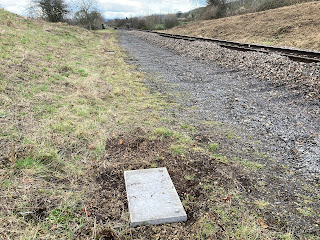
Replacement lids in Dixton cutting. Please don't drive over these. (The cess drain here is British Railways 1950/1960 standard concrete U channel; but with lots of repairs involving porous plastic pipe and pea gravel. These lids cover the sections with the ends of the porous pipes.)

Finally it was visual inspections and clearance of three more culverts, 32A, 33A and 33B. 32A is probably the most visually specular culvert on the line, it is the ‘fume’ that takes the Tirle Brook under the line in Dixton Cutting.

This is what a visual inspection involves, taking a photo into the bore. Unusually for January the water level here in the Tirle Brook culvert 32A was low enough. Jonathan's boots get their waterproofing tested!

And here is the view into the bore; looking upstream the 'flume' on the down side just visible. Photo by Jonathan.

After periods of heavy rain the flow on the down side inlet is white water. On the up side the railway land extends for a considerable distance, through a wooded ravine; on the Isle of Man this would be called a glen. With quite steep sides and several fallen trees, this outlet needs regular checking for obstructions. None found today, nor did we find any fairies or pixies, not even deer. What we did find was some interesting tree fungus, so far none of our experts have identified it.
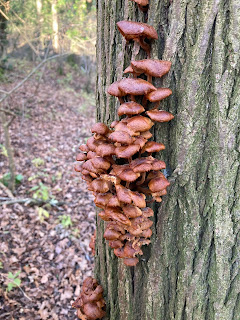
Interesting tree fungi in the Tirle Brook glen. Anyone able to identify it?

A busy and varied day, made pleasant with some afternoon sunshine. Also noteable as the first time this year it was still daylight when we left Winchcombe Yard to head home.

Saturday, 15 January 2022

Milepost project reaches a Milestone

Those of you who are, or have been, Project Managers - or who were subjected to Project Management will know all about the importance of Milestones in projects. Well the Milepost project has just reached an important Milestone - continue reading to find out how.

Thursday 6 January 2022

The twelfth day of Christmas. Back in the Tudor times this was the last day of the Christmas holiday and marked with the biggest feast. For us it was the first day back at work. Biggest question was 'is it too cold for brick or block laying?'.

With six of us in, we split into two teams. The construction team decided it was just warm enough for block laying. so went to Working Lane to commence the build of culvert 24B up side haul road exit. First they fitted the extension pipe; the collar join made with filler before Christmas proved to be water tight. Attempts to divert the flow through a temporary pipe were not too successful, so to keep water level in the working area down the pump was run quite a bit. By lunchtime and the onset of cold rain, 4 rows of concrete blocks and one row of bricks were laid.

Culvert 24B up side outlet from haul road, extension pipe and first rows of blocks clearly visible.


End of day (well after lunch) all work covered up for protection against the frost.

The odd job team first headed to Dixton Cutting. Inspection of the flume culvert 32A, the Tirle brook, showed it was running well. No sign of any flooding here like in previous years. The cutting crest ditch on the down side low mileage of the culvert which the Wednesday clearance team dug has obviously taken some flow. Maybe later in the year we will extend this about 50 yards further back. The damage done to the up side concrete drain lids by the telehandler when the pre Christmas track relaying was inspected. We worked out what we need to fix, a quantity of lids and some pea gravel. Fortunately all in in stock.

One section of the 1960s concrete drainage lids that will need replacing in Dixtons Cutting. These lids do not have reinforcing, they were not designed to be driven on!

Then on to Stanley Pontlarge to meet with the adjacent landowner as the access through his small holding is churned up. Fortunately no deep ruts, but a few depressions near the top, and immediately under our gate that will need need levelling out. Sorting this out properly will need the telehandler, some loads of No.1 stone, and some drier weather. Whilst we were there we inspected the manhole near the road at the bottom of the access, this is the outfall from culvert 28A. As expected it has a good build up of sandy silt, clearing it out will need the long handle grab; so another job to go on the list.

Finally the odd jobs team brush cut the area around the hardstanding at the bottom of the haul road at Working Lane. This is where the concrete slabs from Toddington will go as first part of the hardstanding extension.

Area cleared for hard standing extension at Working Lane.

Then as it was (a) lunchtime and (b) starting to rain, so both teams retreated to Winchcombe for warmth and dry. After lunch we spent a hour in the workshop working on mileposts. Three new heads now have caps fitted and painting of heads and caps was progressed.

Thursday 13 January

An even colder day - but at least we had sunshine. Again the question 'is it too cold for brick/block laying?'. Not quite, plus the use of some old carriage seating material which C&W were throwing out as insulation and covering of the fresh mortar makes a difference. Another case of good reuse!

We were at full strength of seven members, the member on jury service this week was not required in court. So it was a three team split.

The construction team headed for culvert 24B at Working Lane. They had the short straw from sunshine and temperature point of view, the work location was in the shadow of the embankment all day. Almost perma frost! At the end of the day, all the blocks on the new headwall were laid, and the brick facing was over half way complete. Another day will see this complete. So to end the day a supply of concrete blocks were moved to the next construction, culvert 24C up side haul road exit.

In the shadow all day, 24B haul road. Hoses from pumps visible, and the water was icy cold. Thermal socks a prime requirement today! (Photo by Dave).


Before the covers went on, end of day on 24B. No more concrete blocks required, just bricks. Our bricklayer leaves the sprit level on to show that it is dead level. We would not expect anything less!

Getting ready for the next build, blocks at 24C up side exit, this goes under both the embankment and the haul road. (Photo by Dave).

The second team took the brush cutters up to culverts 3A and 3B between Peasbrook Farm and Pry Lane. The access on both sides to both of these was cleared - ones which COVID-19 lockdowns had caused to be missed last year. At both culverts the visual internal inspections were undertaken. Then it was a quick visit to Broadway station to check on the number of concrete drain lids we have there. These will be used in the repairs at Dixton Cutting - fortunately just the right number. Whilst there, we were able to have a close look at the progress the C&M team are making on the canopy extension. Very impressive.

A problem with culvert inspections at this time of year is getting low enough to take the 'through the bore' photo. Often water is too deep - and today it was very col.d This is 3B looking from the down (inlet) side. A culvert rebuilt in 2016 as part of the Broadway project and still in perfect condition.

Then back to Working Lane, for more brush cutting and culvert inspections at culverts 25B and 25C. The former was flowing well, the later was just damp. Both are small diameter pipes and both require some attention to the outlet headwalls on the up side.

In contrast to 3B above, this is the outlet of 25B up at Gretton. A very small diameter pipe, there was once a headwall here.

Finally the third team headed to Toddington to collect some of the broken concrete paving slabs from the former garden centre site. Three loads were taken down to Working Lane, and put in place as the first part of the base for the extended hardstanding. This team then had the honour of completing the milestone on the milepost project. At Gretton they wire brushed the in place bridge rail posts for both 13½ and 13¾. Then both posts received a coating of hammerite black. And the milestone? Yes, the new replacement head for 13½ was fitted.

At last - our first replaced milepost; we should have brush cut around it before painting the bridge rail post.

Mentioned in Dispatches

Well at least in the 7th January edition of Steam Railway (No 527). On page 42 is a letter from Andy Protherough, former head of the Drainage department, in reply to their item in issue 525 'Don't neglect infrastructure'. Andy's letter is headed 'Neglect Drainage at your peril' - a sentiment we certainly endorse.

Michael Beveridge

We are sad to report to passing of Michael Beveridge. He was one of our skilled bricklayers, and a stalwart of the team for the past four years. He retired in the autumn with a medical condition which subsequently was diagnosed as acute liver cancer. Sadly this was too far advanced for treatment, he passed away just before Christmas. He is certainly missed, not only for his skills, but for his comradely and humour. His funeral took place at Gloucester Crematorium on Friday 14th January. We send our deepest sympathy to his family.

Michael Beveridge - master constructor
(Photo Stuart Hamilton)


Thursday, 23 December 2021

The Extra Half Mile

As noted in the last posting, following the rediscovery of milepost 7¼ the new head intended for this has duly become that for 7¾ with the addition of two pairs of extra quarter marks. Another bonus of the rediscovery is that we now need one less length of bridge rail; we are now only 18 lengths short!

The new 7¾ head ready for installation, complete with cap. Interestingly the old BR yellow 7¾ is also in the workshop; so with the one on the line we currently have three 7¾s. But not for long.

Tuesday 14 December

Another week with two working days for the Drainage team to accommodate member's other commitments.

The Tuesday gang this time numbered just three, but that was the ideal number for clearing drains, clearing access to culverts and undertaking the internal visual inspections. Two on brushcutters, one on a rake or shovel. Each year we inspect all the small cross drains plus all the culverts other than those which the external inspectors cover. Anyway, that is the plan, we are still catching up with the backlog caused by the 2020 and 2021 COVID-19 lockdowns. Today the team progressed from Culvert 20C at Chicken Curve north to Pipe 16A near Didbrook No2 bridge. A total of 8 structures. Helpful that a couple of culverts and cross drains are located close to bridges which were still clear of vegetation following the earlier clearance for the bridge inspections.

Down side inlet of Culvert 20C, cleared of extensive growth of brook lime, but the water here was very murky.

Down side of Cross Pipe 16B, in need of a touch of repointing of the blue brick courses, probably these are original GWR of 1900 vintage

An unusual find located by the up side boundary fence at Didbrook was an old coffee table. As it a very sturdy construction, we though it was too good to go in the skip. It is now drying out at Winchcombe, any offers of a good home are welcome.

The Recovered coffee table.

Thursday 16 December

The other four members of the team were today’s squad. First task was a quick inspection at Dixton Cutting, to see what remedial work is required following the track relaying activities of the Permanent Way department. Then it was up to Laverton to undertake the clearance and internal visual inspections from Cross Drain 6A northwards. The intention was to complete all the way to Broadway – but thick growth on those at Little Buckland thwarted that. Hence the 'score' for today was 6 structures. Thus Culverts 3A and 3B at Peasebrook will be first on the list for next year, and then we have everything south of Gretton to undertake.

Looking through the bore of Culvert 4A from the down side. Picture by Dave.


Head and wing walls of culvert 5B up side outlet. Most, but not all, of the culverts on this section are all blue brick.Picture by Dave.


But not all outlets have headwalls. This is 5C, extended at some point in the past using stone gabions. Picture by Dave.


Until we get some more concrete posts with proper markers on them, we mark the culvert locations with plenty of blue paint. That gap in the undergrowth will have disappeared by next summer! Picture by Dave.

Thursday 23 December

Our final workday for the year! Or rather a half-day as we retired in early afternoon to enjoy a Christmas lunch in the Pheasant at Toddington.

Five of the team spent the morning working in the old C&M workshop at Toddington, at times it was a little like Santa's workshop. Particularly as Winchcombe station had become the North Pole for the Santa trains.

First job was to use some strong sealant to join the twinwall extension pipe and coupler for the 24B Haul Road outlet at Working Lane. Doing this in the dry should make for a watertight joint.

Twinwall pipe and coupler joined, another use for concrete blocks as a weight whilst drying.

All the other tasks (except one) were related to mileposts. The cast lead numbers were drilled and fettled; then primed. Some which had been previously primed as a homework task received the first coat of black paint. Also painted black were the few remaining cast iron original numerals we have. The steel bar strips for the horizontal dividers and quarter marks (and for some of the number '1's) were primed. From a sheet of galvanised steel and a smaller sheet of aluminium five caps for the heads were made. As usual the first one took twice as long as the rest. These are made to fit each head, as we have two type of head which have slightly different dimensions.

Dave in charge of painting.

Polly cutting and bending the first cap from the galvanised sheet.

Jonathan metal bashing another cap.

Martin fettling some of the cast numbers.

Here are today's numbers! The old BR 7¾ head in the background.

The first two of the new heads ready for fixing to their posts. 13½ is between Gretton skew bridge and Townsend Farm bridge; 7¾ is very close to the B4632 road bridge at Stanton (bridge 8). Installation of the latter will be after the work at that bridge is completed.

And finally our most unusual task of the year. A lock on one of the toilet doors in the Tim Mitchell Building had become jammed, trapping a female elf inside. So off went our St. George clasping hammer, screwdriver, pilers and assorted other tools. On his return we had the message 'task successfully completed' but not quite the full details of how the broken lock was unlocked from the outside with out damaging the door. Relief all round! No pictures though.

That is it for another year

With the team taking a well earned break next week, it will be 2022 when we resume. So we send all our readers Season Greetings and wish you all peace, prosperity and happiness for the New Year.

Friday, 10 December 2021

Found it!

What did we find and where? Keep reading to the end of this post to find out!

Thursday 2nd December

The main task for today was to have been the start of construction of the culvert 24B up side haul road exit headwall at Working Lane. However, a prerequisite was the fitting of the extension to the 450mm twinwall pipe to enure the new headwall is well away from the haul road. We had a section of pipe of the right length and a joining collar; but we were unable to get this to make a watertight joint with the existing pipe under the haul road. Subsequent research indicates that twinwall pipes and collars from different manufacturers are not guaranteed to fit snugly. Some require sealing rings (like big washers), some don't. We know the make of the collar, but not that of the existing or extension pipes. Hunting around our stock at Winchcombe and Stanton yards did not uncover any other lengths of 450mm diameter pipe or collars. Thus, we will have to spend some budget on a combination of new pipe, collar, and sealing rings. This setback, together with the colder weather, lead to our decision to postpone construction work for a few weeks.
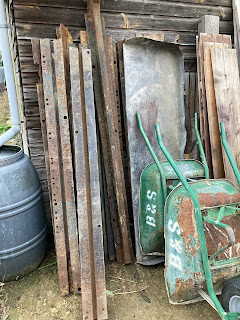
Polly tries to fix the leak from the collar and extension pipe on 24B haul road exit.

Instead we attended to the list of odd jobs. One was to collect the kissing gate metalwork and the cube water container previously recovered at Stanton Yard where they were in the area that will be used as the compound by the contractors working on the B4632 bridge (8). We moved both items to Winchcombe Yard.

Little and large at Stanton Yard. Our Citroen tipper (l) is dwarfed by the bigger vehicle in use by the contractors clearing the area for use during bridge 8 works in the New Year. (Picture by Dave).


Back at Working Lane, the brush cutting team members continued clearing along the fence line on the up side to reach the outlet of culvert 25B. This outlet wanders around the boundary fence, there is a small diameter pipe which leads across the adjoining field as well. The flow on 25B during the winter is quite considerable - usually more than the adjoining 25A. Thus, reinstating the headwall on the 25B exit will have to be a summer job.
Spot the missing headwall! Up side exit of 25B is currently just a pipe emptying into a deep ditch. (Picture by Roger).
 

The telehander was put to good use. First task was a couple of bucket loads of infill taken across the line to backfill the down side crest chamber of culvert 24A, adjacent to the Royal Oak fence. This was a job outstanding from 2019 - it makes the area around the chamber much safer. Whilst the telehander moved the infill to the chamber, final positioning was a manual job (well done Nigel).

Down side crest chamber of 24A, Nigel takes a breather before final shovelling of the backfill. ("Who dumped this here then?" could almost be the caption!)

The other telehandler job was moving seven or so bucket loads of infill via the adjoining field (with permission) to backfill the new headwall on the 25B entry to the junction section with 25A. A couple of hours with the telehandler and a little bit of shovelling and raking completed this. By next summer when the grass and other vegetation has grown there will be no trace of the big hole that was once here. So after a bit of frustrating day, it was good to tick off a couple of completed tasks!

Jonathan carefully positions the telehander to avoid too much manual handling of the backfill on the 25B junction inlet headwall.

25B junction inlet finally complete!

Thursday 9th December

A second week in a row with a full attendance - if this continues the team will be requesting a Christmas Bonus! The main objectives of today were to use the brush cutters to clear vegetation from around manholes and culvert chambers in the sections accessed from Stanton Yard. As the contractors working on the B4632 bridge will be using Stanton Yard for the first couple of months next year, access will be restricted then.

Initially we split into three teams. Dave & Nigel were the A team, they started brush cutting from Stanton Yard northwards. They earned the A team name because they completed all manholes up to culvert 6B at Laverton Fields, plus the stream across the aqueduct. This did then mean over a mile of reversing the Transit van to get back to the yard for lunch. The turning point at Laverton Fields has disappeared.

Aqueduct (bridge 9) down side inlet. After removal of the dead leaves from this autumn. (Picture by Dave).


Martin and Andrew were the B team - they commenced by clearing culvert 11B at Stanton and then undertook the internal visual inspection of it. Interestingly very little water is flowing in from the down side; but quite a bit flows out on the up side. This then is constrained by a small diameter and partially blocked pipe under the adjoining field - evidenced from the puddles by the fence. Near the top of our 'to do' list is the construction of a new ditch and pipe to take the 11B outlet inside of the railway fence down to the 11A exit at bridge 11.
Up side exit ditch of culvert 11B. Entry to pipe across the field is just by the fence line. Note the standing water by the fence in the field. The new pipe/ditch will run to the right here, inside the boundary fence.


Roger, Jonathan and Polly were the C team; they had all the odd jobs. First was shifting some very large diameter twinwall pipes from the down side to the up side at Winchcombe yard. These pipes are for the unfinished work on the River Isbourne. They next took another load of concrete rubble infill to Working Lane. Then it was on to Steam Loco at Toddington to collect four lengths of bridge rail that have been drilled for the new milepost head fixing. Finally they arrived at Stanton to join up with team B.

The combined B & C teams then cleared the manholes and chambers on the cutting crest from bridge 11 back to Stanton Yard. Two more internal visual inspections of culverts were completed, these being 7A (a syphon on the low mileage side of bridge 8) and 6B (the stream by the foot crossing at Laverton Meadows).
General view of syphon culvert 7A. The inlet which comes under the B4632 on the Broadway side of bridge 8 flows into the chamber protected by the yellow gratings. The outlet on the up side of the railway is behind the headwall by the far fence. In between is a manhole for the up side cess drain - this is not connected to the syphon.

Up side headwall and high mileage wing wall of culvert 6B near the foot crossing at Laverton Meadows. Stream too deep to enter even with wellies today, so clearing this vegetation is another job for the spring or summer.

After lunch and a team change around, one group completed manhole clearing all the way up to bridge 6 at Laverton Meadows. Also cleared was the access up to the inlet and outlet of syphon culvert 6C; so another internal visual survey was completed.

Syphon culvert 6C. Well strictly the circular metal plate is the 'plug' in the centre of the syphon, as this is view into the chamber that was in the six foot at bridge 7. The pipe and water in the bottom is a cess drain - again no connection to the syphon.

The second group took the lengths of bridge rail back to Winchcombe, carefully unloading (they are very heavy) and adding to the stock for the milepost project. There are around two dozen mileposts currently that do not have the correct bridge rail posts. So we are still on the scrounge for suitable lengths of bridge rail that are easy to recover.
The stock of bridge rail lengths which will become milepost uprights. The two at the front have the new holes drilled by the Steam Loco department (thanks!) at the bottom.

Whilst on the subject of mileposts, you might have guessed the answer to the question posed at the beginning of this post. As as we were packing up, we spotted the infamous lost milepost 7 & quarter in the dense jungle just north of the foot crossing at Laverton Meadows. This post had evaded being found by clearance, drainage and milepost teams on at least four earlier occasions. The dying vegetation finally allowed its location to be spotted. So the team cleared around this to make it a bit more visible. Fortunately Permanent Way had been very accurate in guessing its location, track panel 1 for that quarter mile starts one sleeper on the low mileage side! What is more, the post is complete with correct numerals, bridge rail upright, and metal cap. It just needs painting. The new 7 & quarter head we made a few weeks ago will not be wasted. With the addition of two pairs of quarter marks it becomes the new head for 7 & three quarters - that is one of the posts currently with the inauthentic plastic house numerals.

MP 7 & quarter visible again. In reasonable condition, it was last refurbished in 2016.